
How to open your first forex account, from A to Z
There are hundreds of “how to open a forex account” guides online, and most of them start in the wrong place.
They teach you to fill in the form, the easiest part, and skip the three decisions that really decide how the account turns out: whether you are ready, which broker fits your own situation, and what you do in the first 30 days.
This article is the overall map for all three, with links to the broker-by-broker guides I have verified.
Part 1: Are you ready to open a real account? (a 5-question checklist)
- Do you understand that you can lose everything you deposit? Not a “yes, I know” said with a nod to move on, but knowing that losing the amount you plan to deposit would not affect your daily life, is not borrowed money, and is not your child’s school fees.
- Do you know what a lot, a pip, leverage and a spread are? If not, spend 30 minutes on the core four: lot, spread, leverage, how much capital to start with. Opening an account before you understand these four ideas is like driving before you know where the brake pedal is.
- Do you understand the legal situation in Vietnam? No forex broker has been licensed in the country yet. You trade with an international broker and carry the responsibility yourself. Read whether forex is legal in Vietnam to know exactly where you stand.
- Have you placed at least a few dozen trades on a demo account? A demo cannot teach you psychology, but it can teach you the mechanics. Do not let your first real trade also be the first time you press the button.
- Do you have a money management plan? At a minimum: risk 1–2% of the account on each trade, worked out with the formula risk ÷ (stop loss × pip value) rather than by feel.
If all five are in place, move on to Part 2. If one is missing, deal with that first; this market has existed for more than half a century and will still be there when you are ready.
Part 2: Choose a broker for YOUR situation, not for the advertising
There is no “best broker for everyone”, only the broker that fits a given situation best. Here is the routing table, the way we advise it:
| Your situation | Sensible direction | Detailed guide |
|---|---|---|
| Capital under 100 USD, need learning material in Vietnamese | XM (Micro/Ultra Low, deposit from 5 USD) or HFM (Cent, withdraw from 5 USD) | Open XM · Open HFM |
| Fast deposits and withdrawals come first, flexible turnover of capital | Exness (mostly automatic withdrawal processing; processing time may vary depending on the payment method you choose) | Open Exness |
| Frequent trading, scalping or EAs, need the lowest cost | IC Markets (the ECN benchmark, no minimum deposit), Tickmill (all-in ~0.6 pip), Vantage (Raw from 50 USD) | IC Markets · Tickmill · Vantage |
| Analyse on TradingView and want to trade straight from the chart | Vantage or Tickmill (TradingView version) | Vantage |
The full ranking, with scores on 6 criteria, is in the 2026 ranking of reputable forex brokers. How we score is public in our review methodology.
One rule whichever broker you choose: go in only through the official website and look up the licence yourself on the regulator’s site. Fake brokers copying the names of real ones are the most common way people have their money taken today (see the cases the police have named).
And if you do not know where to start filtering, try the framework for choosing a broker by the way you trade, which chooses by your own trading frequency and capital size rather than by a general ranking.
Are “opening” and “creating” a forex account different?
No, it is the same thing under two names. You will see both phrases on guide pages and in the brokers’ own interfaces (some brokers say “Register”, others say “Open account”).
What really differs, and what you need to tell apart, is the type of account you create: a demo account uses virtual money for practice, a real account uses your money. The 4-step process below applies to a real account.
Part 3: The general 4-step process (the same at every decent broker)
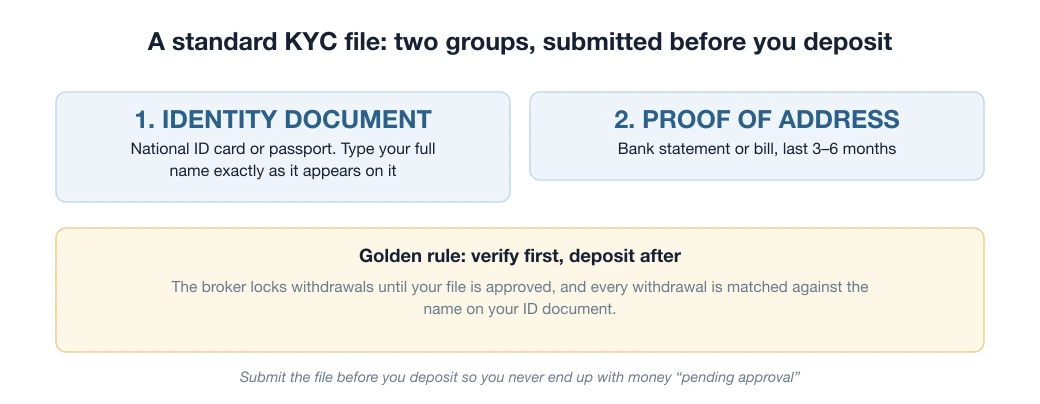
- Register: a real email and phone number, and your full name typed exactly as it appears on your ID document; every withdrawal later is matched against that string of characters.
- KYC (identity verification): national ID card or passport + proof of address (a bank statement or bill from the last 3–6 months). The golden rule: verify first, deposit after. The broker locks withdrawals until your file is approved, so money that goes in before the paperwork is done puts you in a bind of your own making.
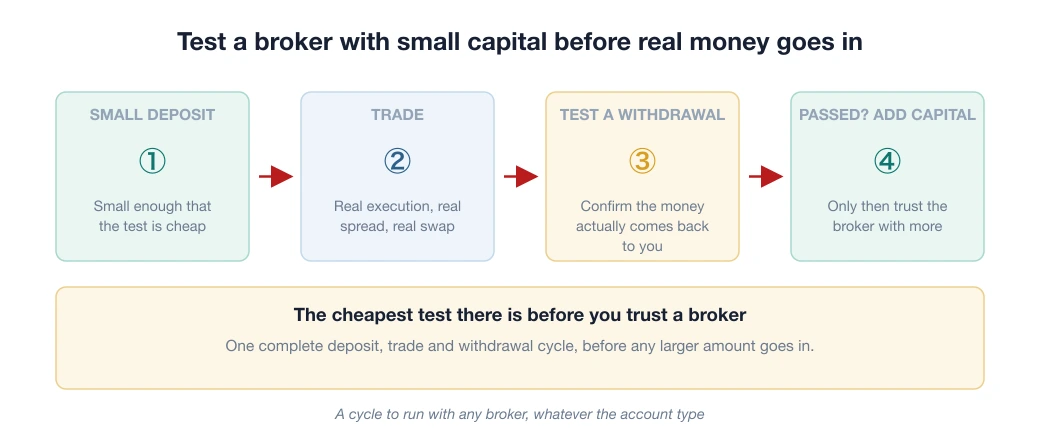
- Deposit a small amount: however much you intend to put in, the first deposit should be small, so you can run step 4.
- Test the full cycle: place a few small trades → make a test withdrawal → only if the money arrives on time do you start thinking about real capital. A deposit-trade-withdraw cycle with 50 USD tells you more about a broker than any review, ours included.
Part 4: The 7 mistakes beginners repeat most
- Depositing first, verifying later: covered above, but worth a second mention because it is the most common of all.
- Choosing a broker for its bonus: a bonus is seasoning; for someone who trades little, the volume conditions attached usually “cost” more than the bonus is worth.
- Entering trades by feel instead of working out position size: accounts blown in the first month are almost always blown by oversized lots, not by wrong analysis.
- Using all the leverage you are given: a broker offering 1:500 does not mean you have to use 1:500. Read forex leverage to understand this double-edged knife.
- Not testing a withdrawal early: waiting until you “need the money urgently” to withdraw for the first time puts you on the back foot.
- Trusting “signal callers” and VIP groups: the people calling trades earn commission on your deposits, and they do not share your losses. We take this model apart in the warnings section.
- Trading many currency pairs at once in the first week: stay with one pair (EUR/USD is the classic candidate) until you can read its rhythm.
Part 5: A roadmap for your first 30 days
- Week 1: open the account + KYC + a small deposit. Trade 0.01 lot (or Cent); the goal is to get used to the process, not profit. In parallel, study the technical analysis series starting from the foundation article.
- Week 2: make a test withdrawal. Start a trading journal: the reason for entering, the reason for exiting, and how you felt when you placed the trade. Write it as soon as the trade closes, not from memory in the evening.
- Weeks 3–4: keep volume small and focus on execution discipline: set the stop loss before entering, do not move the stop, do not add trades to win back losses. At the end of the month, reread the journal. You will see for yourself which kind of mistake you make.
- Only increase capital when: you have gone 30 days without blowing the account, the withdrawal process is verified, and the journal shows discipline errors falling. Increase in steps (one and a half times, then double), never “all in”.
For quick answers to common questions (legality, capital, spread, lot…), the questions and answers section answers each one directly. The self-check after 30 days has three lines: the account has not blown, you have made one clean test withdrawal, and the journal is thick enough for you to name the mistake you keep repeating.
Frequently asked questions
Does it cost anything to open a forex account?
No. Opening an account at brokers whose licences you can look up is free. You only need to deposit when you want to trade for real, and most brokers charge no deposit fee.
How old do you have to be to open a forex account?
You need to be 18 or older and hold a valid ID document for identity verification (KYC). Some legal entities require a higher age depending on the region.
Can you trade without KYC verification?
You can trade on a demo account without KYC, but to deposit or withdraw real money almost every licensed broker requires identity verification. Complete KYC from the start so your money does not get stuck when you withdraw.
- ESMA (27/03/2018). A figure worth knowing before you open your first account: ESMA recorded that 74–89% of retail accounts lose money, with average losses of 1,600–29,000 EUR per client
- CFTC (United States). Its forex fraud advisory recommends checking a firm’s registration status before depositing any money
Spotted something inaccurate? Tell us and we will check it and publish a correction.