
What is a lot in forex? What 0.01 lot is worth in money
The order window has a box called “volume”. That box decides how much you lose if you are wrong, and most beginners fill it in by feel.
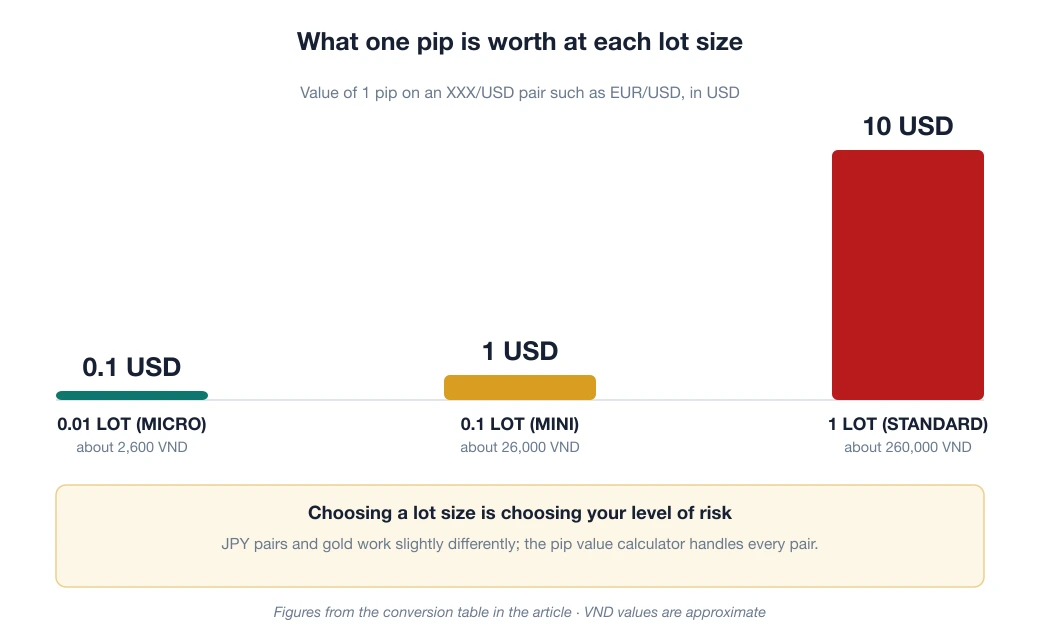
The unit in that box is the lot. One standard lot is 100,000 units of the base currency, which works out to about 10 USD per pip on XXX/USD pairs. Choosing a lot size is choosing your level of risk, so it deserves more thought than choosing which way to trade.
The conversion table to memorise: worth taping to your screen
| Name | Volume | Units | Value of 1 pip (XXX/USD pair) |
|---|---|---|---|
| 1 standard lot | 1.00 | 100,000 | ~10 USD (~260,000 VND) |
| Mini lot | 0.10 | 10,000 | ~1 USD (~26,000 VND) |
| Micro lot | 0.01 | 1,000 | ~0.1 USD (~2,600 VND) |
| Cent lot (cent account) | 0.01 cent | 10 | ~0.001 USD, a few tens of VND |
A quick note: the pip values above apply to pairs with USD in second place (EUR/USD, GBP/USD…). JPY pairs and gold work slightly differently, so check the pip value on your broker platform before you trade.
Reading the table through a real example
You open a EUR/USD trade with a 30-pip stop loss:
- 1 lot: the stop is hit and you lose 300 USD. You need an account of ~15,000–30,000 USD for that loss to be only 1–2%.
- 0.1 lot: you lose 30 USD, which suits an account of 1,500–3,000 USD.
- 0.01 lot: you lose 3 USD, which suits an account of 150–300 USD.
- Cent: you lose a few hundred VND, a practice ground for people who have never traded live (the HFM Cent account is a typical example).
The pattern jumps out of that list: the right volume is a function of your capital and your stop loss, not a matter of taste. And this is a mistake beginners often make: a 50–100 USD account trading 0.1 lot, 1 USD per pip, so a 30-pip move against them takes 30–60% of the account.
Two losing trades in a row and the capital is nearly gone, then comes the forum post asking “is forex a scam?”. No. The maths did not cheat anyone.
The formula for the right lot size: three lines you can do by hand
Lot = Amount you are willing to lose ÷ (Stop loss in pips × Value of 1 pip for 1 lot)
A full example: a 200 USD account, 2% risk per trade = 4 USD, a 25-pip stop loss, and a pip value of 10 USD for 1 lot:
Lot = 4 ÷ (25 × 10) = 0.016 → round down to 0.01 lot
Three rules go with it: (1) always round down, since risking 1.8% is better than risking 2.3%; (2) the stop loss comes from your analysis (price structure, see the technical analysis series), so decide it FIRST and only then work out the lot, never the other way round.
(3) Work it out by hand a few times until the formula is familiar, then use a spreadsheet for speed.
Quick questions, short answers
“What is the smallest trade a broker allows?”. At most brokers, 0.01 lot. A cent account goes lower still (0.01 cent lot). That is why a group of brokers for small capital exists; see forex brokers for small capital.
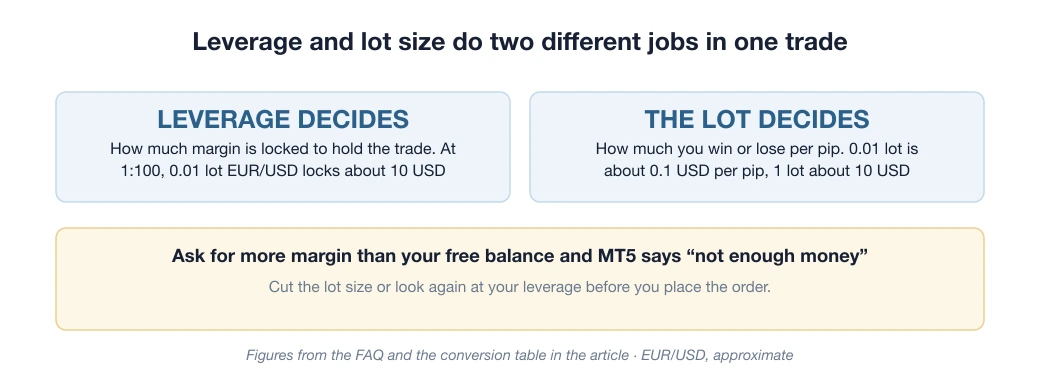
“Why does MT5 say ‘not enough money’ when I place an order?”. The volume you entered requires more margin than your available balance. Margin is the money locked away to keep an open trade running.
Cut the lot size or look again at your leverage. The two ideas are siblings. Leverage is the mechanism that lets you control more money than your real capital, and it decides how much margin gets locked; the lot decides how much you win or lose per pip.
“Can I double my lot after every losing trade (martingale)?”. Mathematically, martingale trades small wins for a blown account that becomes certain once the losing streak runs long enough, and a long enough losing streak always comes.
Our answer: no, and any “guru” teaching you the opposite is not putting their own money on that risk.
Frequently asked questions
How much capital do I need for 0.01 lot?
Thanks to leverage, opening 0.01 lot does not require 1,000 USD. At 1:100 leverage, the margin is only about 10 USD for EUR/USD. Each pip of movement is worth about 0.1 USD, so this is a sensible trade size for beginners.
What is 1 pip worth on 1 lot?
On 1 standard lot (100,000 units) of a pair with USD in second place, such as EUR/USD, each pip is worth about 10 USD. A mini lot (0.1) is about 1 USD per pip, and a micro lot (0.01) about 0.1 USD per pip.
How many lots should a beginner trade?
Beginners should start with a micro lot (0.01) to keep risk small. What matters is choosing a volume so that each trade risks only 1–2% of your total capital, worked out from the distance to your stop loss.
- Exness, “Forex”, official contract specifications (broker updated 24/07/2026): contract size 100,000 units, pip size 0.0001 to 0.01, minimum volume 0.01 lot. Read on 17/08/2026
- ESMA (27/03/2018). Lot size decides the real loss: with a 30:1 leverage cap and a margin close-out rule at 50% of minimum margin, a lot that is too large for the capital gets closed automatically before the market turns back
Spotted something inaccurate? Tell us and we will check it and publish a correction.