
What is forex leverage and how much should you use?
100 USD in the account, controlling a 10,000 USD position in the market. That is 1:100 leverage, and it is why someone with small capital can enter this market at all.
It is also why most beginner accounts disappear within a few weeks. The same multiplier applies to profit and to loss, with no favouritism.
How leverage works: one example throughout
You have 1,000 USD and the broker offers 1:100. You open 1 lot of EUR/USD (a unit of position size; one standard lot is 100,000 units), a contract value of 100,000 USD:
- Margin locked: 100,000 ÷ 100 = 1,000 USD, your entire account.
- Each pip on 1 lot is about 10 USD. The price moves 50 pips against you, an entirely ordinary intraday move. You are down 500 USD, half the account.
- About 100 pips against you: the account is near zero and the broker closes the position automatically (stop out). Game over after one unremarkable swing.
The same 1,000 USD opening 0.1 lot instead: each pip is 1 USD (a pip is the smallest price step, usually the fourth decimal), and a 50 pip move against you costs 5% of the account. Uncomfortable, entirely survivable. Same 1:100 leverage, different position size, two different outcomes. That is the crux of this whole article.
Margin call and stop out: two alarms worth understanding
To see how much margin a specific trade locks before you enter it, divide the position value by the leverage.
- Margin call: when equity falls close to the margin currently locked, the broker warns you and asks you to add funds or close positions.
- Stop out: equity falls further (the threshold varies by broker) and the system closes positions automatically, starting with the worst, to protect what is left. This is not the broker "stealing your trade" as many beginners assume. It is an emergency brake, and if it triggers, the problem is the position size you chose at the start.
Nominal leverage versus real leverage: one number the broker grants, one you choose
Nominal leverage is the number the broker grants (1:100, 1:500, 1:2000 and so on). Real leverage = total position value ÷ your capital, and you decide it through position size.
Example: a 1,000 USD account opening 0.1 lot (10,000 USD) is running 10:1 real leverage, whether the broker grants 1:100 or 1:2000. Professional traders rarely let real leverage exceed 5 to 10:1.
So "this broker offers 1:2000, far too dangerous" puts the emphasis in the wrong place. What the broker grants matters less than what you use. High nominal leverage even has a technical benefit: it locks less margin for the same position, leaving more equity as a buffer.
The danger appears only when it tempts you into a large position. And that is a test of discipline, not a fault in the number.
Reference table: real leverage and how much you can absorb
| Real leverage you use | Adverse move that costs 50% of the account | Assessment |
|---|---|---|
| 2:1 | ~2,500 pips | Very conservative |
| 10:1 | ~500 pips | Professional territory |
| 50:1 | ~100 pips | One news release is enough |
| 100:1 | ~50 pips | Gambling with a nice interface |
(Approximate figures for EUR/USD, to illustrate the risk ladder.)
How much leverage should you choose? An answer with numbers, not feelings
This is the most asked question about leverage, and most answers online are "it depends on experience": true but useless. There is a way to answer it numerically.
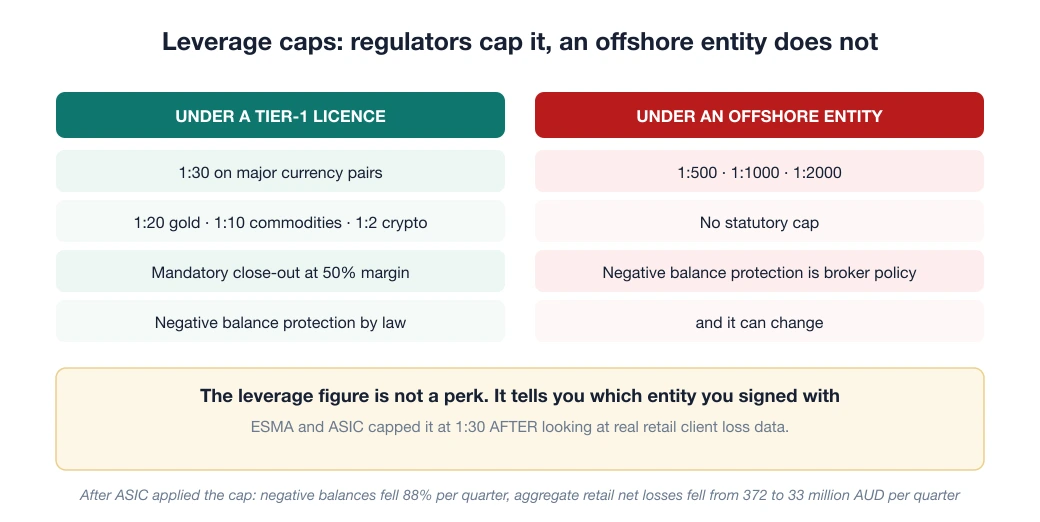
Start from the number the regulators chose. ESMA (EU) and ASIC (Australia) both settled on a 1:30 cap for major currency pairs with retail clients, not arbitrarily, but after looking at real loss data.
And ASIC published the result after the cap: aggregate net losses of retail clients fell about 91%, from 372 million to 33 million Australian dollars per quarter.
Why the right question is "how much REAL leverage", not "how much does the broker grant"
Broker-granted leverage is only a ceiling. It decides how large a position you may open, not how large you should. What actually affects the account is real leverage:
Real leverage = total value of open positions ÷ account capital.
A 1,000 USD account opening 0.1 lot of EUR/USD (about 10,000 USD of value) is running 10:1 real leverage, whether the broker states 1:500 or 1:2000. Two people on the same 1:2000 broker can be running real leverage dozens of times apart.
Three reference levels: choose by what you can absorb, not by what you are granted
| Real leverage | How far the market moves against you to cost 50% of capital | Suits |
|---|---|---|
| 5:1 to 10:1 | about 5 to 10% | Beginners, and most long-term traders who still have an account after a few years |
| 20:1 to 30:1 | about 1.7 to 2.5% | Traders with a system and a tested stop-loss discipline |
| 100:1 and above | under 0.5% | Almost nobody sustains this; one piece of noise ends it |
How to use this table: do not ask what the broker grants. Ask instead, "how far can the market move against me before I accept losing 50% of my capital?" and pick the matching real leverage. That number is usually far smaller than beginners assume.
So what does the broker-granted level mean?
It means one thing, but not the thing you might think: it tells you which legal entity you are contracting with. A legal entity is the particular company that signs the contract with you.
Being offered 1:500 or 1:2000 means your account does not sit under a regulator capping leverage at 1:30, because if it did, the broker would not be permitted to grant that level. Details in why brokers offer such high leverage.
A practical tip: select a lower leverage setting inside your account settings if the broker allows it. That turns discipline into a technical constraint. You cannot open an oversized position even when you lose your composure, and that is exactly when you need the constraint.
Using leverage properly: a 3-step process
- Choose the risk per trade: 1 to 2% of the account. On 500 USD that is 5 to 10 USD.
- Set the stop loss from analysis (say 30 pips, based on price structure rather than an arbitrary round number; see the Vietnamese technical analysis series).
- Work backwards to position size: risk ÷ (stop loss × pip value). Position size is the result of permitted risk, never a number picked in advance on a whim.
Follow that process and whether nominal leverage is 1:100 or 1:2000 stops being a frightening variable. It becomes a technical term in the account paperwork.
The leverage each broker grants and the specific conditions are recorded in our Vietnamese broker reviews. On choosing a high-leverage broker responsibly, there is a separate Vietnamese analysis, written from a risk management angle rather than as encouragement.
Frequently asked questions
Should I use 1:500 leverage?
1:500 is very high and dangerous for a beginner, because a 0.2% adverse move is enough to wipe the account. You can open an account with high leverage but should cap your own position size so that real risk stays low. Beginners should use around 1:20 to 1:50.
Does high leverage increase profit?
High leverage increases potential profit but increases loss in the same proportion, and it makes you easy to knock out on small moves. What determines profit is strategy and risk management, not high leverage.
What is a margin call?
A margin call is the warning issued when your margin balance falls too low against the requirement; if you do not add funds or close positions, the broker closes them automatically (stop out) to protect what remains. The higher the leverage, the more easily a margin call occurs.
- ESMA (27/03/2018). CFD leverage limits for retail investors: 30:1 down to 2:1, 50% margin close-out, negative balance protection; 74-89% of retail accounts lose money
- ASIC (effective 29/03/2021). CFD product intervention order: the same 30:1 to 2:1 leverage ladder; retail clients of 13 providers lost over 774 million AUD net in March and April 2020 alone
Spotted something inaccurate? Tell us and we will check it and publish a correction.