
Why do brokers offer you such high leverage?
In Europe, the maximum leverage for a retail client is 1:30. In Vietnam, you are offered 1:2000.
That gap is not a favour. ESMA capped it at 1:30 in 2018 and Australia applied a comparable cap from 2021.
But those limits only bind the legal entity (the specific company that signs the contract with you) inside their own region. Your account is not there, so the cap does not apply either.
Understanding this changes how you read an offer: the leverage figure is not a perk, it is an indicator of who you are contracting with.
What the regulators actually cap
ESMA's measures have applied since 1 August 2018, and EU member authorities have kept the framework:
| Asset class | ESMA cap (EU) | ASIC cap (Australia) |
|---|---|---|
| Major currency pairs (EURUSD…) | 30:1 | 30:1 |
| Minor pairs, gold, major indices | 20:1 | 20:1 |
| Other commodities, minor indices | 10:1 | 10:1 |
| Individual equities | 5:1 | 5:1 |
| Cryptocurrencies | 2:1 | 2:1 |
Three further obligations come attached to the leverage cap, and they disappear at the same moment you leave a Tier-1 entity:
- Margin close-out at 50% of minimum required margin, calculated across the whole account. This is the breaker that trips before the account is wiped out.
- Negative balance protection: your loss is capped at the money in the account, and you cannot be pursued for more.
- A ban on trading inducements. ASIC names trading credits, cashback and "free" gifts specifically. This is why the deposit bonus schemes you see in Vietnam almost never come from a Tier-1 entity.
ASIC published results from the first six months after the measures took effect: the number of retail client accounts falling into negative balance dropped 88% per quarter on average, and aggregate net losses of retail clients fell 91%, from 372 million to 33 million Australian dollars per quarter.
The order took effect on 29 March 2021 and has been extended to 23 May 2027.
The 372 to 33 million figure does not say that a leverage cap makes people trade better. It says that most of that loss came from entering positions far too large for the account, something a mechanical cap blocks without anyone having to learn anything.
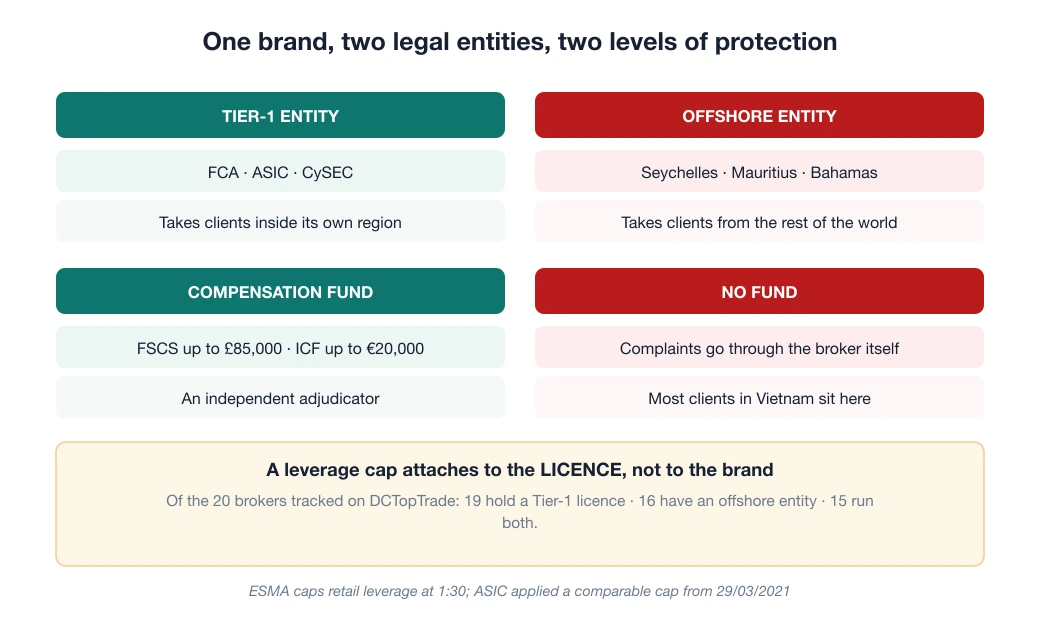
So why are you still offered 1:2000?
Because the cap above attaches to a licence, not to a brand. Same logo, same MT5 platform, but:
- A client in the UK opens with the UK entity and is subject to the 1:30 cap.
- A client in Vietnam is routed to an offshore entity, where no cap binds.
The broker is not evading the law here; it is complying with the law of each place. Of the 20 brokers we track, 15 run both entity layers at once on exactly this model. The figures and how to check for yourself are in whether a Tier-1 licence protects clients in Vietnam.
Why regulators capped it: what they were looking at
This is the part worth more thought than the numbers. ESMA and ASIC did not cap leverage out of dislike for the industry.
They capped it after collecting retail account loss rates from the brokers themselves, and concluding that at high leverage the product was causing systematic detriment to small investors.
Put differently: the leverage level you are being offered is the level two major regulators looked at the data on and decided could not be sold to people like you.
That is not a reason to panic, but it is a fact worth placing next to the advertising line "flexible leverage up to 1:2000".
The important part: high leverage alone does not kill an account
This needs to be stated accurately, because it is where a lot of writing oversimplifies. Leverage is a permitted ceiling, not a level you are obliged to use. What determines risk is the position size you actually enter.
Someone with 1,000 USD on 1:2000 leverage entering 0.01 lot (a unit of position size; one standard lot is 100,000 units) is taking little risk. The same person on 1:30 entering 0.5 lot is taking far more. The leverage number does not appear in the formula for a loss; position size does.
What high leverage really does is remove a guardrail: it allows you to enter a position far too large for the account, which a 1:30 cap would block automatically. A low cap is a kind of training wheel. Taking the training wheels off does not make you fall, but it makes falling possible.
The full mechanism of how leverage amplifies profit and loss is in what forex leverage is and how much to use. To size a position against the risk you accept, see forex money management.
How to check for yourself: 3 steps
- Look at the maximum leverage your account is granted. If it exceeds 1:30, you are with an entity outside the EU, UK or Australia, and there is nothing further to guess.
- Check whether the broker gives negative balance protection for your entity. Search the terms document for "negative balance protection". If it is only a commercial policy rather than a legal obligation, it can change.
- Set your own cap. Not using all the leverage granted to you is your right, and it is the only measure in this article that does not depend on what the broker permits. Many platforms let you select a lower leverage setting directly in the account settings.
Read the leverage figure as an indicator
Next time you see "leverage up to 1:2000" advertised, do not read it as a perk. Read it as a statement:
"This account does not sit under any regulator that caps leverage, and the things that come with that cap, including mandatory margin close-out and statutory negative balance protection, do not come with it either."
Leverage caps in each region are numbers set by a regulator, so they change. If a figure in this article is out of date against the current rules, send us the source and we will correct it.
That information is far more useful than the number itself. And it is free, once you know how to read it.
Frequently asked questions
Why do European brokers cap leverage at 1:30 while brokers advertising in Vietnam offer 1:2000?
Because the leverage cap attaches to a licence, not to a brand. ESMA capped retail leverage on major pairs at 1:30 from 2018, and ASIC applied a comparable cap from 2021. Clients in Vietnam are usually routed to an offshore entity, where no cap binds.
Is high leverage dangerous?
Leverage is a permitted ceiling, not a level you must use; what determines risk is the position size you actually enter. What high leverage really does is remove a guardrail, allowing a position far too large for the account, which a 1:30 cap would block automatically.
What are the ESMA leverage caps?
30:1 on major currency pairs, 20:1 on minor pairs, gold and major indices, 10:1 on other commodities and minor indices, 5:1 on individual equities, and 2:1 on cryptocurrencies. They come with a margin close-out rule at 50% of minimum required margin and with negative balance protection.
What is negative balance protection?
A rule capping your loss at the money in the account, so you cannot be pursued for more. It is a legal obligation in the EU and Australia; at an offshore entity it is usually only a commercial policy of the broker and can change.
Spotted something inaccurate? Tell us and we will check it and publish a correction.