
What is an introducing broker, and why ask who referred you?
Short answer: an IB (introducing broker) is a party that refers clients to a trading broker and receives commission based on the volume you trade.
They do not hold your money, do not execute your orders (the moment your order is actually filled), and do not grant leverage (which lets you control more money than your own capital). All of that still belongs to the broker.
But they have a very large influence on which broker you choose, and that is the part worth understanding.
The real mechanism: where an introducer's money comes from
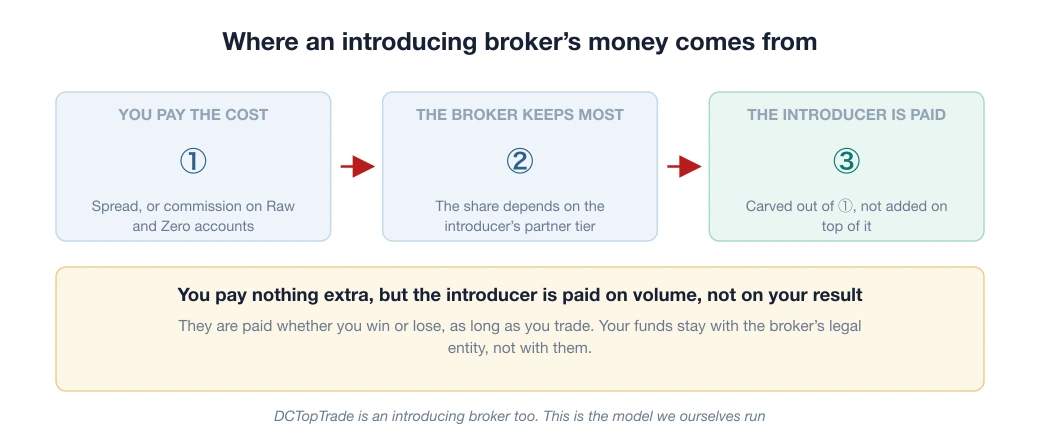
Every order you open pays a cost to the broker, either the spread (the gap between the buy and the sell price, which is the fee you pay) or a commission. The broker shares part of that with the introducer who referred you. Three points matter:
- You pay nothing extra. The introducer's commission is carved out of the cost you were already paying the broker, not added on top.
- The introducer is paid on volume, not on your profit or loss. Whether you win or lose, they get paid as long as you trade.
- An introducer does not hold your money. Your funds sit with the broker's legal entity. So when a withdrawal dispute comes up, an introducer can do almost nothing beyond passing the message along. The broker decides.
Exactly where the conflict of interest sits
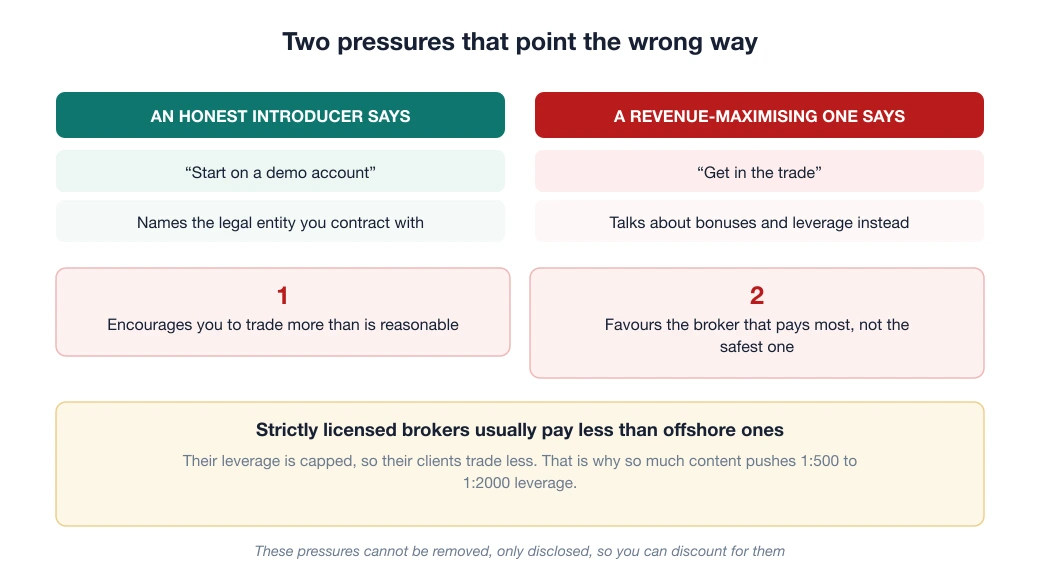
Because their income is tied to trading volume rather than to your result, the introducing broker model creates two pressures that point the wrong way:
- It encourages you to trade more than is reasonable. An honest introducer says "start on a demo account"; a revenue-maximising one says "get in the trade".
- It encourages recommending the broker that pays the most commission, not the safest one. And those two groups usually pull apart, because brokers under strict licences typically pay less than offshore ones: their leverage is capped, so their clients trade less.
The second point explains something you run into often: why so much Vietnamese-language content pushes brokers offering 1:500 to 1:2000 leverage. Not because they are better, but because high leverage makes clients trade more heavily (article in Vietnamese), and heavier trading means more commission.
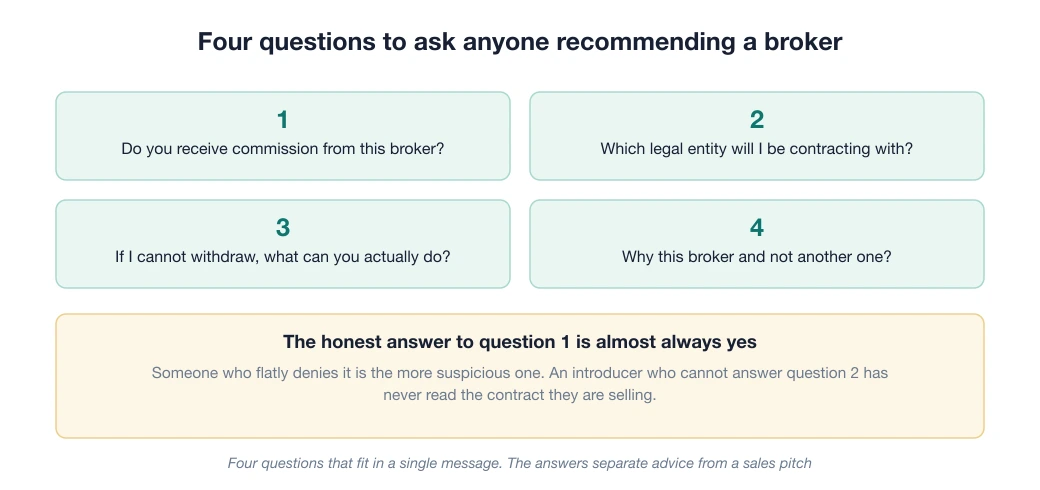
Four questions to ask anyone who recommends a broker to you
- "Do you receive commission from this broker?" The honest answer is almost always yes. Someone who flatly denies it is the more suspicious one.
- "Which legal entity will I be contracting with?" Not the brand name, the company name. An introducer who does not know this has never read the contract they are selling.
- "If I cannot withdraw my money, what can you actually do?" The honest answer is: very little. Anyone promising "leave it to me" is promising something outside their control.
- "Why this broker and not another?" If the reasons only revolve around bonuses and leverage, you are listening to a sales pitch, not advice.
How is an introducer different from a "expert" managing your money?
This is where many people in Vietnam lose money to a confusion. An introducer only introduces. Someone who takes your money to "trade it for you", splits the profit by a ratio, or asks you to transfer funds to their personal account, is not an introducing broker.
That is a completely different risk model. The State Bank of Vietnam has confirmed it has not licensed any forex broker in Vietnam, so managed-account forex arrangements there have no legal framework protecting you.
Something you can do right now: open your account terms, find the legal entity named in them, and compare it against what the person recommending the broker told you. The case where an introducer pressures you into depositing more is covered in introducers who skim your rebate.
Frequently asked questions
Do I pay a fee to an introducing broker?
No. The introducer’s commission is carved out of the spread or fee you were already paying the broker; it is not added to your trading cost. But "costs you nothing extra" does not mean "no conflict of interest". An introducer is paid on the volume you trade, so they have an incentive to encourage you to trade more than is reasonable.
Does an introducing broker hold my money?
No. Your funds sit with the broker’s legal entity, not with the introducer. This is why an introducer can do almost nothing beyond passing on a message when a withdrawal dispute arises: the broker decides. Anyone who says "leave the withdrawal to me" is promising something outside their control.
How do I know whether the person recommending a broker is an introducer?
Ask directly: "Do you receive commission from this broker?" The honest answer is almost always yes, and that in itself is not a bad thing. More suspicious is someone who denies it, or who cannot tell you which legal entity you will be contracting with.
Spotted something inaccurate? Tell us and we will check it and publish a correction.