
How introducing brokers get paid, and where the conflict sits
An introducing broker earns money by having the broker share back part of the trading cost paid by the people they referred.
The full role and mechanism are in what is an introducing broker. Income is calculated on the volume you trade, not on whether you make a profit.
How the money moves
- You trade and pay the spread, plus (on Raw/Zero accounts) a commission.
- The broker keeps most of that and shares a percentage with the introducer who referred you.
- The introducer can keep the whole share, or pass part of it back to you. What comes back is the rebate.
The share in step 2 depends on the introducer's tier in each broker's partner programme: the more referred clients trading, and the more they trade, the higher the tier and the larger the share.
The meaning of a "100% rebate" label sits in step 3, not in step 1. Details in what "100% rebate" really means.
🔴 The conflict of interest is structural, not a matter of individual ethics
What follows counts against the very model we take part in.
An introducer's income is proportional to the volume you trade.
How that force acts on you, and how the break-even point is calculated, is in does a rebate make you trade more than you planned. It is not proportional to whether you still have money. Out of that come three real pressures, which exist even when the introducer is entirely decent:
| Pressure | What you actually see |
|---|---|
| Trade more heavily | Encouragement to enter trades often, "catch this session", a constant stream of signals |
| Use higher leverage | Emphasis on "a small balance can still trade big lots", because big lots generate big commission |
| Lean towards higher-paying brokers | The most recommended broker is not necessarily the one that fits you best |
These three pressures cannot be removed. They sit in how the model operates, independent of anyone's intentions. The only thing that can be done is to state them openly, so you can discount accordingly when reading any recommendation, including ours.
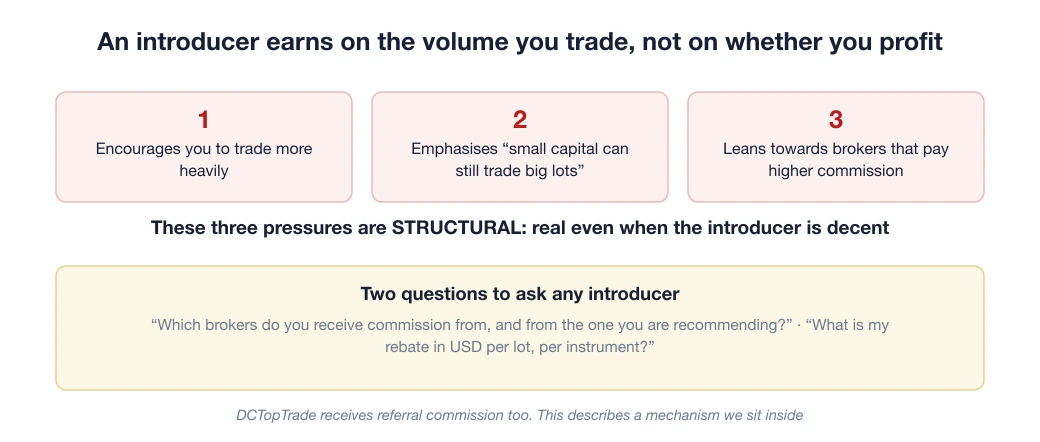
Four questions to ask any introducer
- "Which brokers do you receive commission from, and do you receive it from the one you are recommending to me?" This exposes the interest relationship immediately. Anyone serious answers plainly.
- "What is my rebate in USD per lot, per instrument?" Without a table of numbers there is nothing to compare.
- "What is your partner account number?" So you can cross-check it with the broker. Brokers do provide this when you ask.
- "If I trade less, what do you lose?" The honest answer is "income". Anyone who says "nothing" either does not understand the model or is dodging.
On "what an introducer earns": what we will not say
A great deal of content about this job revolves around how much you can make. We do not publish income figures, and we are not inviting you to become an introducer.
The reason: any such number depends entirely on how many people are referred and how much they trade, two variables nobody can predict, and stating one turns into a form of income promise.
What can be said is the structure: income comes from volume, rises with partner tier, and in some programmes can be split across several tiers, meaning the person who referred you may also be sharing back with whoever referred them.
Multi-tier arrangements stretch the chain of interest further, and that is where the most caution is needed.
Below are two real payout records, taken from an introducing broker's partner dashboard. Client account numbers and the partner account number are masked; volume and commission figures are unchanged.


Two periods, the same partner account, and the rate per lot differs by more than eight times. The reason lies in which instruments the referred clients traded: gold and indices pay considerably more than the major currency pairs, so the same lot count can produce two very different amounts.
That is also why every advertising line of the form "become an introducer and earn X per month" is empty: without volume and without instrument, the number says nothing.
But there is one thing these two images say very clearly, and it concerns you rather than us. That money is generated by the volume you trade, not by whether you profit or lose.
Six thousand seven hundred lots is six thousand seven hundred times paying the spread. The introducer takes their share on the losing trades too, and that is exactly the conflict of interest described above, this time in numbers instead of words.
There is a fifth question few people think of once they are already at the table: what your introducer can read inside your account, from your balance down to each closed trade.
What this means if you are trading
Not "avoid introducers". With one you get a rebate; without one the broker keeps that share in full. What is worth doing is:
- Read every recommendation alongside the question "what does this person gain if I do it". That applies to this article too.
- Verify the rebate actually arrives, how to reconcile the three numbers.
- Do not let the rebate decide your number of trades. If a trade is only worth taking because "there is a rebate anyway", the rebate is steering your strategy.
And to repeat the baseline: the State Bank of Vietnam has not licensed any forex broker in Vietnam, so this referral activity also sits outside the domestic regulatory framework.
Frequently asked questions
How does a forex introducing broker make money?
The broker shares back to the introducer part of the trading cost paid by the referred client, comprising spread and commission. The share depends on the introducer’s tier in each broker’s partner programme. The introducer can keep that share in full or pass part of it back to the trader, and what is passed back is the rebate.
Where is an introducing broker’s conflict of interest?
An introducer’s income is proportional to the volume you trade, not to whether you profit. That produces three real pressures even when the introducer is decent: encouraging heavier trading, emphasising high leverage, and leaning towards brokers that pay more commission. These sit in the structure of the model so they cannot be removed, only disclosed so readers can discount for them.
Should I avoid introducing brokers?
There is no need to avoid them. With an introducer you get part of your cost back; without one the broker keeps that share in full. What is worth doing is reading every recommendation alongside the question of what the person gains if you follow it, verifying that the rebate actually arrives, and not letting the rebate level decide how many trades you take.
How much do forex introducing brokers earn?
Introducer income is determined by three variables, and knowing the three is more useful than a single figure: the trading volume of the people referred, the introducer’s tier in the broker’s partner programme (a higher tier means a larger share), and in some programmes a multi-tier split where whoever referred the introducer also takes a share. Because all three depend on other people’s behaviour there is no single correct figure, and putting one here would amount to an income promise, which this site does not make.
Spotted something inaccurate? Tell us and we will check it and publish a correction.