
Does an FCA or ASIC licence protect clients in Vietnam?
15 of the 20 brokers we track run two entity layers (the specific company that signs the contract with you) at the same time.
The first layer holds a Tier-1 licence, from the FCA in the UK or ASIC in Australia or CySEC in Cyprus, and it is displayed on the home page.
The second layer is registered somewhere else, usually an island jurisdiction, and that is where accounts for clients in Vietnam are actually opened. This is lawful, common, and almost never explained to readers in Vietnam.
On the Vietnamese side, the regulator describes the whole activity in one sentence:
"Payment and transfer of money abroad to forex platforms is also a transaction not permitted under current foreign exchange management rules."
A Tier-1 licence on the first layer does not change that.
This is not an accusation of fraud. It is a corporate structure, entirely lawful, and published by the brokers themselves on their own licensing pages. The problem is that almost nobody reads it before depositing.
The number: 15 out of 20
Across the licence data of the 20 brokers reviewed on this site:
| Group | Brokers |
|---|---|
| Hold at least one Tier-1 licence | 19 / 20 |
| Hold at least one offshore entity | 16 / 20 |
| Hold BOTH at once | 15 / 20 |
| Offshore entity only, no Tier-1 | 1 / 20 |
Put differently: almost every large broker advertising in Vietnam holds a genuine Tier-1 licence, and almost every one of them also holds an offshore entity (registered in an island jurisdiction with far lighter supervision).
The question worth asking is not "does this broker have a licence" but "which of those entities is my account under".
Why there are two layers: the actual mechanism
Not to deceive anyone. There are two very straightforward operational reasons:
- A Tier-1 regulator only accepts clients resident in its own region. The FCA licenses a UK company to serve UK clients. Someone in Hanoi is not within the consumer protection remit the FCA exists to provide. A broker wanting clients in Vietnam needs a different entity to do it.
- Trading conditions at a Tier-1 entity are tightly constrained. A 1:30 leverage cap, a ban on deposit inducements, mandatory close-out at 50% margin. Many of the attractive conditions advertised in Vietnam are not permitted to exist under a Tier-1 licence; they are only lawful at an offshore entity. The mechanism is detailed in why brokers offer such high leverage.
This determines what is left if a broker collapses. The three protective layers, and which one actually saves you, are in the Vietnamese article on where your money goes if a broker goes under.
So two entity layers are the inevitable consequence of wanting both the credibility of a Tier-1 licence and access to markets outside that region. Brokers do not hide it, they publish it. Just on the "Legal Documents" page rather than the home page.
Where the real difference sits
Three layers of protection, falling away one by one as you move from Tier-1 to offshore:
| Protection | Tier-1 entity | Offshore entity |
|---|---|---|
| Client money segregated from company funds | Mandatory, audited | Usually promised, with far lighter supervision |
| Compensation fund if the broker fails | FSCS up to £85,000 (UK) · ICF up to €20,000 (Cyprus) | None |
| Independent dispute adjudicator | Yes (the Financial Ombudsman in the UK, for example) | Usually only the broker's own internal complaints desk |
| Negative balance protection | Mandatory by law | At the broker's discretion, and can change |
The second row contains a detail that a great deal of writing gets wrong, so it needs stating precisely:
The distinction matters because it points at the right action: not petitioning FSCS, but checking who your contract is actually with.
The regulator's register: harder evidence than 15 out of 20
The 15 out of 20 above is computed from licence data the brokers publish themselves.
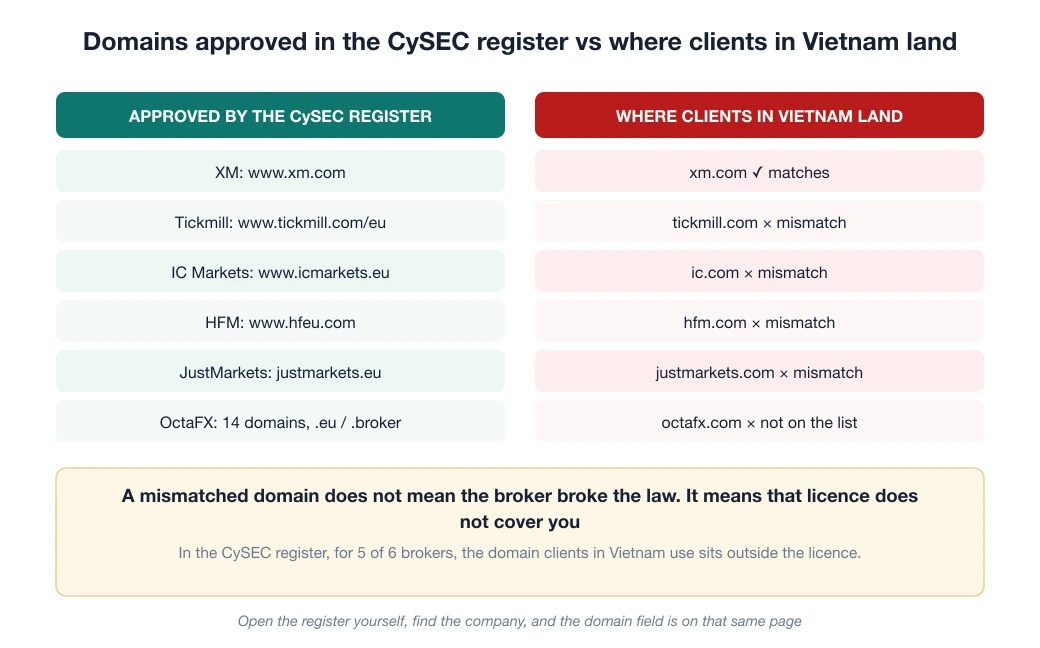
The CySEC register (the regulator's public register) has a field almost nobody examines, the approved domain.
Each Cypriot investment firm licence is tied to a specific list of domains. The broker may only provide services under that licence on exactly those domains. Compared against the domain clients in Vietnam actually register on:
| Broker (licence no.) | Domain approved by CySEC | Where clients in Vietnam land | |
|---|---|---|---|
| XM, 120/10 | www.xm.com · www.trading-point.com | xm.com | ✔ matches |
| Tickmill, 278/15 | www.tickmill.com/eu | tickmill.com | ✘ mismatch |
| IC Markets, 362/18 | www.icmarkets.eu · www.ic.com/eu | ic.com | ✘ mismatch |
| HFM, 183/12 | www.hfeu.com | hfm.com | ✘ mismatch |
| JustMarkets, 401/21 | justmarkets.eu | justmarkets.com | ✘ mismatch |
| OctaFX, 372/18 | 14 domains, all .eu / .broker / .trading | octafx.com | ✘ absent |
Five of six brokers have clients in Vietnam using a domain that is not on the licensed list. This is data taken from a regulator's register, not an inference. You can open the CySEC register yourself, find the company name, and the domain field appears right there on the page.
Why this reinforces the whole article: the 15 out of 20 says the two-layer structure exists.
The table says something stronger: the licensing authority itself has recorded which domains the licence covers, and the domain you are standing on is usually not among them. You can verify that without taking anyone's word.
One case must be read correctly, XM. XM is the only broker whose domain matches. But clients outside the EU still usually contract with XM Global Limited (FSC Belize 000261/27) rather than the Cypriot entity.
So a matching domain is a necessary condition, not a sufficient one; you still have to check the entity name on the contract. That is why step 1 below matters more than step 3.
A mismatched domain does not mean the broker is breaking the law. A broker is fully entitled to set up a different entity for clients outside the EU, and they publish it openly.
This table answers exactly one question: does the European licence in the advertising apply to your account? For five of six brokers, the answer is no.
How to check for yourself: 3 steps, about 10 minutes
- Open your account confirmation email. The company name in the footer, or in the attached terms file, is the entity you contracted with. This is the strongest evidence because it is your own contract, not general information on a website.
- Go to the "Legal Documents" or "Licences" page on the broker's website (not the home page). Find the table listing the entities; almost every broker has one. Match the company name from step 1 against that table to see which row you are in.
- Look up the licence number of that specific entity on the regulator's site, and read the "approved domains" field while you are there, because as the table above shows it is the most revealing field and almost nobody checks it: FCA Register, ASIC Connect, CySEC. If your entity does not appear there and only shows up in a Seychelles or Mauritius register, you have your answer.
A fuller procedure for verifying a broker before depositing is in the Vietnamese six-step checklist.
This does NOT mean offshore brokers are frauds
This is where a lot of writing overshoots, so it needs saying plainly:
- An offshore entity belonging to a group that holds a Tier-1 licence is very different from an anonymous broker registered in the same place. That group has brand assets to lose, and a Tier-1 authority supervising the rest of its operation.
- Most clients trade for years without any problem. The entity structure only becomes important at the moment of a dispute. That is when you find out where you were standing.
- Many offshore brokers do segregate client money and pay out on time, for years. Having no compensation scheme does not mean you will lose money.
The right frame here is probability and recourse, not good versus bad. You are accepting a trade: easier trading conditions, in exchange for losing your recourse if the broker fails. That trade can be reasonable, as long as you know you are making it.
Change the question
The question "is this broker trustworthy" is close to unanswerable, because the "trustworthiness" of a multi-entity group is not a single number. The answerable and more valuable question:
"Which entity is my account under, does that entity have a compensation fund, and where do I complain if there is a dispute?"
The entity section is the part of this article most likely to go out of date, because groups restructure without broad announcement. If any detail does not match the contract you hold, tell us so we can check it again.
All three questions can be answered in 10 minutes, and the answers do not depend on who you trust.
Frequently asked questions
Does a broker’s FCA licence protect me in Vietnam?
FSCS attaches to the FCA-authorised entity rather than to where you live, so if you genuinely are a client of the UK entity you are covered up to £85,000. But most brokers route clients from Vietnam to an offshore entity, where there is no compensation fund at all. Check the company name in your account confirmation email.
How do I find out which entity I am under?
Open your account confirmation email or the terms file you agreed to; the company name recorded there is the entity you contracted with. Then match it against the entity table on the broker’s Legal Documents page.
Does having an offshore entity make a broker fraudulent?
No. An offshore entity is a lawful structure, published openly, and most large groups have one. It only means you have no compensation fund and no independent adjudicator if a dispute arises. That is a risk to know about, not evidence of dishonesty.
How many brokers hold both a Tier-1 licence and an offshore entity?
Of the 20 brokers we track and review, 15 run both layers at once: 19 hold at least one Tier-1 licence and 16 hold at least one offshore entity.
- FSCS. What we cover: Investments (limit £85,000 per person per firm)
- CySEC. Investor Compensation Fund (limit €20,000)
- CySEC, register of Cypriot investment firms: each firm carries an APPROVED DOMAIN field (source of the six-broker table in this article)
- CySEC. Trading Point Of Financial Instruments Ltd (XM), licence 120/10, approved domains include www.xm.com
- CySEC. Octa Markets Cyprus Ltd, licence 372/18, 14 approved domains, octafx.com not among them
- FCA Register, look up entities authorised in the UK
- ASIC Connect, look up entities licensed in Australia
Spotted something inaccurate? Tell us and we will check it and publish a correction.