
Where does your money go if a forex broker goes bust?
Your money does not sit in a broker the way it sits in a wallet.
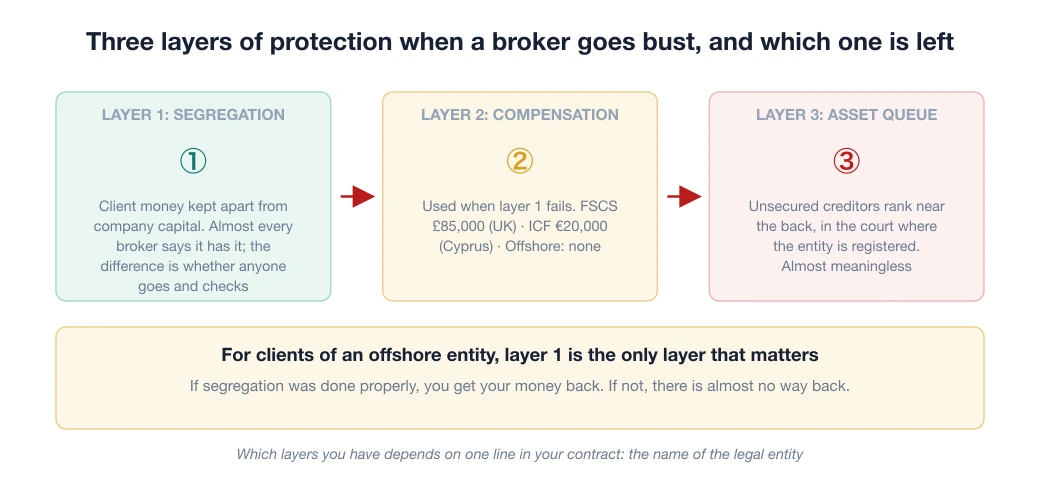
It sits in a bank account held in the broker's name and marked as client money. If the broker collapses, what happens to that money depends on three layers of protection, and for most Vietnamese clients only the first one really exists.
Broker insolvencies are rare, but they have happened, and the people who lose money are usually the ones who never thought about it.
Layer 1: Segregated accounts
This is the foundation, and almost every broker says it has it. The principle: client money must sit in a separate bank account, kept apart from the company's operating capital. The broker may not use client money to pay salaries, rent the office or cover business losses.
If segregation is done properly, then when the company goes bust that pool of money is not part of the assets shared out among creditors. It is returned to the clients.
The key phrase is “if it is done properly”. The difference between regulators is not whether they require segregation; almost all of them do.
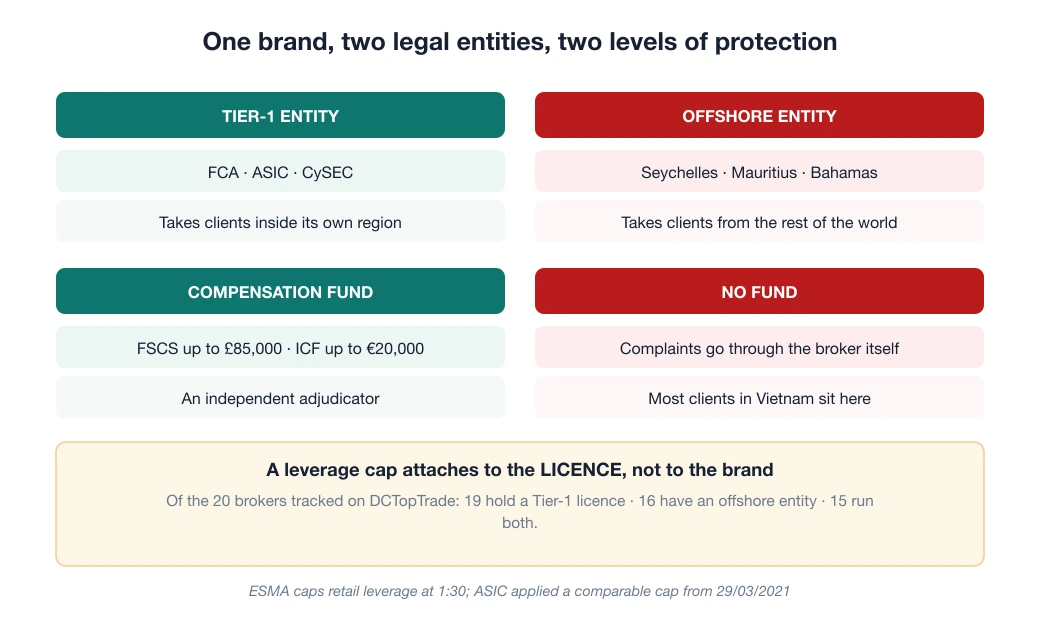
The difference is whether anyone goes and checks: regular independent audits, mandatory reporting, penalties for breaches. Tier-1 regulators do this routinely. Regulators in offshore jurisdictions (registration on island states, where supervision is much lighter) have far fewer resources for supervision.
Layer 2: Investor compensation funds
This layer comes into play when layer 1 fails: client money was mixed with company money, or misappropriated, or there is simply not enough of it. An industry-funded scheme then pays out the shortfall, but only in some jurisdictions, and with a cap:
| Jurisdiction | Scheme | Maximum payout |
|---|---|---|
| United Kingdom (FCA) | FSCS | £85,000 per person, per firm (firms that failed after 01/04/2019) |
| Cyprus (CySEC) | ICF | the lower of 90% of the eligible claim and €20,000; retail investors only |
| Seychelles, Mauritius, Bahamas, Belize, BVI… | None | No compensation scheme |
Layer 3: Queuing for the assets, and why this layer means almost nothing
When neither of the layers above saves you, you become an unsecured creditor in the insolvency proceedings. That sounds like there is still a way in, but in practice:
- Unsecured creditors rank near the back of the queue, after the costs of the proceedings, after taxes, after staff wages, after secured creditors.
- The proceedings drag on for years and take place in the court where the entity is registered. For a Seychelles entity that means a Seychelles court, and the cost of pursuing a claim there usually far exceeds the amount you could recover.
- Recovery rates for this group in financial collapses are usually very low.
So in practice, for clients of an offshore entity (the specific company named on the contract you signed), layer 1 is the only layer that matters. If segregation was done properly, you get your money back. If not, there is almost no way back.
If you found this page because you have already lost money
Most people in Vietnam who search this question are not asking beforehand, they are asking afterwards, once the broker has stopped paying out. If that is you, the three layers above are no longer something to weigh up, but the four steps below still are:
- Tell two very different situations apart. A genuinely licensed broker in financial trouble, and a platform built from the start to take people's money, call for completely different responses. With the second group, this is a criminal matter rather than a civil dispute with a business. How to tell: signs that a platform is not a real broker.
- Collect evidence before you do anything else. Transfer statements, screenshots of your trading history, every message with the person who referred you and with the support team, the terms you agreed to. The platform may lock your account and cut off your access to your own data.
- Identify the legal entity before you think about complaining. If it is an entity licensed by a Tier-1 regulator, you have a body to file a complaint with. If it is an offshore entity, in practice there is no third party to complain to. That is hard to hear, but knowing it early is better than chasing the wrong route for months.
- Be wary of “fund recovery” services. People who have already lost money are the group targeted a second time. Anyone who asks for an upfront fee to “get your money back for you” is almost certainly the next round of fraud.
More specific steps when your account is locked or you cannot withdraw: what to do when you cannot withdraw your money.
This changes the question you should be asking
The usual question is “is this broker safe?”. Far more useful questions are:
- Does the entity I signed with have a compensation fund? You can answer that in 5 minutes by reading the broker's Legal Documents page.
- Which bank holds my money? Many brokers publish the name of the bank that receives client funds. Not publishing it does not mean something is wrong, but publishing it is more trustworthy.
- If there is a dispute, where can I complain besides the broker itself? If the only answer is “the broker's support team”, you have no third party at all.
How to check for yourself: 3 steps
- Search for the phrase “segregated” or “client funds” in the broker's terms documents. Read where the money is held and whether it is audited, rather than just the advertising line “your money is absolutely protected” on the homepage.
- Identify your own legal entity from the account opening confirmation email, then compare it with the compensation fund table above.
- Do not leave idle money in your trading account. This is the most practical measure, and it does not depend on whom you trust: a trading account should hold only the capital you are actually using. Withdrawing profits regularly both reduces counterparty risk and tests whether the broker's withdrawal channel runs smoothly, since withdrawal complaints usually appear before a broker actually runs into trouble.
How big this risk is
Broker insolvency is a rare event. Most large brokerage groups operate steadily for many years, pay out on time, and there is no reason to think they are about to collapse. This article does not claim otherwise.
What this article says is this: a low probability does not mean a light consequence. With an event that is rare but wipes you out, the sensible response is not to worry, but to limit how much money you have exposed, which is something entirely within your control.
It all comes down to one line in the contract you clicked to accept
Where your money goes if a broker goes bust depends almost entirely on one line in the contract you clicked to accept: the name of the legal entity. That line decides whether you have three layers of protection, two, or only one.
The three layers of protection described above depend on each regulator's rules, and those rules do change. If you have read a more recent update, send us the source.
And that line cannot be changed once the broker is in trouble, whereas the amount of money you leave in the account can be changed at any time.
Frequently asked questions
If a forex broker goes bust, can I get my money back?
If the broker has properly segregated client accounts, your money is not part of the assets shared out among creditors and is returned to you. If segregation failed, you need a compensation fund: the FSCS pays up to £85,000 in the UK, the ICF up to €20,000 in Cyprus. Offshore entities have no fund at all.
Where is the money in a trading account held?
In a bank account held in the broker’s name but marked as client money, kept apart from the company’s operating capital. How closely that segregation is supervised differs a great deal between Tier-1 regulators and regulators in offshore jurisdictions.
What is the maximum the FSCS compensation fund pays?
Up to £85,000 per person per firm, for firms that failed from 01/04/2019 onwards. The FSCS attaches to the firm authorised by the FCA, not to where the client lives.
How much money should I keep in a broker account?
Only the capital you are actually using to trade, and withdraw profits regularly. This reduces counterparty risk in a way that is entirely within your control, and it does not depend on judging whether the broker can be trusted.
Spotted something inaccurate? Tell us and we will check it and publish a correction.