
Account locked and cannot withdraw: what to do
Not being able to withdraw is not always a scam. But you need to tell "a snag you can fix" apart from "a sign you are losing the money" so you do not deposit more for nothing. Below are the steps in order, along with the boundary that matters for making the right call.
Step 1: Stay calm and identify the cause
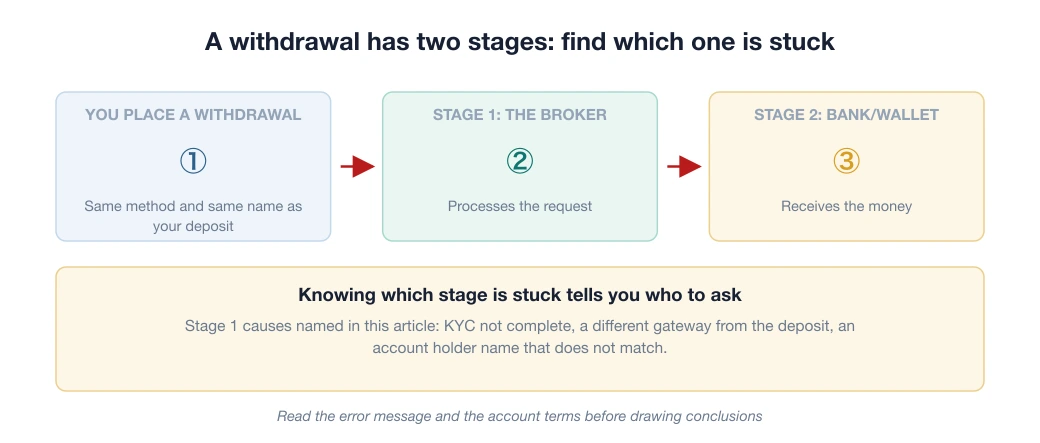
Most "cannot withdraw" cases at licensed brokers come from causes you can fix, not from the broker "eating the money":

- KYC not completed, or source of funds or wealth not yet verified.
- Withdrawing through a different gateway from the one you deposited with, or an account holder name that does not match (anti-money-laundering rules, or AML).
- Still tied to bonus conditions or open positions.
- The account has been flagged for "suspicious activity" and needs more documents.
Read the error message and the account terms carefully before drawing conclusions.
Quick diagnosis table: symptom → cause → what to do
Match your situation against the table below to see where you stand, instead of panicking or brushing it off:
| What you see | Common cause | Severity | What to do |
|---|---|---|---|
| Withdrawal cancelled automatically | Wrong withdrawal gateway, or the account holder name does not match | Fixable | Withdraw through the gateway you deposited with, in the name on your profile |
| Asked for more documents | Incomplete KYC / source-of-funds check | Fixable | Submit every document, with sharp photos |
| Withdrawable balance lower than expected | Bonus clawed back proportionally | Per the terms | Reread the conditions of the bonus programme |
| Withdrawal delayed for days, no reason given | Account flagged, or the broker is in trouble | Be on guard | Ask for the reason in writing, stop depositing more |
| Asked to deposit more to "unlock the withdrawal" | Scam pattern | Stop now | Do not deposit under any circumstances, collect evidence |
| Account locked, support silent | High risk of losing your capital | Stop now | File a formal complaint, keep every piece of evidence |
The golden rule running through this table: in the group you supply the missing information and you are done; in the group the only thing you must not do is deposit more money. Every offer of "just deposit X more and you can withdraw" is a trap, with no exceptions.
Step 2: Complete KYC and withdraw the right way
Submit all the verification documents; withdraw to the same method you deposited with and in the account holder's own name. With many brokers (Exness, for example), your original capital has to go back through the method you deposited with, while profit may be withdrawn through another method available to you; knowing this rule keeps you from getting stuck.
A real case: the OTP code arrived, but entering it gave an error
A reader posted the two screenshots below publicly and asked the community for help.
On the left is the withdrawal confirmation screen: amount to receive 8,801,353 VND, 0% fee, processing time listed as instant. Right under the code box is the red line An error occurred.
On the right is the support chat about that same case. The user says clearly that the code did arrive in Gmail, but entering it gave an error; the problem was not that the code never came.

The red frame circles the link the bot sent along with the line "please try logging in". The title of that link is a news item about the broker's B2B business, not a login page.
That mix-up by the bot is harmless. The habit it builds is not.
Users learn that support staff send login links, and that is exactly the script an impersonator needs. The safe way is to type the broker's address into the browser bar yourself, even when the link comes from the official chat window.
Another real case: profit clawed back because of how the trades were placed, not because of documents
There is a group of lock cases that have nothing to do with KYC or source of funds.
The broker locks the account because it considers the client's way of trading abusive, then claws back the profit already credited as well.
A reader sent us the screenshot of the letter below, with a question: "I traded the GAP and made a profit and the broker locked my account. When I lose money they don't say a word, but when I profit they lock it."

"After a review by our Risk Management department, we found that your trading account engaged in Gap Trading, and the related trades triggered the company's Abuser Monitoring risk control policy."
"The profit generated from Gap Trading this time is: [100.63USD] … we will deduct all of the related profit stated above."
A gap is the empty stretch of price between the moment the market closes and the moment it reopens. The opening price jumps clean away from the previous close, without passing through the prices in between.
The letter names no broker, so we do not attribute it to any broker. The mechanism behind it, though, is publicly documented. The three layers below come from the Vietnamese edition of the Exness help centre, updated 22/08/2026.
Slippage is the gap between the price you see when you click and the price at which the order is actually executed.
Layer 1: the execution price is not the price you set. When that gap exceeds a threshold measured in basis points, the order is executed at the market price instead of the level you saw when you clicked.
Layer 2: the order may not reach the market at all. The documentation on pending orders, with the same update date, says a pending order can return the error [đã hủy/khoảng trống giá] (cancelled/price gap) or [vi phạm SL] (SL violation) and not be executed.
Layer 3: even after you are in profit, you can still lose it. This is the layer the letter above refers to. The order goes through, the account records a profit, then the risk department reviews it again and deducts it under the anti-abuse terms.
The slippage protection range is not a constant either.
The same documentation says it changes with market conditions, and with your own trading activity.
In other words, the conditions under which your order gets executed are not fixed across all accounts. Two people placing the same order at the same moment can still get two different results.
In trader groups, this way of placing trades comes up again and again.
The three comments below have not been verified. We quote them to show this is not an isolated case.
- "No broker lets you trade the gap. They will catch you and lock the account in the end."
- "If you place an order right before the Saturday session close, that is deliberate gap hunting. No broker allows it."
- "When the gap goes against you, they eat it. When the gap goes your way, they snatch it too."
Anti-abuse terms are normal, and most large brokers have them, including those holding licences in the UK or Australia.
The problem is not that the broker has such a clause. It is that almost nobody reads it before depositing, even though it is part of the contract you clicked to accept.
Something you can do right now: open the terms of the broker you use and find the section on abusive trading. Each broker names that section differently, so you may not find it, and that alone is also an answer.
The mechanism behind all three layers is explained in full in the article on what slippage is and when it is a bad sign.
Step 3: Contact official support and KEEP the evidence
Contact the broker through its official support channels (live chat or email on the website), not through a stranger claiming to be "staff" who messages you privately.
Important: keep every piece of evidence: screenshots of the withdrawal request, transaction IDs, every email and message exchanged, your deposit and withdrawal history. Ask the broker to state the specific reason in writing.
Step 4: File a formal complaint and take it to a dispute resolution body
If support does not resolve it, send a formal complaint. If your account sits with an entity licensed in the UK, Australia or Cyprus, an individual complaint goes to that country’s financial dispute body (UK: Financial Ombudsman Service; Australia: AFCA; Cyprus: Financial Ombudsman of Cyprus), not to the licensing regulator itself.
If the broker is a member of the Financial Commission, you can file a dispute to have compensation considered.
Offshore means registered in an island jurisdiction, where supervision is much lighter. With unlicensed offshore brokers these channels usually do not apply. That is also why the check before depositing matters so much.
How to write a complaint that carries weight
A rambling complaint email usually ends up at the bottom of the pile. A structured one forces the other side to answer specifically, and more importantly, it becomes a record you can use if you have to take the matter to a regulator:
- State facts, not feelings: date and time of the withdrawal request, transaction ID, amount, method. Drop every sentence of grievance; they dilute the record.
- Quote the broker's own terms on withdrawal processing time, then set them against what you are actually experiencing.
- Ask closed questions that force an answer: "Under which specific clause was withdrawal ID X rejected?" rather than "Why haven't I received my money?".
- Set a deadline: state clearly that if you receive no written reply within N business days, you will pass the file to the regulator, and name that regulator.
- Send it by official email, not only through live chat, so there is an archived trail. Screenshot the entire live chat before closing the window.
With a licensed broker, simply naming the right regulator and quoting the right clause already makes a difference, because a complaint to the regulator is something they genuinely want to avoid.
Step 5: When to accept this is a sign of a scam
Treat it as a bad sign and stop depositing immediately if the broker asks you to deposit more money to "unlock the withdrawal", to pay a tax, or to pay an "order release fee".
Support stays silent for a long time; the broker cannot give a reason in writing; or someone calls to threaten or pressure you. These are familiar patterns of scam brokers, and depositing more only loses more.
Step 6: Beware of "money recovery services" (the second scam)
Let us be honest so you are not scammed again: with offshore or scam brokers, the chance of getting the money back is usually very low. So be extremely wary of anyone promising to "recover the money for you" for a fee.
This is almost always a second scam aimed at the victim. Do not pay any further fee to anyone who promises to recover your capital.
Prevention for next time
The best protection is prevention from the start: verify the broker before depositing, test a small withdrawal, only use money you can spare, as covered in money management, and favour brokers with a transparent withdrawal record in the broker review section.
Remember: no broker has been licensed in Vietnam yet, so you carry the responsibility yourself; understand the risks of forex fully before taking part.
Frequently asked questions
What should I do if a forex broker will not let me withdraw?
First identify the cause (KYC not done, the wrong gateway, bonus conditions, an AML flag) and fix it. Complete verification, withdraw by the same method you deposited with and in the account holder's name, contact official support and keep every piece of evidence. If that does not resolve it, complain to the relevant financial ombudsman or to the Financial Commission (if the broker is a member).
The broker says I must deposit more before I can withdraw. Should I?
Absolutely not. "Deposit more to unlock the withdrawal", paying a "tax" or an "order release fee" is a classic scam pattern, and depositing more only loses more. Stop immediately, keep the evidence and warn the community.
Can I get my money back after being scammed by a broker?
With offshore or scam brokers, the chance of recovery is usually very low. Be especially wary of anyone promising to "recover the money for you" for a fee. That is almost always a second scam aimed at the victim. The real protection is prevention: verify the broker carefully and test a small withdrawal before depositing a large amount.
- CFTC (United States). Forex fraud advisory recommending you check a firm's registration status; with an unregistered firm, clients have almost no official complaint channel left when their money is held
- Vietnamese Government news portal (19/08/2021). Warning from the Ministry of Public Security (A05) about platforms appropriating participants' assets in Vietnam
Spotted something inaccurate? Tell us and we will check it and publish a correction.