
What is slippage in forex? When it is normal, when it is not
Short answer: slippage is the gap between the price you see when you click and the price at which your order is actually filled. You click buy on EUR/USD at 1.09250 and the order fills at 1.09258. You have just slipped 0.8 pip (the smallest price step, usually the fourth decimal place).
It happens because the price changed in the very short time between your click and the fill. That in itself is not fraud, but there are three situations where it is a sign of something else.
Slippage runs both ways, and the ratio between them is the data
Most articles present slippage as a loss. That is not quite right. Slippage runs in two directions:
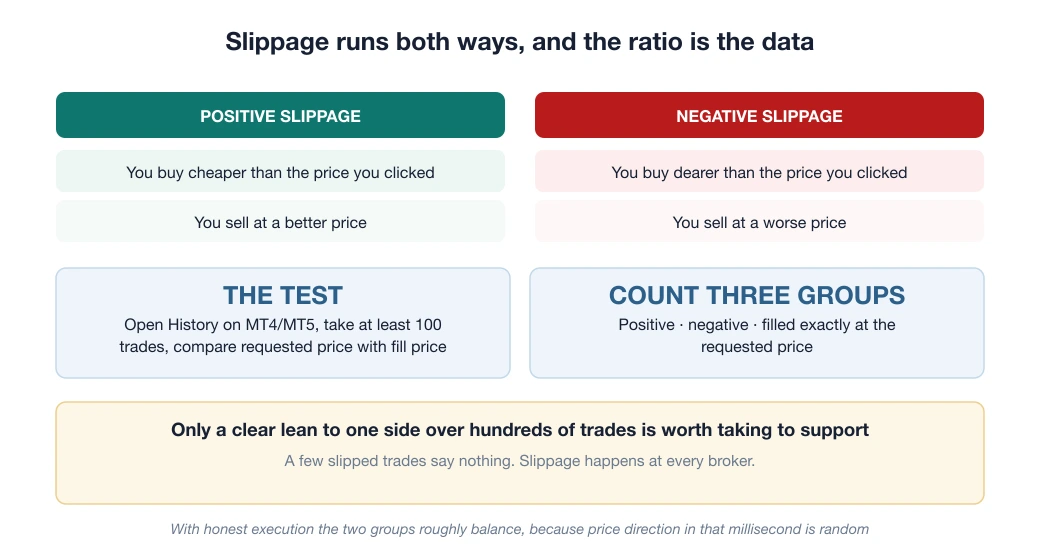
- Negative slippage: you buy at a higher price than intended, or sell at a lower one.
- Positive slippage: you buy cheaper than intended, or sell at a better price.
And this is the first test, one you can run right now: open your trade history and count the orders with positive slippage and the orders with negative slippage.
In an honest execution environment (execution being the moment your order is actually carried out), the two groups roughly balance. Whether price moves up or down in that millisecond is random.
If you see almost nothing but negative slippage, that is the data worth talking about. It is not proof of fraud, but it is a concrete figure to put to the support team, instead of a feeling that "the broker seems to be cheating".
Three moments when slippage is normal
- Right when major news breaks. US non-farm payrolls, interest rate decisions, CPI: price can jump tens of pips in a second. No broker can fill an order at a price that has vanished.
- At session changeovers and the start of the Asian session. Liquidity is thin and fewer parties are quoting, so the gaps between available prices widen.
- When you trade a large volume. A large order has to "eat" through several price levels in the order book; the part above the volume available at the best price fills at a worse level.
These three situations happen at every broker, including those with the strictest licences. They come together with spread widening: same cause, same timing.
Three signs that slippage is NO LONGER normal
The three signs below separate "the market is volatile" from "something is wrong at the broker":
- Persistent one-way slippage. As above: almost only negative slippage, over hundreds of trades, even when the market is calm. Randomness does not produce that shape.
- Slippage that happens exactly when you are in profit and not when you are losing. In particular, take-profit orders fill badly while stop-loss orders fill cleanly.
- Unusually large slippage in normal market conditions. A 15-pip slip during news is normal; a 15-pip slip at 2 p.m. on a day with no news is not.
All three are observations that need figures, not feelings. All three can be taken from your own order history.
Why the legal entity you contract with decides your maximum loss
Slippage that is large enough can push an account below zero, and who absorbs that negative balance depends on where the entity you signed with is licensed.
When price gaps, when the market reopens after shock news, or in an event like the Swiss franc in 2015, your stop loss can fill much further away than the level you set, even leaving the account below the amount you deposited. The question then is: who covers the negative part?
- Under an EU or Australian regulator: negative balance protection is a legal obligation for retail clients. The broker must wipe out the negative part. On top of that there is mandatory close-out at 50% of margin to stop the situation early.
- Under an offshore entity: negative balance protection (if any) is a broker policy, set by the broker and changeable by the broker.
In other words, the same slippage can have very different consequences for two people, simply because the company name on the contract is different.
I compared 20 brokers and 15 run two layers of legal entities, meaning two different companies depending on where you live, and Vietnamese clients are almost always in the offshore layer (registered on an island state where supervision is much lighter). The details are in the article on whether a Tier-1 licence protects Vietnamese clients.
Measure your own slippage: 10 minutes on MT4/MT5
- Open Terminal → History and choose a long enough period (at least 100 trades).
- Export a report: right-click → Report → save the file.
- For each order, compare the requested price with the fill price. Count three groups: positive slippage, negative slippage, filled exactly.
- Work out the ratio between the positive and negative groups, and the average slippage of each group.
Those four figures measure your own account, and the same broker can give different results on two different account types.
If the ratio leans clearly towards the negative side, send that exact table to the support team and keep a record of the reply.
A broker has its own threshold that decides which price you get
Slippage is not entirely random, and at least one large broker publishes its threshold in numbers.
That threshold decides whether your order fills at the level you set or at the market price.
"If the price difference is equal to or exceeds a certain number of basis points (also called the anti-slippage range) for a specific trading instrument, your order will be filled at the market price."
The threshold is published per instrument and measured in basis points. It applies to every account type at that broker: Standard Cent, Standard, Zero, Pro and Raw Spread.
| Instrument | Anti-slippage range (basis points) |
|---|---|
| EURUSD | 0-8 |
| GBPUSD | 0-7 |
| USDJPY | 0-8 |
| GBPJPY | 0-15 |
| NZDUSD | 0-16 |
| GBPNZD · EURNZD | 0-24 |
| XAUUSD · BTCUSD · XAGUSD | 0 to 3 times the spread at the time of the fill |
A thin pair such as GBPNZD has a threshold three times wider than EURUSD. The same price spike gives two different results on the two pairs, and the difference comes from the rules, not from luck.
The last group in the table has no fixed numeric ceiling. Those three products set the threshold as a multiple of the spread at the time of the fill, so however far the spread widens, the threshold widens with it.
The table shows the published levels, not fixed ones. The same document states that the range changes with market conditions and with the account's trading activity.
This mechanism protects both sides, because it prevents an order from being filled at a price that has already vanished.
A broker that publishes its threshold in numbers is also more transparent than one that says nothing.
What stands out is that this figure almost never appears in any broker comparison, including the ones that rank brokers by cost.
The execution threshold also leads to another group of cases, where profit that has already been booked is still clawed back: account locked and cannot withdraw, what to do.
Four ways to reduce slippage, in order of effectiveness
- Avoid entering trades just before major news. This is the most effective way and costs nothing. The news calendar is in the article on trading hours.
- Use pending orders instead of market orders when your strategy allows. You set the price instead of taking the price.
- Set a maximum deviation in the MT4/MT5 order window: if the price moves beyond the threshold, the order does not fill instead of filling at a bad price.
- Reduce the volume of each order if you slip often; smaller orders fill cleanly within the best price level.
One thing NOT to do: switch brokers because of a few slipped trades. Slippage happens at every broker, and you need enough data, at least a few dozen trades across different market conditions, before drawing a conclusion. Switching brokers on a hunch often leads to a broker with weaker regulation.
Frequently asked questions
What is slippage in forex?
It is the gap between the price you see when you click and the price at which the order is actually filled. The cause is that price changed in the very short time between the click and the fill. Slippage runs both ways: negative (buying higher or selling lower than intended) and positive (buying lower or selling higher).
Does slippage mean the broker is cheating?
Not necessarily. Slippage happens at every broker, including those with the strictest licences, and it is common during major news, at session changeovers or when trading large volumes. The suspicious sign is when slippage runs almost only in the negative direction over hundreds of trades, or when it is unusually large while the market is calm.
How do I know whether I am slipping a lot or a little?
Open Terminal → History on MT4/MT5, export a report covering at least 100 trades, then compare the requested price with the fill price. Count three groups: positive slippage, negative slippage and filled exactly, and work out the ratio and the average slippage. In an honest execution environment, the two slippage groups roughly balance.
Can slippage blow up an account?
It can, when price gaps and a stop loss fills much further away than the level you set. Who covers the negative part depends on the entity you contract with: under an EU or Australian regulator, negative balance protection is a legal obligation for retail clients; under an offshore entity, it is only a broker policy that the broker can change.
Spotted something inaccurate? Tell us and we will check it and publish a correction.