
What is spread in forex? How it sets your trading cost
You click buy. The order fills, and your account is already slightly negative even though the price has not moved.
Nothing is broken. You have just paid the spread, the gap between the buy price and the sell price that the broker keeps.
A lot is the unit of order size; 1 standard lot equals 100,000 units of the base currency. On 0.1 lot of EUR/USD, a 1-pip spread (a pip is the smallest price step, usually the fourth decimal place) takes about 1 USD from you in the very first second.
How the spread works: see it once and it makes sense
The screen shows EUR/USD at Bid 1.08500 / Ask 1.08512. You buy at 1.08512, but if you closed immediately you would sell at 1.08500 → an instant loss of 1.2 pips.
That is the spread, the “entry ticket” for every trade. The price has to move 1.2 pips your way just for you to break even.
For a long-term trader (holding trades for days, aiming for a hundred pips), this ticket hardly matters. For a scalper who goes in and out of a dozen trades a day chasing 5–10 pips each, the spread is an opponent as big as the market itself.
Floating vs fixed spreads, and why “from 0.0 pips” is half the truth
The broker itself defines the two types in its help documentation:
“A dynamic spread, also known as a floating spread, is a type of spread that is always changing.
The spread value depends on market volatility and can be larger or smaller than average, so the “dynamic” element here is exactly these constant changes.”
The words “can be larger than average” tell you the advertised figure is only the bottom of the range. What you pay is the value at the exact second you click.
- Floating: the most common type, it stretches and shrinks with liquidity. The advertised figure is always the ideal minimum: “from 0.0 pips” means 0.0 at certain moments, not all the time.
- Fixed: a few brokers (such as AvaTrade) apply a spread that stays put. It is easy to calculate, but in return it is usually higher than the floating average.
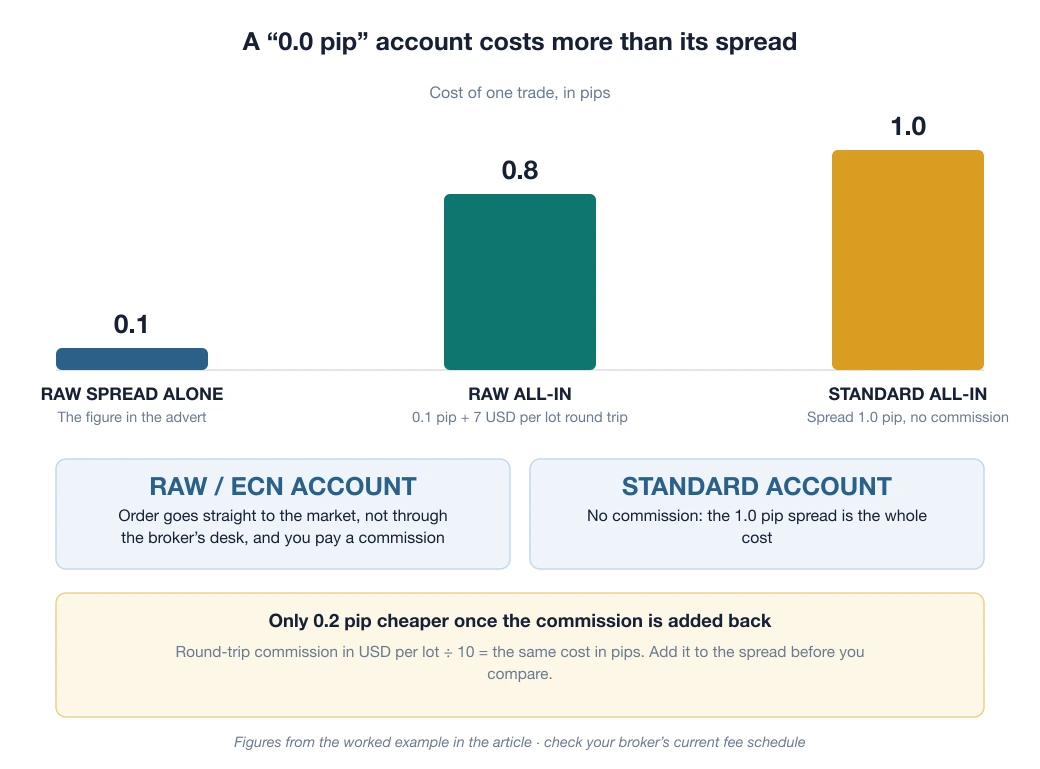
The second half-truth: a “0.0 pip” account always comes with a commission. The two-line conversion every trader should know by heart:
Round-trip commission (USD per lot) ÷ 10 = the equivalent in pips → add it to the spread to get the all-in cost.
A real example: a Raw account with a 0.1-pip spread + a 7 USD per lot round-trip commission → all-in = 0.1 + 0.7 = 0.8 pips.
Against a Standard account at 1.0 pip “with no commission”, it turns out to be only 0.2 pips cheaper, not “0.1 against 1.0” as it first appears.
This is the same calculation we use across our comparison articles, for example in the guides to opening an IC Markets account (~0.6–0.8 pips all-in), opening a Tickmill account (~0.6) and opening a Vantage account (~0.72).
Spread widening: when it is normal, and when to ask questions
Spread widening is when the bid-ask gap grows unusually wide compared with the day’s average.
EUR/USD, usually at 0.6–1 pip, can widen to 5, 10 or even several dozen pips within a few seconds. People search for this almost as often as they search for “what is spread” itself.
Four causes, in order of how often they happen
- Major economic news. US non-farm payrolls, interest rate decisions, CPI: liquidity providers pull their quotes for a few seconds around the release, because nobody wants to quote before they know the number.
- The Asian open and session changeovers. Liquidity is at its thinnest of the day and fewer parties are quoting, so the gap widens.
- Weekends and holidays. Especially the last few minutes before the Friday close and right at the Monday open.
- Unexpected events. Geopolitical news, unscheduled speeches: this is when the spread widens most sharply and least predictably.
Why spread widening is more dangerous than it looks
A few extra pips on one trade would be cheap on their own. What hurts is that the widened spread counts against the distance to your stop loss.
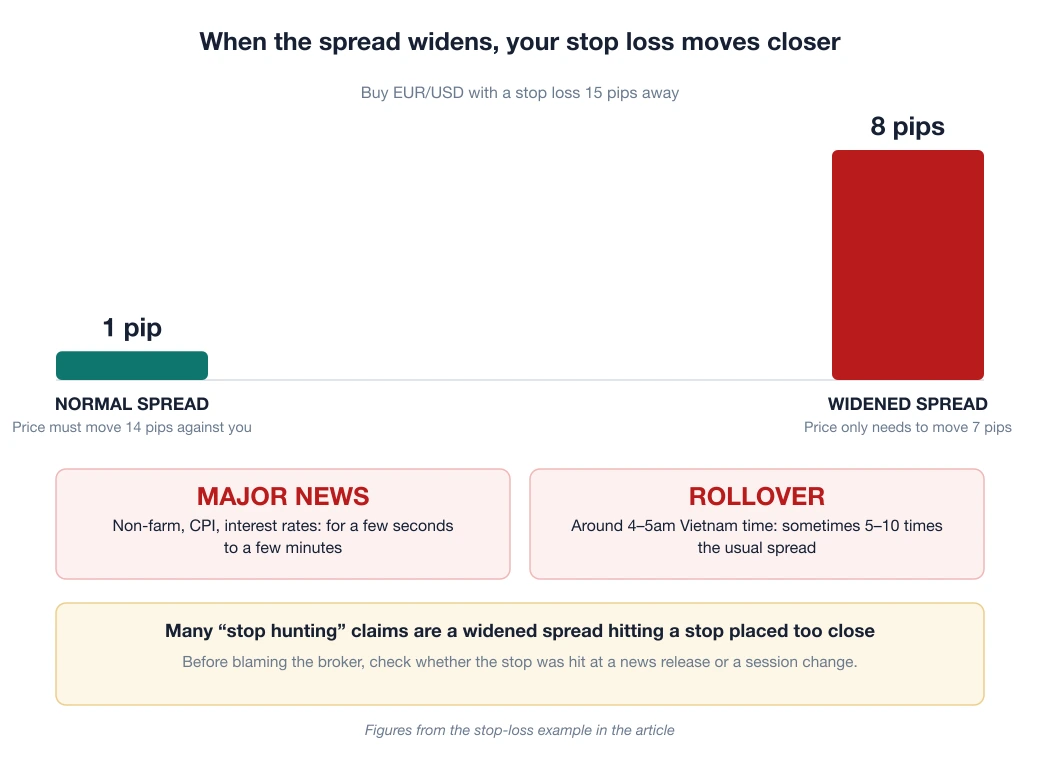
A concrete example: you buy EUR/USD with a stop loss 15 pips away. With the usual 1-pip spread, the price has to move 14 pips against you to hit it.
When the spread widens to 8 pips, the price only needs to move 7 pips against you and your trade is closed, even though the market never reached the level you planned for.
This is the real origin of most “the broker hunted my stop loss” accusations. In many cases the broker hunted nothing: the spread widened exactly as the market mechanism works, and a stop loss placed too close simply fell into that zone.
How to check: see whether the moment your trade was closed coincides with a news release or a session change.
When widening says something about the BROKER, not the market
- Widening in a quiet market: 2pm on a day with no news, and the spread is five times normal.
- Widening only when you have an open trade, and not while you are only watching. Check by opening the same chart on a demo account at the same broker, side by side.
- Widening that lasts unusually long: after the news, spreads at other brokers are back to normal within 1–2 minutes, while yours is still wide after 15 minutes.
All three need data, not a feeling: take screenshots that show the clock, and note the spread level and the time.
A sibling of this, slippage, happens at the same moments for the same reasons; read the two together and you get the full picture.
Measure your real spread yourself: 5 minutes on MT4/MT5
- Open MT5 → right-click the Market Watch window → enable the Spread column (shown in points; 10 points = 1 pip).
- Watch the pair you trade at 3 times: the Europe-US overlap (19:00–23:00 Vietnam time, peak liquidity, the best spreads), early morning in Asian hours (slightly wider spreads), and around 4–5am Vietnam time (rollover, the widest spreads of the day, sometimes 5–10 times normal).
- Log a few sessions → you have your own “real spread table”, worth more than any advertised table.
The two moments the spread jumps suddenly: major news releases (non-farm, CPI, interest rates, when the spread spikes for a few seconds to a few minutes) and rollover at 4–5am.
Beginners often fall into the trap of placing a stop loss close to the price and then getting “hunted” exactly when the spread widens. The broker is not hunting your stop; you are standing too close to the tracks when the train goes by.
How much the spread costs you: figures for each type of trader
| Type of trader | Volume per month | What a 0.4-pip all-in gap is worth |
|---|---|---|
| Long-term, 5 trades of 0.1 lot | 0.5 lot | ~2 USD a month, pick your broker on other criteria |
| Regular swing trading, 30 trades of 0.1 lot | 3 lots | ~12 USD a month, starting to be worth watching |
| Scalper/EA, 100 trades of 0.5 lot | 50 lots | ~200 USD a month, the spread is a matter of survival |
How much the spread matters is proportional to how often you trade. A beginner who trades rarely does not need to obsess over 0.1 pip.
Heavy traders should read our ranking of low-spread brokers, where we compare all-in costs, not advertised figures.
Frequently asked questions
What counts as a low spread?
For EUR/USD, a spread below 1 pip is considered good on a Standard account. Raw/ECN accounts, the type that passes orders straight to the market rather than through the broker’s desk, can go down to 0.0–0.3 pips but come with a commission. Compare the total cost (spread + commission), not just the spread figure.
Why does the spread keep changing?
A floating spread moves with liquidity, meaning how easy it is to buy and sell in the market at that moment: during busy hours (the London and New York sessions) the spread is tight; during strong news or when liquidity is thin, the spread can widen suddenly.
Is the spread the only fee in forex trading?
No. Besides the spread, you may have to pay a commission (Raw/ECN accounts), swap, which is the overnight fee for holding a trade into the next day, and sometimes deposit or withdrawal fees. Read the broker’s full fee schedule before you trade.
- ESMA (27/03/2018). The spread is a cost you pay as soon as you open a trade; ESMA recorded 74–89% of retail accounts losing money, with average losses of 1,600–29,000 EUR per client
- CFTC (US). Forex fraud advisory: finding it hard to get background information on a company is a risk sign; advertised spread conditions should be checked against the actual contract
Spotted something inaccurate? Tell us and we will check it and publish a correction.