
How to open a Vantage account and pick Raw ECN (2026)
Vantage has one feature that makes opening an account a little different from brokers of a similar size: it runs four platforms. MT4, MT5, cTrader and TradingView, and the registration form makes you choose right at the start.
Plenty of people pick one just to get it over with, then three months later nag themselves with “I should have picked the other one”. So the order here is the reverse of the usual: settle the platform first, settle the account type second, and leave the sign-up steps for last, with the easiest part at the very end.
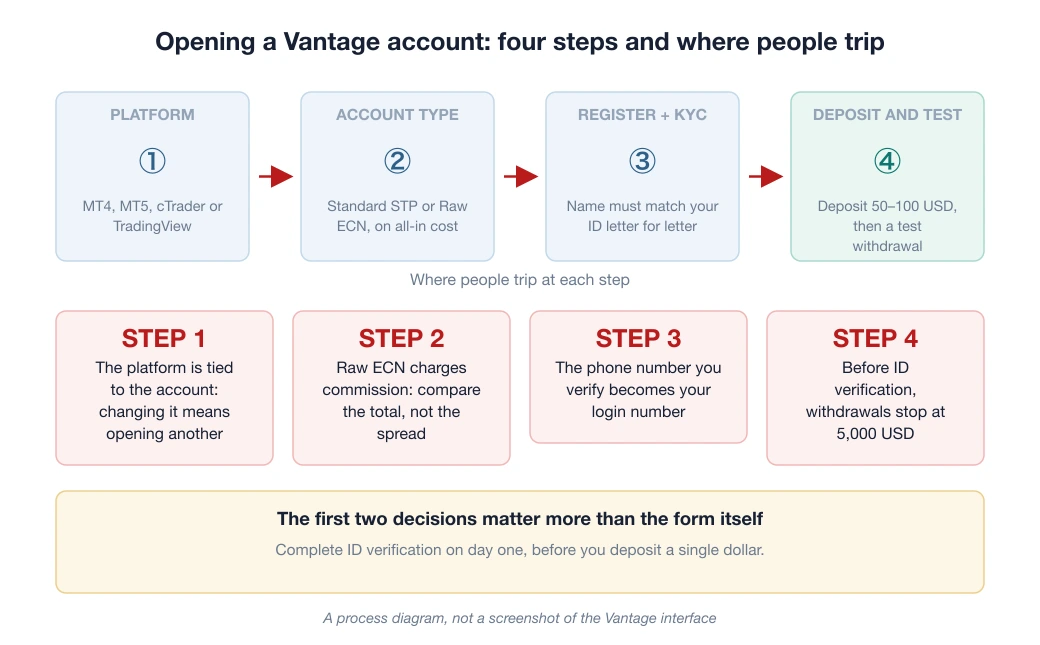
The four steps at a glance: the first two decisions matter more than the clicking
With Vantage, filling in the form is the easiest part. The first two steps are where the real decisions sit: the platform is tied to the account (to change it you have to open another account).
The second is Standard STP versus Raw ECN (which sends orders straight to the market, not through the broker’s own dealing desk). The two can only be compared on all-in cost, not by looking at the spread on its own. Spread is the gap between the buy and the sell price, in other words the fee you pay.
Decision 1: which platform? (The five minutes most worth spending)
- TradingView: if you already analyse charts on TradingView every day (like most of the new generation of traders), this is the reason to pick Vantage outright. You place orders straight on the chart you know, on a single screen, with no more analysing in one place and trading in another. Brokers that combine a strong licence with direct TradingView support are few. This is Vantage’s real selling point.
- cTrader: transparent execution with depth of market, a modern interface, and convenient handling of many orders at once. It suits hands-on traders who trade often and want to “see” the liquidity.
- MT4/MT5: the industry standard, and a must if you run MetaTrader EAs (automated trading programs) or copy signals from the MT community. Nothing flashy, but everything is compatible with it.
Not sure what to choose? MT5: middle of the road, plenty of documentation, and Vantage lets you open several accounts under one profile, so switching later costs you nothing but a few minutes.
Decision 2: the account type, judged on all-in cost
| Account | Deposit from | Fee structure | All-in EUR/USD |
|---|---|---|---|
| Standard STP | ~50 USD | Spread from ~1.0 pip, no commission | ≈ 1.0–1.2 pip |
| Raw ECN | 50 USD | 0.0 spread + commission | ≈ 0.72 pip |
| Pro ECN | 10,000 USD | Lower commission | Lower still |
The middle row is worth a look: the Vantage Raw ECN account starts at 50 USD. That is not the lowest entry among ECN brokers, since IC Markets has no minimum deposit for its Raw Spread account.
For anyone who wants a “taste” of an ECN fee structure without much capital yet, 50 USD is still a low entry point. An all-in cost of ~0.72 pip also puts Vantage at the same table as the top ECN group (IC Markets ~0.6–0.8, Tickmill ~0.6).
A pip is the smallest price step, usually the fourth decimal place.
Then there is copy trading, an area Vantage invests in heavily. If your goal is to copy rather than trade yourself, read this part of the Vantage review carefully before you choose an account type, because copy accounts work in their own way.
The general rule on any copy platform: a leader’s past statistics are not a promise about the future. Copy fees eat into profit; read what copy trading is if the concept is new to you.

Two things this screen tells you that the table above does not:
- Vantage has Cent accounts, in both a Standard and a Raw version. This is an intermediate step worth using: real money but small sizes, a better fit than jumping straight into a regular account. How it works is in the article on what a cent account is.
- There is a type called Premium whose label says outright “Unlimited Leverage”. ⚠️ Unlimited leverage means a very small margin requirement, not small risk. The account still blows up exactly in line with price moves, only faster, because you can open positions far larger than your capital. How it works, and where the trap lies, is in the article on what very high leverage means for your risk.
This screen also states that crypto deposits are provided by a third-party partner, not run by Vantage itself. That detail is worth remembering if something goes wrong, because the party processing the payment is not the party you signed a contract with.
The last step: registration + KYC (the easy part, 10 minutes)

Three fields on this form decide a lot of what comes later:
- “Country of residence” comes pre-filled with Vietnam. This field decides which legal entity you belong to and which set of conditions applies. Do not change it for convenience.
- The “Referred by” field. This is where a partner code goes. Leave it blank and you can still open an account normally; fill it in and the account is attached to an IB (introducing broker). If you intend to receive a rebate through a partner, you must fill it in at the moment you register; attaching one afterwards is usually much more trouble.
- The mandatory box “I am not a US resident”. It is not a formality: Vantage does not serve US clients, and a false declaration breaches the terms, which is enough to get the account locked when it is discovered, usually right when you withdraw.

Read that line carefully before you tap. The number you enter at this step is not just for receiving a code. It becomes login information.
Use a borrowed number, a company number or one you are about to change, and losing access to the account later is a real possibility, and recovery always requires the exact set of documents you verified with.

- Official Vantage website → open a live account. Type your name exactly as it appears on your ID document (without diacritics), plus a real email and phone number.
- Choose the platform + account type you settled in the two sections above; base currency USD.
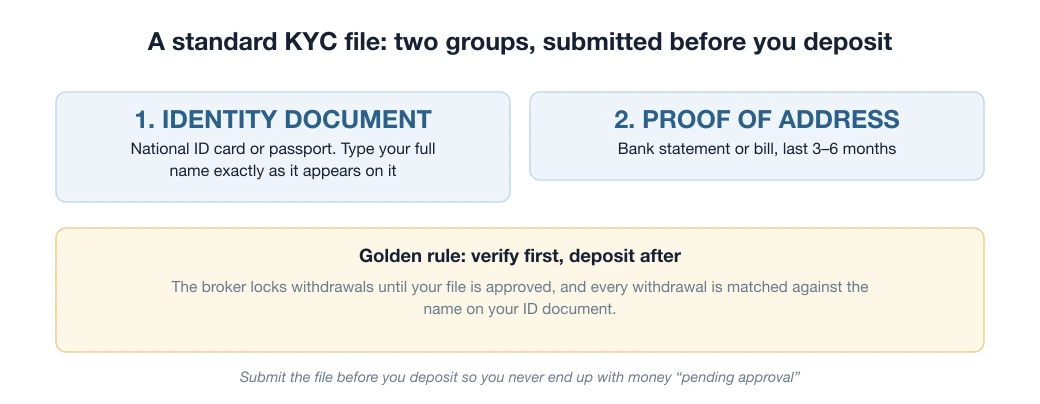
- KYC: national ID card or passport (photographed straight on, sharp, all corners visible) + proof of address (a statement or bill from the last 3–6 months). The name must match the bank account you will deposit from and withdraw to; a mismatch means your withdrawals are blocked automatically later. Approval usually comes the same day.
- Deposits: Vantage is strong in both “lanes” for Vietnamese users, domestic VND bank transfer (money arrives in ~1 hour) and USDT TRC20 (a few minutes). How to choose a lane, plus a step-by-step USDT walkthrough for people who have never used crypto, is in the article on Vantage deposits and withdrawals.
Follow the steps above on the real screen: opening the registration form in a separate tab and checking it against this guide is faster than reading everything first and acting afterwards. If you have never traded, pick a demo account first.
Settle the platform and the account type before you register; both are tied to the account, and changing either means opening another account.
Once KYC is done the account is usable, but the first login tends to trip on exactly one thing: Vantage has three different types of password, and only one of them can place orders.
Deposit and withdrawal limits depend on your verification level, and this is where “blocked withdrawals” get misread
Right after registration, the Vantage client area shows a limits table. It states clearly what limit applies to an account that has not verified its identity:

And just above it, Vantage states the ceiling after verification:

| Account status | Deposit ceiling | Withdrawal ceiling |
|---|---|---|
| Email + phone verified, ID document not yet verified | 5,000 USD | 5,000 USD |
| ID document verified | up to 10,000,000 USD | |
Why this is worth spelling out: many “deposits go through, withdrawals don’t” cases at brokers have a very ordinary technical cause. At Vantage, it is the account hitting the 5,000 USD ceiling because ID verification was never completed. The user deposits bit by bit, trades at a profit, and when a withdrawal goes over the threshold it is blocked, which gets read as “the broker is holding my money”.
What to do, 10 minutes: complete ID verification on day one, before you deposit a single dollar. We apply this rule to every broker, and the reason is always the same: skip it and you can still deposit and trade as normal, and you only find out when you want to withdraw.
A clear limit on this: the table above is a screenshot of one account at one point in time (15/08/2026).
Vantage itself adds the line “These limits may be adjusted based on regulatory requirements or account activity”, so read the figure in your own account and do not treat the number here as the standard.
The first two weeks: how we recommend using any new broker
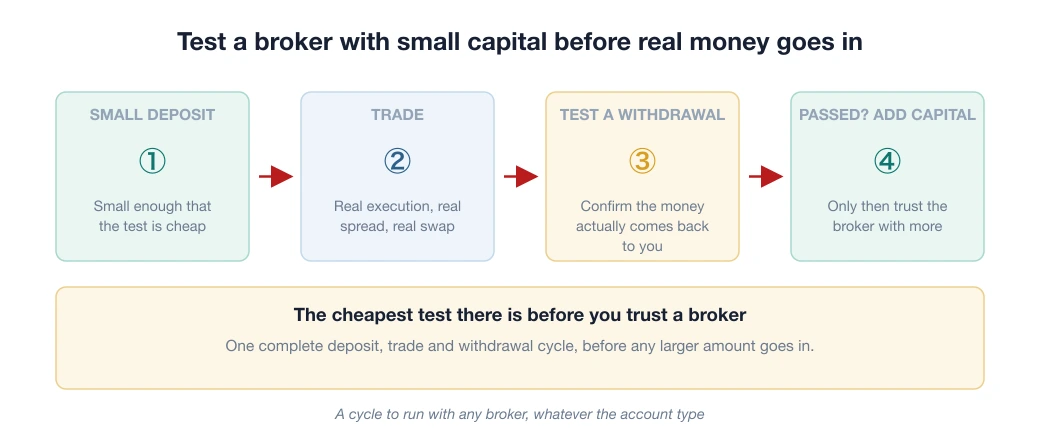
- Week 1: deposit 50–100 USD into Raw ECN. Trade small sizes, worked out with the formula risk ÷ (stop loss × pip value), at 1–2% risk per trade. The goal this week is not profit but data: spreads in the Asian, European and US sessions, slippage on news, execution speed.
- Week 2: place a test withdrawal and measure the time from clicking the button to the money reaching your account or wallet. Only a broker that passes the full deposit, trade and withdraw test is worth discussing with larger capital; we apply this rule to every broker, not just Vantage.
- After that: if things run smoothly, add capital in line with your risk tolerance. Still weighing up the ECN group? IC Markets vs Tickmill and the Vantage review (with licence and platform images) give you the full comparison.
Frequently asked questions
What is Vantage’s minimum deposit?
Vantage’s Raw ECN account takes deposits from about 50 USD, lower than many other ECN brokers. The Pro ECN account requires more capital (from 10,000 USD) and is aimed at professional traders.
Should I choose Vantage Standard STP or Raw ECN?
Standard STP has no commission and spreads from ~1.0 pip, which keeps things simple for beginners. Raw ECN has a 0.0 pip spread but charges commission (~0.72 pip all-in on EUR/USD), which works best for people who trade a lot. Compare the total cost.
Which platforms does Vantage support?
Vantage supports MT4, MT5, cTrader and TradingView, a range that suits both traders used to MetaTrader and those who prefer a modern interface. There is a demo account to practise on before you use real money.
- IC Markets. Trading accounts overview (read 20/10/2026): no minimum deposit for Raw Spread, cTrader and Standard; Raw Spread commission 3.5 USD per lot per side; Standard spread from 0.8 pip
- Screenshots of the Vantage client area taken by the site owner, 15/08/2026 (6 images, blank forms so no personal information): the Vietnamese registration form with a “Referred by” field; the phone-linking screen stating that “the verified phone number will become your login phone number”; the limits table of 5,000 USD before ID verification and 10,000,000 USD after verification; the screen for choosing among 5 account types on MetaTrader 5
- CFTC (US). Advises checking a firm’s registration status before opening an account; the legal entity name in the contract must match the name on the licence
Spotted something inaccurate? Tell us and we will check it and publish a correction.