
What is a cent account? A demo-to-live bridge few people use
There is a paradox in this trade that everyone nods along to and hardly anyone acts on. Everyone knows the “demo champion who blows up a live account” is an everyday story. Yet when shown the tool built to solve exactly that problem, the common reaction is a shrug: “trading that small, when would I ever get rich?”
That tool is the cent account. The balance is counted in CENTS instead of dollars: deposit 50 USD and the account shows 5,000 cents, a “0.1 lot” order on it is only 0.001 of a standard lot, and each pip is worth just a few hundred Vietnamese dong.
A pip is the smallest price step on the quote, usually the fourth decimal place.
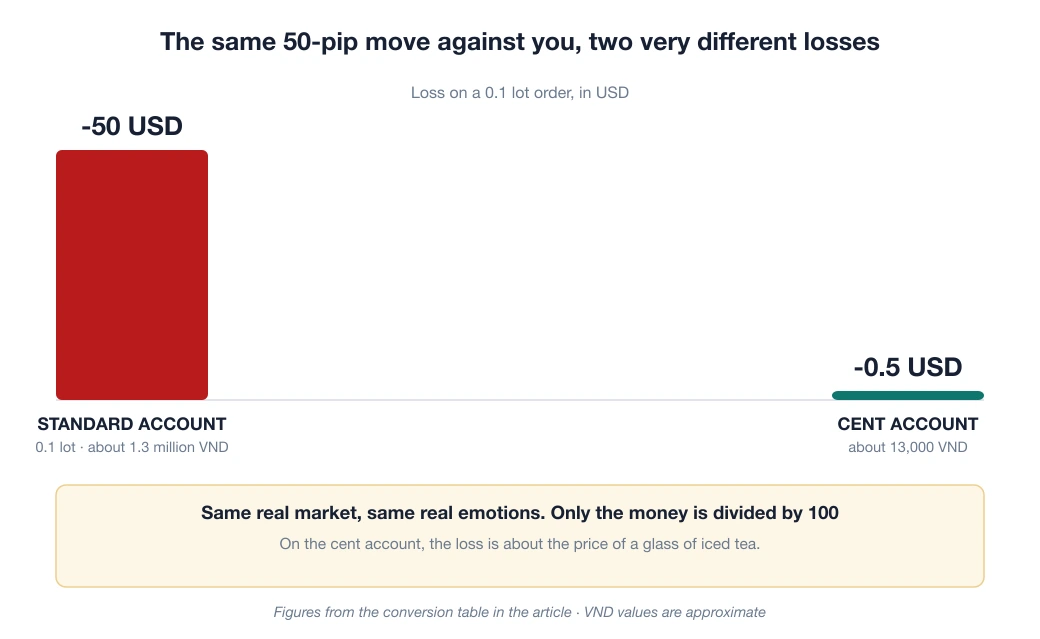
The pair of columns in the chart below says it all: the same 50-pip move against you, one side loses 1.3 million VND, the other loses the price of a glass of iced tea. Same real market, same racing heart.
How it works: the same real market, money divided by 100
A cent account trades on the same price feed, with the same liquidity (how easily you can buy or sell without the price jumping), on the same MT4/MT5 platforms as a regular account. Only the unit of money differs. The conversion in practice:
| Regular account | Cent account | |
|---|---|---|
| A 50 USD deposit shows | 50 USD | 5,000 cents |
| An order of 0.1 lot = | 10,000 units | 100 units (0.001 standard lot) |
| 1 pip is worth | ~1 USD (~26,000 VND) | ~0.01 USD (~260 VND) |
| A 50-pip move against you | -50 USD | -0.5 USD (~13,000 VND) |
The clever part is psychological. Your brain sees “5,000” and wins and losses in the hundreds and thousands, enough to trigger real emotion (something a demo cannot do), while the absolute damage is the price of a glass of iced tea. This is the light-weights corner of the trading gym.
Who should use a cent account: the four groups that benefit most
- People who have just graduated from demo (the full checklist is in the article on how long to trade on demo): run the exact system you have statistics for on a cent account for 1–2 months. The gap between your demo results and your cent results is the “psychology tax” you have to pay, and here you pay it at the lowest interest rate there is.
- People testing a new strategy or EA (an automated trading program): a good-looking backtest does not guarantee good live results. A cent account is a place to verify with real execution and real costs, at close to zero risk.
- People whose capital really is small (under 50 USD): instead of trading 0.01 standard lot, which is still too heavy for 30 USD of capital, a cent account lets you manage risk at 1–2% per trade PROPERLY on a tiny balance, so good discipline is learned early.
- People coming back after blowing an account: rebuild confidence and discipline somewhere it cannot hurt any more, then scale up gradually.
Which brokers offer a cent account worth using?
Not every broker has one. Pure ECN brokers (which pass orders straight to the market rather than through their own dealing desk), such as IC Markets and Tickmill, usually do not offer it.
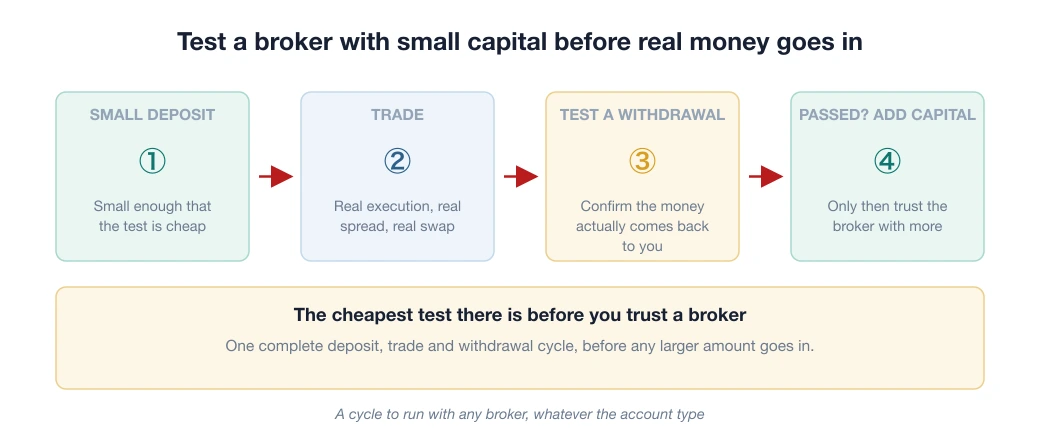
Two that we have vetted. The first is HFM: its Cent account has no minimum deposit and allows withdrawals from just 5 USD, a perfect pair for the small deposit, trade and test-withdrawal loop we always recommend.
The second is Exness: its Standard Cent account has a minimum deposit that depends on the payment method (Exness does not publish one fixed figure).
It also uses the broker’s mostly automatic withdrawal processing. Processing time may vary depending on the payment method you choose. How to open each type is covered in the guides to opening an HFM account and opening an Exness account.
Three mistakes with cent accounts: avoid them and it delivers its full value
- Trading cent with a “it is only small change, just go for it” mindset: this wrecks the whole purpose. The rule: trade cent SERIOUSLY, as if every cent were a dollar, because the habits you build here carry straight over to a larger account.
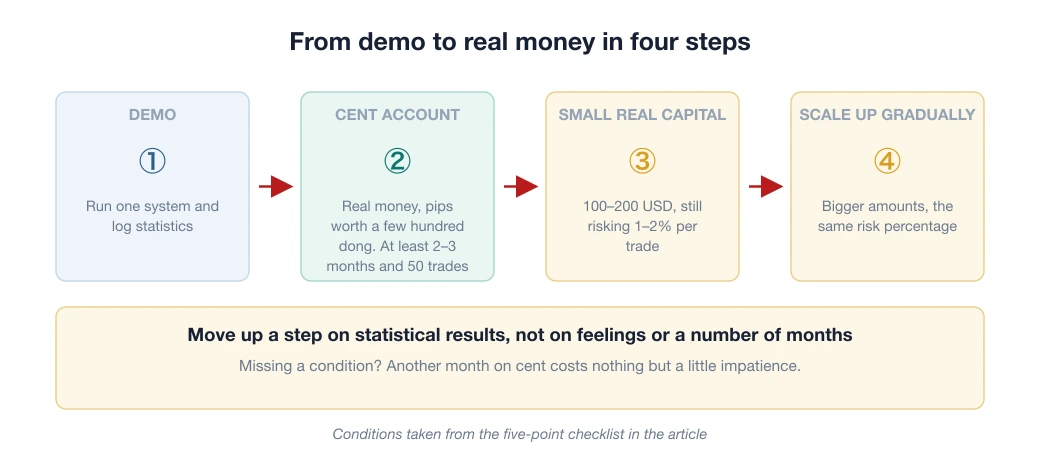
- Staying on cent too long out of fear: like demo, cent is a bridge, not a destination. Stable results for 2–3 months, then move up to small real capital (100–200 USD). Stand on the bridge forever and you never cross the river.
- Expecting meaningful profit: 10% a month on 50 USD is 5 USD. If that makes you impatient about “when will I get rich”, reread the maths of what to expect from your capital. At this stage you are building SKILL, and skill is the only asset that scales to every capital size later on.
How do cent and micro accounts differ? Two terms that often get mixed up
Articles (and even broker sales staff) regularly use these two terms interchangeably:
- A cent account changes the MONEY UNIT of the whole account to cents. Every figure is divided by 100, including the real volume of each order.
- A micro account (such as XM Micro) keeps USD as the unit, but defines “1 lot” on the account as 1,000 units (a micro lot) instead of 100,000.
In practice the result is quite similar (you can trade very small). The difference is in how the numbers look: a cent account shows you a “5,000” balance, big enough to trigger real emotion, and that is the subtle part of its design.
If a broker has no cent account, micro is the closest alternative. If it offers both, cent has the edge for training your psychology.
Moving from cent to a regular account: a five-condition checklist
- At least 2–3 months and at least 50 trades on cent with EXACTLY the system you brought over from demo. No changing horses midstream.
- Positive expectancy after costs: total profit > total loss (including spread and swap) over that set of statistics. You do not need big numbers, you need REAL and positive ones.
- Measurable discipline: count in your journal how often you moved a stop loss, added to a losing trade to win it back, or exceeded your allowed risk. That count must fall every month.
- You have made at least one test withdrawal, a complete deposit, trade and withdrawal cycle, the principle we apply everywhere.
- The real capital you plan to use is already in your “risk wallet” (the three-wallet rule in the article on how much money to start with): not borrowed, not taken from your living expenses.
Meet all 5 and move up to 100–200 USD on a regular account while keeping the same 1–2% risk per trade: the absolute amounts get bigger but the ratio stays the same. Missing any one, another month on cent costs you nothing but a little impatience, far cheaper than relearning an old lesson with big money.
A use of cent accounts few people think of: a test bed for EAs and signals
Buying an EA, renting a VPS, following a signal group: before letting any of them touch real capital, run it for 1–2 months on a cent account.
Real execution (the moment your order is actually filled), real spread (the gap between the buy and the sell price, which is the fee you pay), real swap (the overnight fee for holding a position into the next day), real drawdown: the whole truth, for a ticket price of a few tens of thousands of VND.
An EA that “backtests at 300% a year” but cannot survive 2 months on cent (it happens more often than you would think) has just saved you the real capital you were about to pour into it.
At brokers whose cent accounts have no minimum deposit, such as HFM, two months of testing like this costs a few tens of thousands of VND in fees, and leaves you a set of real statistics to decide with.
Frequently asked questions
Is a cent account real money?
Yes, 100% real money, traded on the real market and withdrawable as normal. The only differences are that the balance is shown in cents (a 50 USD deposit shows 5,000 cents) and order volume is 100 times smaller than on a standard account.
Which brokers offer a good cent account for Vietnamese traders?
HFM (Cent account with no minimum deposit, withdrawals from 5 USD) and Exness (Standard Cent, minimum deposit depending on the payment method, mostly automatic withdrawal processing) are two options that we have vetted in detail in our reviews.
How long should I trade on cent before moving to a regular account?
Once your results have been stable for 2–3 months with exactly the system you tracked on demo, move up to small real capital (100–200 USD) and then scale up gradually. A cent account is a bridge, not a destination.
- Exness, "Standard Cent account" (Vietnamese edition, broker updated 14/08/2026): 1 cent lot = 1,000 USD, equal to 0.01 standard lot; balance displayed in cents
- ESMA (27/03/2018). A cent account shrinks the size of the order, not the structural risk: ESMA recorded 74–89% of retail accounts losing money on these same products
Spotted something inaccurate? Tell us and we will check it and publish a correction.