
How long should you trade on demo before going live?
Ask 10 people “how long should I trade on demo” and you get 10 different numbers: 1 month, 3 months, 6 months, “until I profit consistently”... All of them miss, because the question uses the wrong unit of measurement.
Demo is not measured in time. It is measured in CONDITIONS: you graduate when one fixed system has run at least 30–50 trades with statistics, and the platform mechanics have become reflexes.
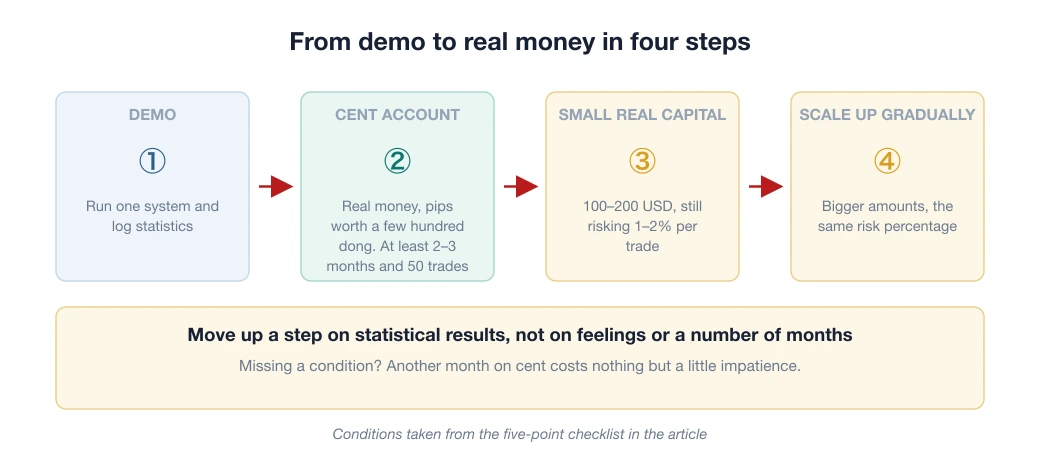
Someone who focuses gets that done in 3–6 weeks; someone who treats demo as entertainment is still marking time after two years. The 4-step roadmap in the chart below is the frame for the whole article, together with a counterintuitive fact: staying on demo too long does real harm.
What demo is for, and what it is NOT for
Demo is the perfect environment for learning three mechanical things: (1) platform mechanics, placing an order, a stop loss and a take profit, and editing an order without fumbling; (2) your analysis process, running your checklist from trend → price zone → signal until it becomes habit.
(3) System statistics: the win rate and average R:R of your method over a few dozen trades.
Demo cannot teach exactly one thing, but it is the thing that decides the outcome: your psychology when real money is flickering on the screen.
The fear that makes you close early, the itch to trade back a loss, the “reluctance” to cut a wrong trade: all of these appear only when the number on the screen is your own real money.
This is why the “demo champion” who blows up a real account in the first month is a classic story in this trade.
Demo graduation checklist: meet all 5 and go
- Mechanics without thinking: place an order with SL/TP within 30 seconds, know how to modify or partially close an order, never mix up buy and sell (it sounds funny, but it really happens).
- ONE fixed system, ≥ 30–50 trades: the same set of entry and exit rules, not changed halfway. Changing systems constantly = starting again from trade number 1.
- A journal with numbers: win rate, average R:R, longest losing streak. You do not need pretty numbers, you need REAL ones. A thin positive expectancy is fine, because the goal of the next stage is to keep it under pressure.
- You have traded demo with EXACTLY the capital you will deposit for real: trading a 100,000 USD demo and then depositing 200 USD for real is fooling yourself, and every feel you have for lot size and volatility will be off. Reset the demo balance to exactly the amount you plan to deposit.
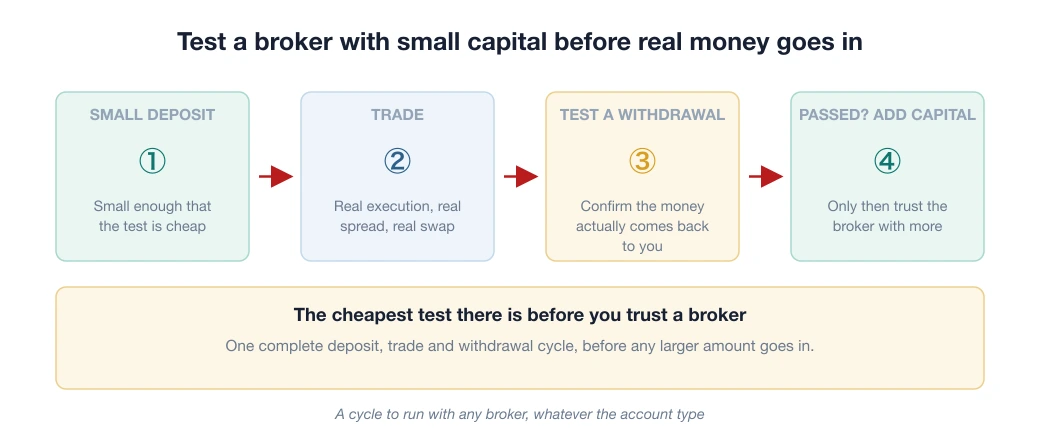
- You understand the real costs: you know how spread and swap eat into results. Demo often fills orders a little more “cleanly” than live, so know it in advance and it will not shock you.
Why is staying on demo TOO LONG harmful?
- It feeds bad habits: no real money = no consequences = careless entries, holding losers without a second thought, piling on trades for fun. The longer it goes on, the deeper these habits take root, and they carry over to a real account intact.
- It delays the only lesson still missing: real-money psychology can only be learned with real money, and every month you linger is another month before that subject starts.
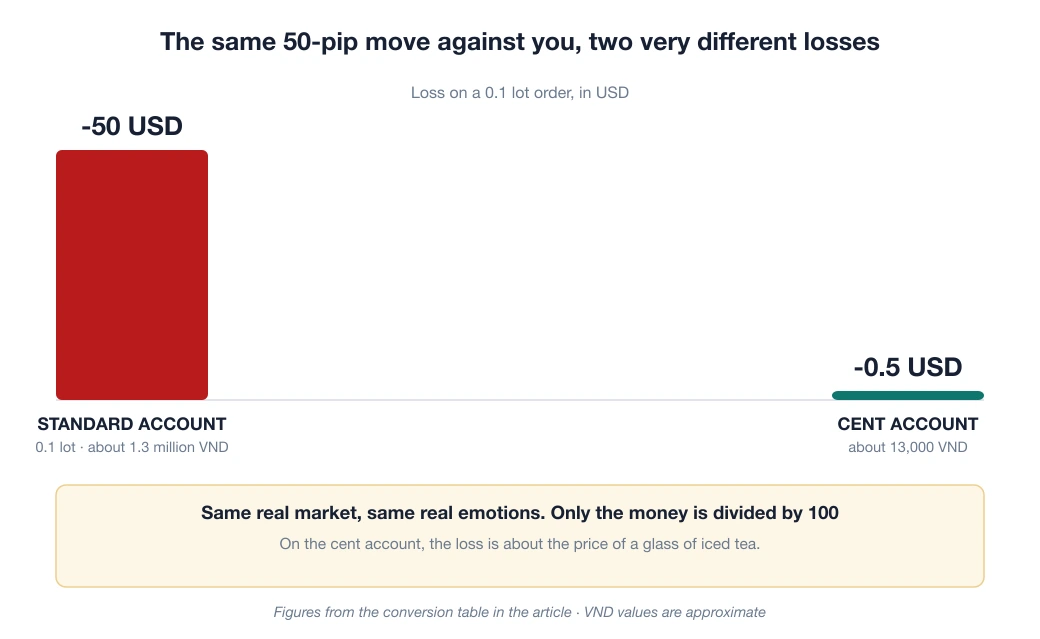
- An in-between option already exists: the cent account, real money but each pip is worth only a few hundred dong. Real enough to make your heart race, small enough not to hurt. Read what a cent account is and the transition roadmap below.
The smoothest demo → live roadmap
- Serious demo for 3–6 weeks until you meet the 5-point checklist.
- Cent or minimum capital for 1–2 months: deposit 50–100 USD (pick a suitable broker from the top brokers for small capital), run EXACTLY the system you have statistics for, and compare the results with demo. The gap is your “psychology tax”, and only now do you start paying it off in instalments at a low interest rate.
- Scale up step by step once your cent results are stable: one and a half times, then double, never a leap. Every time you add capital, your psychology needs a beat to adjust again.
- Keep a demo running alongside, for good, as a laboratory: test every new idea on demo first, and move it to the real account only once it has proven itself. Professional traders do not drop demo, they change its role.
How to open a demo that feels “like the real thing”: 4 settings that decide it
Brokers’ default demos usually give you a virtual balance of 10,000–100,000 USD with maximum leverage (which lets you control more money than your real capital), and that setup turns demo into a game. Change 4 things as soon as you create it:
- Balance = exactly the amount you plan to deposit for real (most brokers let you choose it when you create the demo, or you can create a new demo account with the balance you want).
- Account type = the type you will use for real: trading a Standard demo and then going live on Raw ECN means changing the fee structure halfway.
- Leverage = the level you plan to use for real, not the maximum the broker allows.
- Trading hours = the hours you will trade for real: practising on demo during a free lunch hour but later only being able to trade in the evening skews your statistics by session, and you almost have to start again (see how each session behaves).
Backtest, demo, cent: three training rooms, do not mix up their roles
- Backtest (running a system on past data): answers “did this system EVER have an edge?”. It is fast, hundreds of trades in one sitting, but it has no emotion and it is easy to fool yourself by over-fitting the past.
- Demo: answers “can I run this system in real time?”. It adds the human variable but still lacks the money variable.
- Cent: answers “can I run it when my HEART IS RACING?”. It is the last piece before real capital.
The standard sequence goes through all three in exactly that order. Skip a step and the market will make you relearn it, at a higher tuition fee.
Signs you are “addicted to demo”, and the push to get out
Three symptoms: (1) you are past 50 trades with solid statistics and still telling yourself “one more month to be sure”; (2) you reset the demo account every time it blows up instead of dissecting your journal; (3) your demo volume keeps growing “for the thrill”.
If you have two or more of these, here is the push: deposit exactly 50 USD into a cent account (HFM has no minimum deposit) and make yourself a deal that the first 20 trades are only 0.01 cent lot (a lot is the unit of order volume; 1 standard lot is 100,000 units).
The loss on those 20 cent trades is less than a bowl of phở. But the lesson it teaches, “your heart racing when you press the button”, is something demo never sells, at any price.
Frequently asked questions
Is 1 month of demo trading enough before going live?
If you meet the 5 graduation conditions (fluent mechanics, 1 system with ≥30–50 trades and statistics, a demo with exactly your real capital), then yes. Time is not the yardstick, the conditions are.
Why do I profit on demo but lose with real money?
Because demo lacks exactly the variable that decides the outcome: real-money psychology. Fear makes you take profit early, reluctance to lose money makes you hold losers, and these behaviours do not appear on demo. The fix: move across through a cent account instead of jumping straight into large capital.
What balance should I set on a demo account?
Exactly the amount you plan to deposit for real. A 100,000 USD demo when you plan to deposit 200 USD distorts your whole sense of volume and volatility, a habit that makes demo useless.
Spotted something inaccurate? Tell us and we will check it and publish a correction.