
Forex trading hours in Vietnam time: which session to trade?
Have you ever wondered why the same trading system gives you “easy” evening trades and much harder morning ones? The answer is often not in your analysis but on the clock. The forex market is open continuously from about 5am on Monday to about 5am on Saturday, Vietnam time.
But liquidity (how easily you can buy or sell without the price jumping) concentrates in the main sessions. For Vietnamese traders, the most productive forex trading hours are in the evening (7pm–11pm in summer, 8pm–midnight in winter), when the European session in London and the US session in New York overlap.
The four main sessions split the trading day into four very different rhythms, and at some hours the best move is not to open a trade at all.
The 4 main sessions in Vietnam time
| Session | Vietnam time (approx.)* | Character |
|---|---|---|
| Sydney | ~5am – 2pm | Opens the week, thinnest liquidity |
| Tokyo (Asia) | ~7am – 4pm | JPY/AUD pairs are active; EUR/USD usually moves sideways in a narrow range |
| London (Europe) | ~3pm – midnight | A high-volume session; the day’s trend usually starts here |
| New York (US) | ~8pm – 5am | A heavy flow of US news; big moves |
*Times shift by ±1 hour with the season because Europe and the US use daylight saving time (DST) and Vietnam does not. The times in this table are winter times. In summer everything happens 1 hour earlier.
Why are 7pm–11pm the “golden hours” for Vietnamese traders?
That is when London and New York are open together: two large forex centres running in parallel. The measurable consequences:
- The narrowest spread of the day (peak liquidity). That matters to everyone and is a matter of survival for scalpers. You can check it yourself by turning on the Spread column in MT5, as shown in the article on what spread is.
- Enough movement for a setup to play out fully: breakouts get follow-through instead of running out of steam halfway, as they do in the Asian session.
- It fits a Vietnamese daily routine: after work, while you are alert, with no need to stay up all night. This is a time-zone advantage that Vietnamese traders rarely notice they have.
Four time windows to avoid opening trades
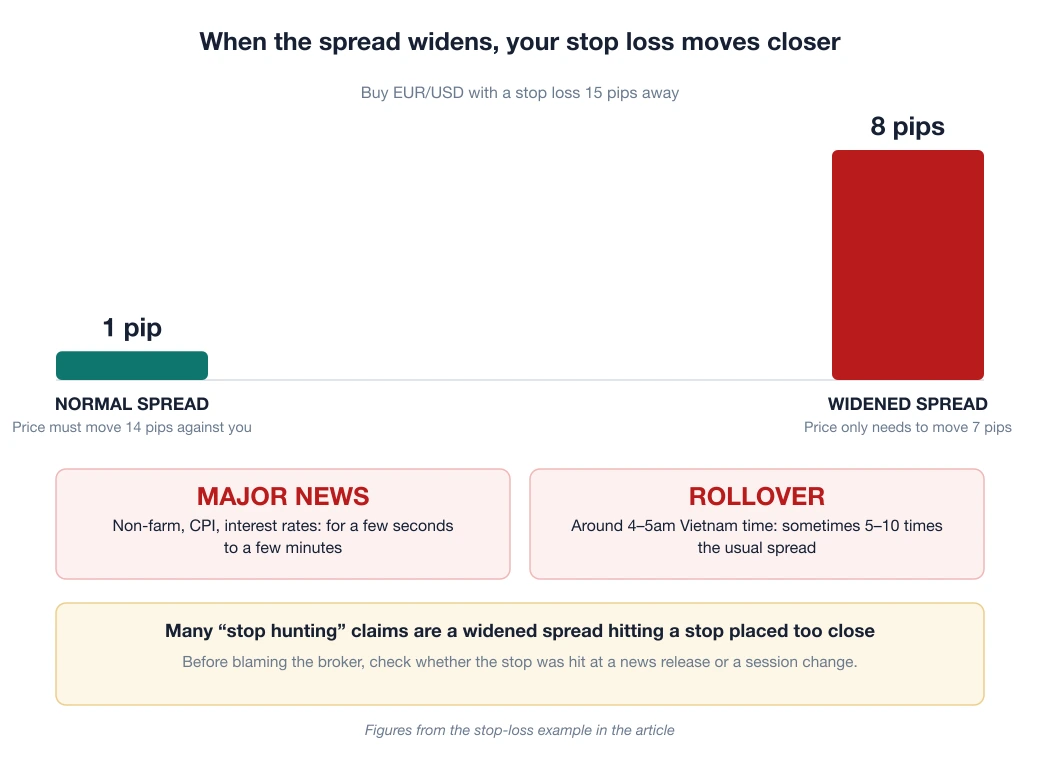
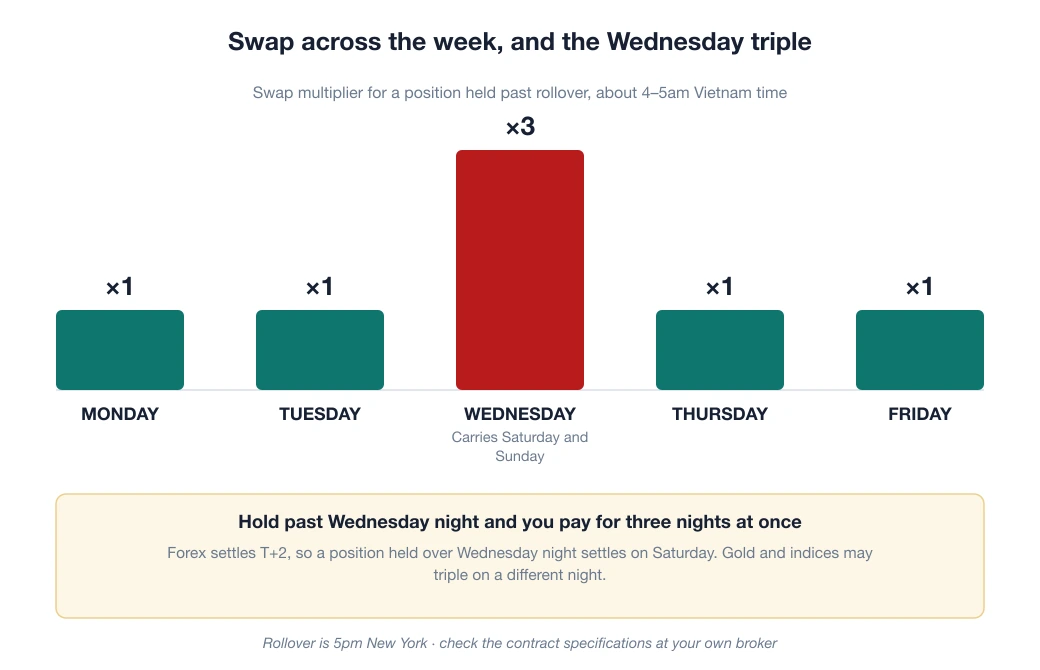
- 4am–6am (rollover and the session handover): liquidity dries up, the spread widens many times over, swap is charged, and a tight stop loss is easily taken out by a meaningless spike. Do not open new trades, and do not leave your stop too close during these hours.
- 5–30 minutes around major news (Non-farm on Friday evening, ~7:30pm–8:30pm Vietnam time, CPI, interest rate decisions): price whipsaws in both directions and orders fill with slippage. Beginners should stand aside and watch. Opening a trade to “catch the news” is gambling with a fee attached.
- Monday morning at the open: the weekend gap has not been “digested” yet, and the early direction of the week is often a fake-out.
- Late Friday night: liquidity drains away before the weekend break. Holding trades over the weekend carries the risk of a Monday morning gap, so deciding whether to hold or close should be deliberate, not something you forgot about.
Matching the hours to your trading style
- Only free in the evening? You are already in the best window: trade 7pm–11pm, on EUR/USD, GBP/USD and XAU/USD.
- Only free during the day? The Asian session suits JPY/AUD pairs or a narrow-range style. Or move to the D1 timeframe: analyse once in the evening, place pending orders, and check the result in the morning. You do not need to sit watching the screen to be a trader.
- Swing traders on D1/H4: entry time matters much less, but you should still avoid placing or modifying orders around rollover and major news.
The weekly news calendar: fixed “appointments” worth putting in your phone
Besides the rhythm of the sessions, the market has regular news releases that make volatility explode (Vietnam time; each window below covers both seasons, with summer at the earlier end and winter at the later end):
- First Friday of the month, ~7:30pm–8:30pm: Non-farm Payrolls (US non-farm employment), the monthly “cup final” for news traders. The spread widens and price whipsaws in both directions for a few minutes.
- Mid-month, ~7:30pm–8:30pm: US CPI (inflation), as influential as Non-farm in an era when the market lives on interest rate expectations.
- 8 times a year, ~1am–2:30am: the Fed interest rate decision (FOMC) and press conference, a sleepless night for traders around the world. Beginners should... sleep, and look at the result in the morning.
- Scattered through each week: GDP, PMI and retail sales from the major economies. Follow them on any economic calendar, and get into the habit of glancing at the calendar BEFORE your day’s trades.
The rule for beginners is simple: a major release due within the next hour → no new trades, move your stop to breakeven or close the fragile positions. We regularly analyse how the market moves around the news in the economic news section.
Which session “suits” which pair?
| Vietnam time window | Active pairs | Why |
|---|---|---|
| Morning (7am–2pm, Asian session) | USD/JPY, AUD/USD, AUD/JPY | Japanese and Australian banks are at work, so the real money flow in these currencies happens then |
| Afternoon (3pm–7pm, early European session) | EUR/USD, GBP/USD start to wake up | London opens and the day’s trend usually starts |
| Evening (7pm–11pm in summer, 8pm–midnight in winter), the golden hours | EUR/USD, GBP/USD, XAU/USD (gold) | Europe and the US overlap, liquidity peaks, and US news comes out at this time |
XAU/USD in particular is almost “asleep” in the Asian session and comes alive from the European session, so trading gold in the Vietnamese morning is choosing hard mode.
Why the times shift by 1 hour twice a year
The US and Europe change their clocks with the season (Daylight Saving Time): in summer they move 1 hour earlier, while Vietnam stays the same all year. So every session and news time converted to Vietnam time shifts by 1 hour twice a year (around March and November).
A tip so you do not have to remember: set up an economic calendar or a session clock that follows your device time, and it adjusts itself. Only people who keep “fixed” times in their head get caught out by DST twice a year.
Tonight, open MT5 at 7pm, open it again at 9am tomorrow, and note the Spread column for the same pair at both times. Once you have the numbers from your own broker, move on to technical analysis from scratch.
Frequently asked questions
What time does the forex market open in Vietnam time?
From about 5am on Monday (when Sydney opens) to about 5am on Saturday (when New York closes), continuously 24 hours a day through the week. Times shift by ±1 hour with the season because of daylight saving time in Europe and the US.
What is the best time to trade forex in Vietnam?
7pm–11pm, when London and New York are open together: the narrowest spread, the best liquidity and movement, and it fits the after-work routine of Vietnamese traders.
Can you trade forex at the weekend?
No, the market is closed on Saturday and Sunday. The Monday morning opening price can gap away from the Friday close, so think carefully before holding trades over the weekend.
- Exness, “Trading hours of instruments” (Vietnamese edition, broker updated 13/08/2026): a tool to look up opening hours, close-only hours and trading halts by product and time zone
- ESMA (27/03/2018). Holding positions across sessions creates gap risk; ESMA therefore requires negative balance protection on a per-account basis so clients cannot owe more than they deposited
Spotted something inaccurate? Tell us and we will check it and publish a correction.