
What is swap in forex? Why Wednesday nights cost triple
On a Thursday morning, a swing trader opens the app and stops short. The account has been charged three times the usual amount, yet no trade closed overnight.
The broker did not make a mistake. Nobody hacked the account.
That is the Wednesday-night triple swap, a threefold charge that almost every swing trader pays for once before they understand it.
The root of it is swap, the overnight fee. It is the amount deducted, or CREDITED, when you hold a position past rollover, around 4 to 5am Vietnam time. It comes from the interest rate difference between the two currencies in the pair.
The mechanism is simple once you see it, the triple charge has a clear cause, and there are legitimate ways to stop swap quietly eating into your account.
Why swap exists: an example
When you buy AUD/JPY, in effect you are “holding” the Australian dollar (the higher interest rate) and “borrowing” the Japanese yen (a low interest rate). That rate difference has to be settled for every day you hold the position. If it runs in your favour, YOUR ACCOUNT IS CREDITED (positive swap); if it runs against you, you are charged. So:
- Swap is not a fee “the broker made up”. Its root is the interbank interest rate, and the broker adds its own margin on top.
- On the same pair, a BUY position and a SELL position carry different swap (usually one side is heavily negative, the other slightly negative or slightly positive).
- When interest rates are high, swap gets much larger, and holding a position against the rate difference for a few weeks can cost as much as being stopped out once.
The Wednesday-night × 3 rule: the classic swing trader trap
Forex trades settle T+2. A position held over Wednesday night has a settlement date that falls on Saturday, when the market is closed. So the broker loads the swap for the whole weekend onto Wednesday night into Thursday, and charges it three times.
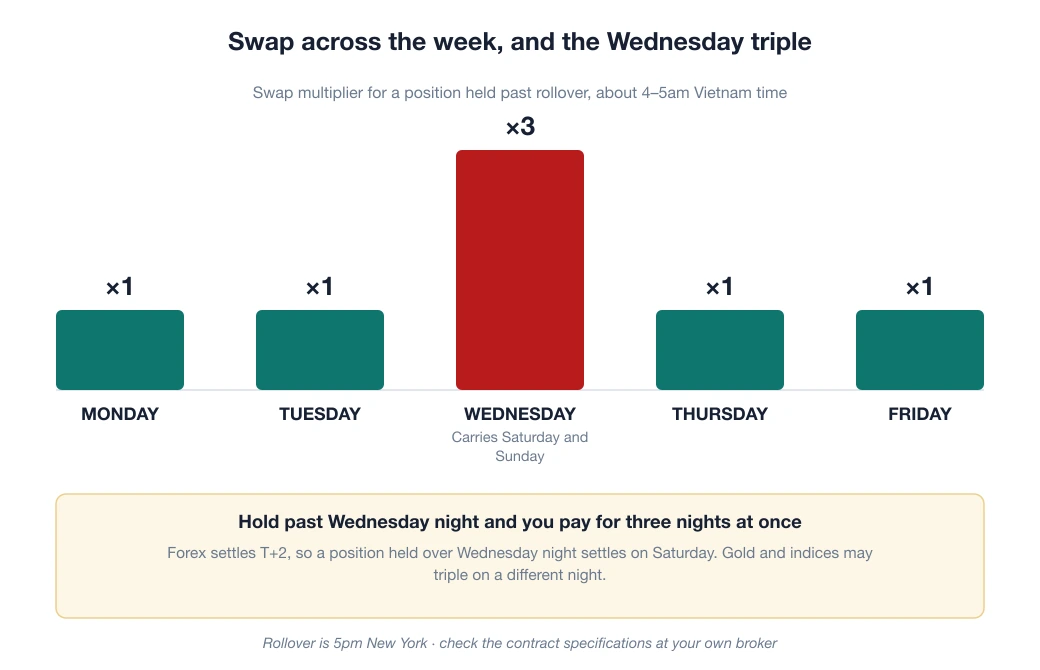
The practical consequence: if your position has heavy negative swap and you are torn between closing and holding, Wednesday evening is the “cheap” deadline. Stay past that night and you pay for all three days.
Some products, such as gold or indices, may load it onto a different night. Check each broker’s contract specifications.
Check swap BEFORE you enter: 20 seconds on MT5
- Market Watch → right-click the pair → Specification.
- Look at the two lines Swap Long (the fee for holding a buy) and Swap Short (for a sell). The unit is usually points per night.
- Quick conversion to money: a swap of -8 points on 0.1 lot ≈ -0.8 USD per night, about 24 USD if you hold for a month; -80 points on exotic pairs is ten times that.
A habit worth building: traders who hold positions for several days should add the expected swap to the profit and loss equation from the planning stage.
If your target is 100 pips and swap eats 15 pips over two weeks of holding, your real reward-to-risk ratio is quite different from the number on paper. A pip is the smallest price step, usually the fourth decimal place.
The question keeps coming up in trading groups

The person asking describes exactly the group that pays swap hardest: holding for a few days, which means past rollover several times, yet not long enough for the fee to become small next to the price move.
The three approaches that follow are aimed squarely at that group.
Three legitimate ways to deal with swap
- Trade intraday: close before rollover (4–5am Vietnam time), no overnight, no swap. This suits scalpers and day traders, and it is one reason many people choose this style.
- Pick the side the swap favours when your analysis allows it: if two setups are equally good and one side earns positive swap, take that side. This is also the basis of the carry trade (holding positions to earn the rate difference), but a real carry trade needs a deep grasp of macroeconomics, so follow the economic news section before trying it.
- Swap-free (Islamic) accounts: many brokers offer them, but read the conditions carefully: they usually replace swap with a fixed administration fee after X nights, or limit the products. “Free” is rarely completely free; I set out the swap-free conditions in the individual broker reviews.
Quick questions
“Why was money taken from my account while I was asleep?” Check your trade history, in the swap column: if you held a position past about 4–5am Vietnam time, that is rollover, not the broker charging at random. If the charge is unusually large on a Thursday morning, it is the Wednesday-night triple swap.
“Can swap ever be a main source of income?” For a retail trader with small capital, not realistically: the positive swap margin is far too thin compared with the risk of price moves. Treat positive swap as a “tip”, not as a strategy.
Working out swap in money: the formula and one full example
Brokers list swap in points per night in Specification. Converting it to money takes 3 steps, and doing it once is enough to remember it:
- The value of 1 point at your lot size: at 0.1 lot, 1 pip ≈ 1 USD → 1 point (1/10 of a pip) ≈ 0.1 USD.
- Count the “charged nights”: holding from Monday this week to Friday next week crosses the daily rollover 9 times (Saturday and Sunday nights are not charged separately), but the two Wednesday nights count triple → 9 + 2×2 = 13 charged nights.
- Multiply: Specification shows Swap Short = -6.5 points → 6.5 × 0.1 USD × 13 ≈ -8.45 USD for a 0.1-lot position held for almost two weeks.
More than 8 USD, the equivalent of more than 8 pips of profit gone without a sound, on a 0.1-lot trade whose target may be only 60 to 80 pips. A lot is the unit of trade size; 1 standard lot equals 100,000 units.
The key point is not the specific number, because every broker is different. It is the HABIT.
Before every swing trade: take the swap points from Specification, run the three steps above for your expected holding time, then add the result straight into your profit and loss calculation.
Negative swap on both sides: the catch few people notice
Intuition says that if one side is negative, the other must be positive.
In practice, at most brokers both sides are negative on many pairs.
The reason is that the broker adds its own fee, called the markup, to the underlying swap, and that wipes out the already thin positive side. Only pairs with a large interest rate gap still have a genuinely positive side.
So do not listen to anyone who says “just trade the positive-swap side and you will be saving money” until you have opened the Specification at the broker you actually use. Every broker’s markup is different.
This is also a broker comparison criterion few people use, yet a very real one for swing traders: on the same GBP/JPY pair, negative swap can differ by several tens of percent between brokers.
For Muslim traders, and for those who “borrow” Islamic accounts
Islamic accounts, also called swap-free accounts, were created for Muslim traders, because their religion forbids receiving and paying interest.
In recent years there has been a trend of non-Muslim traders signing up for this account type to avoid swap. Brokers have responded.
Some require confirmation of religion. More common is a replacement fee designed to make dodging swap pointless: no swap for the first few nights, then a fixed administration fee, often MORE EXPENSIVE than swap if you hold for long.
If you genuinely need a swap-free account, compare each broker’s specific conditions in the broker reviews.
If you only mean to dodge the fee, think again. For most swing strategies lasting a few days, swap is a much smaller cost than the spread, and smaller than one bad entry decision. The spread is the gap between the buy and the sell price, the fee you pay on every trade.
Frequently asked questions
What time is swap charged in Vietnam time?
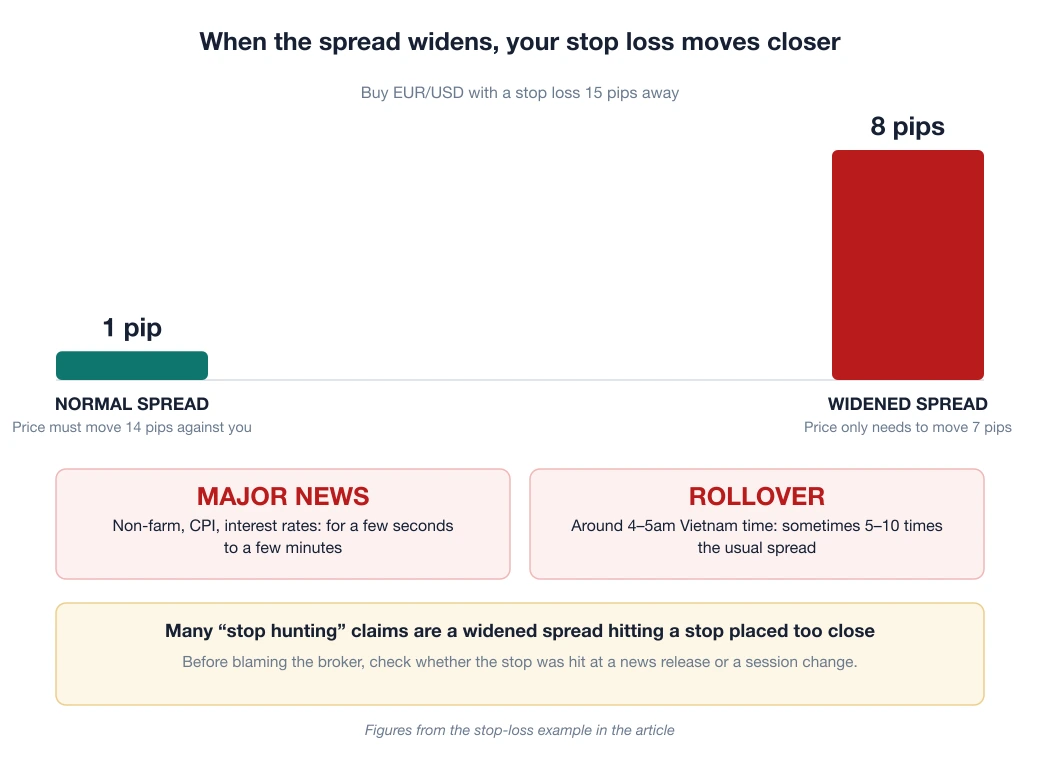
At rollover, 5pm New York, which is about 4am or 5am Vietnam time depending on the season. This is also when the spread widens most during the day, so avoid entering or exiting trades around this time.
Why is swap tripled on Wednesday night?
Because of T+2 settlement: a position held over Wednesday night has a settlement date that falls on the weekend, so the broker combines the swap for Saturday and Sunday into that night.
Is a swap-free account really free?
Not quite. Most brokers replace swap with a fixed administration fee after a certain number of nights, or limit the pairs you can trade. Read each broker’s conditions carefully before choosing.
- Exness, “About overnight fees” (Vietnamese edition, broker updated 31/07/2026): overnight fees are charged or credited at 21:00 GMT+0 in summer and 22:00 GMT+0 in winter, about 4 to 5am Vietnam time; some days are charged triple
- ESMA (27/03/2018). Overnight fees accumulate on leveraged positions; ESMA capped leverage at 30:1 on major currency pairs and required negative balance protection per account
Spotted something inaccurate? Tell us and we will check it and publish a correction.