
How much money do you need to start trading forex?
This question is almost always asked the wrong way. Beginners ask “how much is enough to make money?”. The number you actually need to find is “how much could I lose without it changing anything in my life?”.
For most Vietnamese beginners, somewhere around 50–200 USD answers the second question: enough to feel real, small enough to lose without pain. But the right number for you comes from an expectation calculation, not from anyone’s advice.
The expectation maths: do it before you deposit a single dollar
Suppose you trade well consistently. That means 2–5% a month, a level that is already very high if you can hold it steadily for years (if anyone promises more than that, reread the article is forex a scam):

- Capital of 100 USD → expected profit of 2–5 USD a month. About two cups of coffee.
- Capital of 1,000 USD → 20–50 USD a month. A phone bill.
- Capital of 10,000 USD → 200–500 USD a month. It starts to mean something, but first you need 10,000 USD you can spare and years of experience.
What does this maths tell you? In the early stage, profit is not the goal; skill is the asset you are building. Small capital is cheap tuition for the most expensive course there is: yourself, under the pressure of real money.
Once you understand this, you stop asking “how much do I need to live off forex?” in your first month. The right question is “how much do I need to LEARN without it hurting?”.
Capital by stage, with realistic expectations
| Stage | Suggested capital | Real goal | Suitable tools |
|---|---|---|---|
| Apprentice (months 1–3) | 50–100 USD | Get used to the process, survive, keep a trade journal | A Cent account (HFM) or Micro (XM) |
| Building a system (months 3–12) | 200–500 USD | One fixed strategy, statistics on 100+ trades, stop-loss discipline | Standard/Ultra Low, 0.01–0.05 lot |
| Serious (year 2+) | 1,000 USD+ | Consistent profit after costs, managing capital as a profession | Low-cost Raw/ECN accounts (IC Markets, Vantage) |
The condition for moving up a stage is not “enough money” but enough data: move past stage 1 once you have gone 3 months without blowing the account. Move past stage 2 once statistics on 100 trades show your system has a real edge after costs.
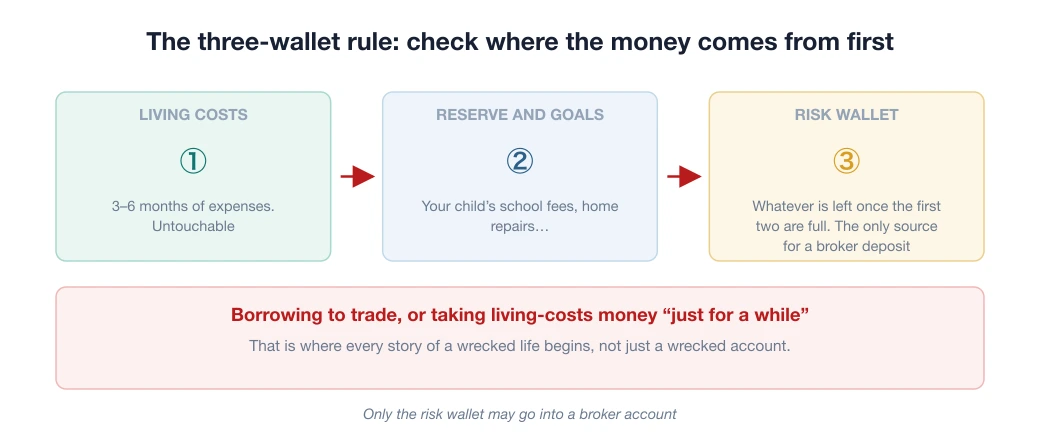
The “three wallets” rule: check where the money comes from before you deposit
Your money should be split into 3 wallets in order of priority: a living-costs wallet (3–6 months of expenses, untouchable), a reserve/goals wallet (your child’s school fees, home repairs…), and a risk wallet, whatever is left once the other two are full. Money you deposit with a forex broker must come ONLY from the third wallet.
Borrowing to trade forex, or taking living-costs money “just for a while”, is where every story of a wrecked life begins, not just a wrecked account.
If you are still weighing whether to enter this market at all, read what forex is before you think about a number.
Depositing too much is more dangerous than depositing too little
Intuition says “more capital is safer”; for beginners, the reality is the opposite. Large capital from the start creates psychological pressure on every trade (moving the stop, holding a loser out of “regret”), the illusion that you have to “do something” worthy of the capital (overtrading), and a cost for every beginner’s mistake multiplied tens of times.
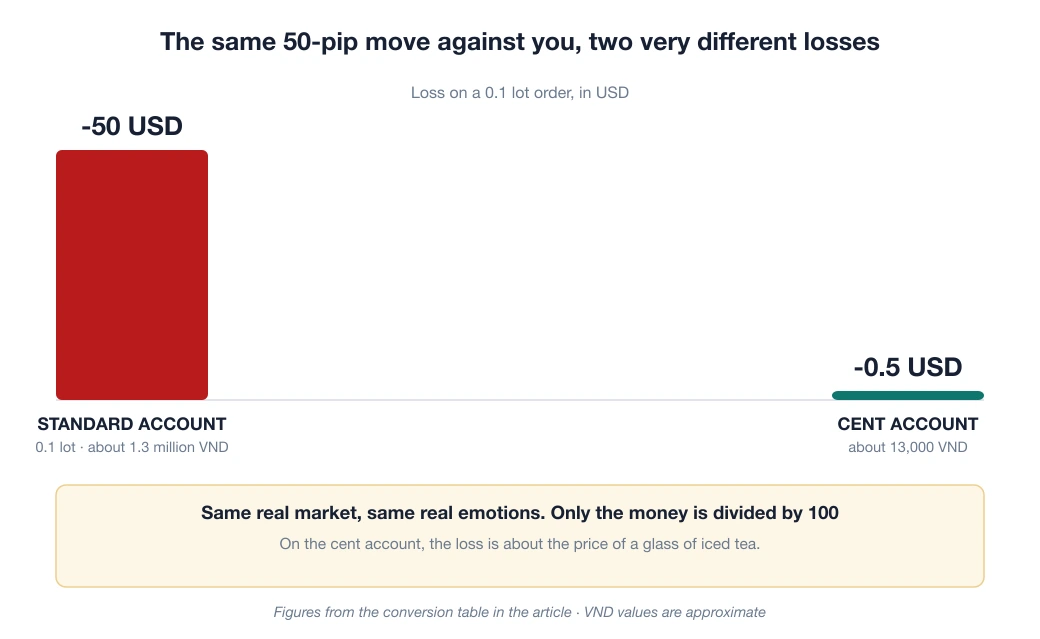
Someone who deposits 100 USD learns the same lessons as someone who deposits 5,000 USD, only 50 times cheaper. Skill does not grow in proportion to the amount deposited; time survived in the market does.
How to start with 50–200 USD: a concrete roadmap
- Choose a broker suited to small capital using the ranking of brokers for small capital. The criteria: a low minimum deposit, a Cent/Micro account and a low minimum withdrawal (HFM allowing withdrawals from 5 USD is a typical example).
- Risk 1–2% of the account on each trade; with 100 USD that is 1–2 USD per trade. Work out the volume with the formula risk ÷ (stop loss × pip value) rather than in your head.
- Set a 3-month “tuition limit”, for example 150 USD. If it is all gone, stop, reread your journal and trade on demo until you find the mistake, without depositing more out of momentum. This limit turns failure into data instead of a disaster.
- Make a test withdrawal early (in week 2) to verify the whole cycle, a habit we repeat in every guide to opening a first forex account.
Frequently asked questions
Can you trade forex with 10 USD?
Yes. XM accepts deposits from 5 USD, Exness sets a low first deposit for Standard that depends on the payment method, and a cent account lets you trade very small volumes. But with 10 USD, the goal should be learning and getting used to the process, not making a profit.
How much capital do you need to live off forex?
There is no fixed number, and the expectation itself is a risk. Living off trading takes large capital, a consistent win rate over many years and iron discipline, and very few people achieve it. Beginners should treat forex as a skill that needs long-term investment, not a way to get rich quickly.
How much should I deposit the first time?
Only deposit an amount you can fully accept losing. 100–200 USD is usually reasonable for learning while you apply risk management. Increase your capital gradually once you have stable results on a small account.
- Exness, "What is the minimum amount needed to start trading?" (Vietnamese edition, broker updated 30/07/2026): the account type with the smallest minimum volume is Standard Cent
- Exness, "Standard Cent account" (Vietnamese edition, broker updated 14/08/2026): 1 cent lot = 1,000 USD, equal to 0.01 standard lot; balance displayed in cents
- ESMA (27/03/2018). Retail CFD leverage limits of 30:1 down to 2:1, a 50% margin close-out and negative balance protection; 74–89% of retail accounts lose money
Spotted something inaccurate? Tell us and we will check it and publish a correction.