
How to open an IC Markets account and pick Raw Spread
Opening an IC Markets account is a bit like a promotion in a trader's career: you usually do not start here, you move here.
You move here when your trading frequency rises, when you start running an EA. A pip is the smallest price step, usually the fourth decimal place. That is when every pip of cost starts to show up in your end-of-month result.
So this guide is not written as "a great broker for everyone". The first part helps you decide whether to open an account at all, the middle part picks the account type with numbers, and only the last part covers the steps, with a "migration" checklist for anyone moving over from another broker.
Who should NOT open an IC Markets account (said up front to save you time)
- Complete beginners still learning. IC Markets has no minimum deposit, so small capital is not turned away at the door. But every advantage the broker has (raw spreads, fast execution, deep liquidity) only pays off when you trade enough. Starting at XM (from 5 USD, training in Vietnamese) or Exness (a low first deposit that depends on the payment method) makes more sense, then come back later. The broker is not going anywhere.
- People who place a few trades a month. Do the sum: the cost gap between IC Markets and a mainstream broker is about 0.3–0.5 pip per trade, or 3–5 USD per lot. Five trades of 0.1 lot a month saves you ~2 USD. That is not worth switching brokers over because you "heard the spread is low".
- People who need bonuses and promotions to stay motivated. IC Markets has almost no bonus culture; the broker competes purely on fees. If you like deposit bonuses, the segment where HFM/XM sit suits you better.
On the other hand, if you scalp, run an EA, or place ten or more trades a week, this is your ground.
Run the same sum with 50 trades of 0.5 lot a month (a lot is the unit of trade size, one standard lot being 100,000 units) and the fee gap becomes 75–125 USD a month. Now it is worth it.
Pick the account type by total cost, not by spread
The classic mistake is to look at "0.0 pip" and forget the commission. Compare the all-in cost of one round-turn lot of EUR/USD:
| Account | Spread | Round-turn commission | Estimated all-in |
|---|---|---|---|
| Raw Spread (MT4/MT5) | from 0.0 pip | ~7 USD/lot (3.5 × 2 sides) | ≈ 0.7–0.8 pip |
| Raw (cTrader) | from 0.0 pip | ~6 USD/lot (3.0/100k × 2) | ≈ 0.6–0.7 pip |
| Standard | from 0.8 pip | 0 | from 0.8 pip |
At the lowest levels the broker publishes, the two are close: Raw costs about 0.7 pip in commission on top of the raw spread, Standard starts at 0.8 pip. The difference is how the fee is charged: Raw splits out a fixed commission, Standard folds everything into the spread.
Your real cost only shows after 20 to 30 trades, when you divide total fees by total lots.
What about MT-Raw or cTrader-Raw? The fee gap is small (cTrader is ~1 USD/lot cheaper). The real decision is about the platform:
- cTrader: transparent depth of market, a modern interface, good bulk order management. Discretionary traders who trade often tend to be won over after a week's trial.
- MT4/MT5: required if you use MetaTrader EAs or indicators (the vast majority of commercial EAs are written for MT). The largest community and the most documentation.
If you are undecided, open Raw MT5 first and switch to or add cTrader later under the same profile. It takes a few minutes.
Opening the account (10 minutes)
- Go to the official IC Markets site → Start Trading / open a live account. Enter your full name exactly as on your passport or ID card; it is an international broker, so the form uses names without Vietnamese diacritics.
- Choose the platform (decided above), the Raw account type and USD as the base currency.
- Answer the investment experience questionnaire honestly. It is a compliance requirement of the licence, not an exam.
- KYC: an ID document plus proof of address (a statement or bill from the last 3–6 months, in the same name). Approval usually takes 1 business day.
- Deposit from 200 USD by card, bank transfer, PayPal or e-wallet, or VND Internet Banking. Details of each channel and the 9 a.m. Vietnam time withdrawal cutoff rule are in the Vietnamese guide to IC Markets deposits and withdrawals.
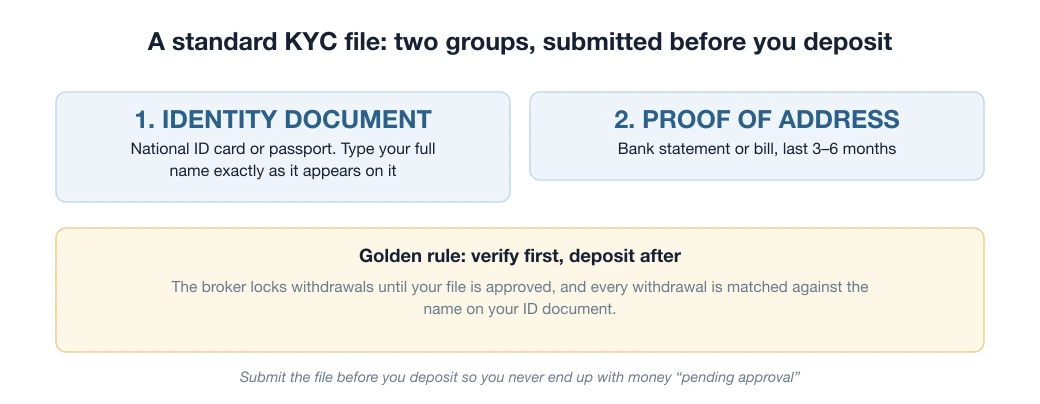
Follow the steps above on the real screen. Opening the registration form in a separate tab and checking it against this guide is faster than reading everything first and then doing it. If you have never traded, choose a demo account first.
Remember to settle the account type before you click register. That decision affects your costs more than every other step combined.
The "migration" checklist: for anyone moving from another broker
Most people who open an IC Markets account are already trading at another broker. A few lessons for a smooth move:
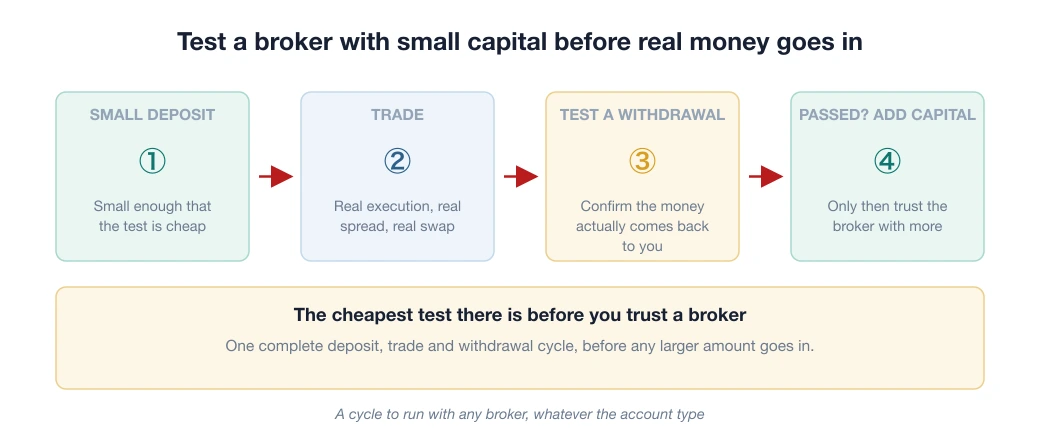
- Do not close the old broker yet. Run both in parallel for 2–4 weeks: small capital at IC Markets, the rest where it is. Compare execution, spreads during news hours and the withdrawal experience, and only then move fully.
- Running an EA? Backtest it again on IC Markets data. A raw spread plus commission changes the EA's break-even parameters compared with a broker that bundles cost into the spread. Many EAs that looked "good" at the old broker turn bad under the new fee structure, and the reverse.
- Measure your own real cost after 20–30 trades: total fees (spread + commission) divided by total lots. That figure is your "real spread". Compare it with the table above to see whether you are trading in hours with good liquidity.
- Serious scalpers and EA users: consider a VPS located near the broker's server. For latency-sensitive strategies, a few dozen milliseconds is real money.
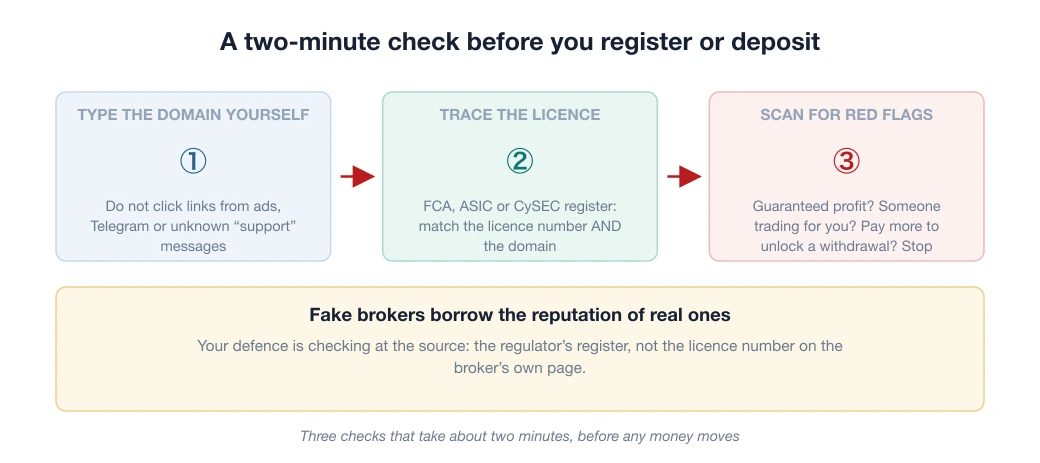
Before you click, finish reading the IC Markets review 2026, which has a screenshot of the CySEC licence taken directly from the regulator's site, and the head-to-head IC Markets vs Pepperstone, its closest rival in the ECN segment (orders passed straight to the market, not through the broker's dealing desk).
This is a decision based on numbers, and we have laid all the numbers out.
Frequently asked questions
What is the IC Markets minimum deposit?
IC Markets has no minimum deposit for the Raw Spread, cTrader and Standard accounts. Small capital can get in, but the raw-spread and fixed-commission advantage only shows when you trade a lot.
Should I choose the IC Markets Raw Spread or Standard account?
Raw Spread has spreads from 0.0 pip but charges commission of 3.5 USD per lot per side (7 USD round trip), which works best for people who trade a lot. Standard has no commission and spreads from 0.8 pip, which is simpler for beginners. Compare the total cost (spread + commission).
Does IC Markets suit EAs and scalping?
Very well. IC Markets has ECN infrastructure and fast execution, allows scalping and EAs, and supports both cTrader and VPS, which is why the broker suits automated trading.
- IC Markets. Trading accounts overview (read 20/10/2026): no minimum deposit for Raw Spread, cTrader and Standard; Raw Spread commission 3.5 USD per lot per side; Standard spread from 0.8 pip
- CFTC (US). Advises checking a firm's registration status before opening an account; the legal entity name in the contract must match the name on the licence
Spotted something inaccurate? Tell us and we will check it and publish a correction.