
IC Markets deposits and withdrawals from Vietnam
There is one number new IC Markets users often overlook: 9 a.m.
The real cutoff is 12:00 noon Sydney time, which works out to 8 or 9 a.m. in Vietnam depending on the season, because Australia has daylight saving time and Vietnam does not (the date-by-date conversion table is just below).
Place your request before that cutoff and it is processed the same business day. Any later and it rolls over to the next day automatically. It is only a time-zone detail, but it decides whether you get your money on Tuesday or on Wednesday.
A sum of money goes through three stages: how it gets into the broker, where it sits, and which route brings it back to your pocket fastest.
First: IC Markets sets no minimum deposit
IC Markets has no minimum deposit for the Raw Spread, cTrader and Standard accounts. Small capital is not turned away at the door, so the question worth asking moves to the fees and timing of each deposit and withdrawal channel.
What the broker competes on is ECN infrastructure (orders go straight to the market, not through the broker's own dealing desk) together with deep liquidity (how easily you can buy or sell without the price jumping), which scalpers and EA traders pick as their “home”.
If you want to run a full deposit and withdrawal cycle with a very small amount, set it beside HFM, with withdrawals from 5 USD, and compare before you choose.
Stage 1: Depositing, which door to use?
IC Markets charges no internal deposit or withdrawal fees of any kind, so every cost (if there is one) sits with the bank or the payment gateway. Practical experience, channel by channel:
- Visa/Mastercard: the money arrives almost instantly. The one thing to watch: card-issuing banks in Vietnam usually charge a foreign-currency transaction fee. It stays “invisible” on the statement, so many people assume the broker charged it.
- Domestic Internet Banking (VND). IC Markets has a payment gateway for Vietnamese clients: you deposit in VND and it is converted at the exchange rate at the time of deposit. Convenient, but work out the rate you were given yourself. The gap against the market rate is this channel's “hidden fee”.
- PayPal/Skrill/Neteller: fast and clean, but only worth it if your wallet already holds money. Topping up the wallet from Vietnam means paying fees on top of fees.
- International bank transfer (SWIFT): for amounts of a few thousand USD and up. Intermediary banks can “bite off” a fee in each direction, and it takes 2–5 business days.
Stage 2. Inside the broker: the Secure Client Area
- Log in to the Secure Client Area → Funding → Deposit.
- Choose the trading account (Raw Spread cTrader or MT4/MT5). If you run several accounts, check the account number carefully: depositing into the wrong account is something you still see in trader groups.
- When done, open the platform and check the Balance. On cTrader the balance updates almost instantly.
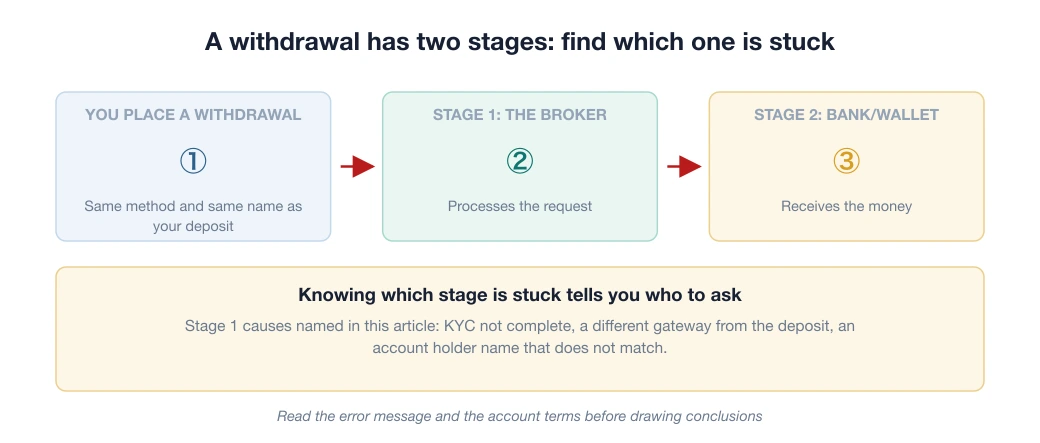
Stage 3: Withdrawing, a cutoff that shifts with the season, and the order of funds
A withdrawal at IC Markets goes through two independent steps that many people lump together and then misread as “the broker is slow”:
- The broker approves the request: before 12:00 noon Australian time (≈ 8–9 a.m. in Vietnam depending on the season, because Australia has daylight saving time) → approved the same day. After that → the next day.
- The money moves: this depends on the channel. Cards take 2–5 business days to show on the statement (the card network's refund mechanism), SWIFT takes 2–5 days plus intermediary fees, and e-wallets are almost immediate after approval.
Why some say 8 a.m., others say 9 a.m., and both are right
In a public discussion among Vietnamese traders (August 2026), a new IC Markets user asked why a withdrawal made a day earlier had still not arrived.
The top comment (sorted by “Most relevant”) says the cutoff is 8 a.m. I wrote 9 a.m. above. Nobody is wrong, and the reason is worth knowing, because it decides whether you get your money today or tomorrow.

The broker's real cutoff is 12:00 noon Sydney time. But Australia has daylight saving time and Vietnam does not, so the conversion to Vietnam time changes twice a year:
| Period (2026) | Sydney time | Cutoff in Vietnam time |
|---|---|---|
| 01/01 → 05/04 | AEDT (UTC+11) | 08:00 |
| 05/04 → 04/10 | AEST (UTC+10) | 09:00 |
| 04/10 → 31/12 | AEDT (UTC+11) | 08:00 |
Daylight saving time in Australia starts on the first Sunday of October and ends on the first Sunday of April. The exact dates change from year to year, so check again in early April and early October.
The way to avoid remembering any of this: place your withdrawal before 7:30 a.m. and you are safe all year round, whatever the season. Anyone who has lost a day by placing a request at 8:15 in November will understand why this detail is worth remembering.
Weekends are no exception. A request placed on Saturday or Sunday waits until Monday morning to join the approval queue. This is what makes many people think the broker is “holding their money”, when in fact their turn simply has not come yet.

Then there is the international anti-money-laundering rule that every regulated broker applies: your original capital goes back to the source you deposited from first, and only profit above your deposits can be sent through another channel.
Deposit 500 USD by card, the account grows to 800 USD → the first 500 goes back to the card, and the remaining 300 goes wherever you choose.
Three real situations worth knowing in advance
- “I need to withdraw urgently at the weekend”: the broker does not approve requests on Saturday or Sunday. A request placed on Friday evening after the cutoff goes in on Monday morning, Australian time. Traders often forget this before long holidays.
- “I'll withdraw to an e-wallet for speed, but I deposited by card”: you can't, because of the AML rule above. If you want fast e-wallet withdrawals later, deposit part of your money through the wallet from the start.
- “My EA runs overnight and I need to deposit urgently at 2 a.m.”: cards and crypto still work 24/7; only withdrawal approval follows Australian business hours. Deposits through these channels are instant at any time.
Still weighing up ECN brokers? The full fee table and regulatory details are in the IC Markets review 2026, and a direct comparison with another ECN broker is in IC Markets vs Pepperstone.
Payment conditions can change. Before a large transaction, open the official Funding page and check it once more.
IC Markets' official website
The official IC Markets website is now ic.com. Check the domain carefully before entering your login details: impostors set up lookalike domains; see the warning about fake sites posing as reputable brokers.
Before a large deposit, look at the fee table shown inside your own Personal Area. That is the table that actually applies to your account.
The Vietnamese deposit page (17/03/2026)
The page advertises more than 14 deposit options in 10 base currencies. Nine of the channels on that list:
| Deposit channel | Currency received | Processing time |
|---|---|---|
| Vietnamese Internet Banking | USD | Instant |
| Credit / debit card | AUD, USD, JPY, EUR, NZD, SGD, GBP, CAD | Instant |
| PayPal | The 8 currencies above, plus HKD and CHF | Instant |
| Neteller | USD, AUD, GBP, EUR, CAD, SGD, JPY | Instant |
| Skrill | AUD, USD, JPY, EUR, SGD, GBP | Instant |
| FasaPay | USD | Instant |
| Cryptocurrency | BTC, ETH, USDC, USDT | Instant |
| Wire transfer | 9 currencies, including USD and EUR | 2–5 business days |
| Broker to broker | 10 currencies | 2–5 business days |
The first row of the table says the most. The broker does open a Vietnamese Internet Banking channel with instant processing, but the currency received is listed as USD. Check it against the page's list of 10 base currencies, AUD, USD, EUR, CAD, GBP, SGD, NZD, JPY, HKD and CHF, and VND is not there.
In practice, the VND to USD conversion happens at the payment intermediary, not at the broker. The exchange rate you get at that step sits outside every fee table the broker publishes, so when you compare costs between brokers, this gap does not show up anywhere.
There is only one way to find out how much it is: deposit a small amount, then compare the USD that reaches your account with the VND that left your bank.
Three other terms on that page, which IC Markets states word for word: the broker charges no deposit or withdrawal fees. But intermediary banks may charge, and the broker is not responsible for that part.
The broker does not accept third-party payments: deposits must come from an account in your own name. Client money is held in segregated accounts at major international banks.
The third-party rule is where people get stuck most often in practice. Deposit through a relative's account and your withdrawal will run into trouble later, because the money has to go back to the exact source it came from.
Source: IC Markets' Vietnamese deposit page, version of 17/03/2026. The conditions that apply to your account are the ones shown in your Personal Area.
Before a large withdrawal, open the deposit and withdrawal page once more.
Frequently asked questions
What is the minimum deposit at IC Markets?
IC Markets has no minimum deposit for the Raw Spread, cTrader and Standard accounts. The conditions of each payment channel are in the deposit channel table in this article.
Does IC Markets charge withdrawal fees?
The broker charges no internal deposit or withdrawal fees. International bank transfers alone may incur intermediary bank fees, which are charged by the banks.
How long does an IC Markets withdrawal to a Vietnamese bank take?
A withdrawal placed before 12:00 Australian time is processed by the broker the same day; the money usually reaches a Vietnamese account after 2–5 business days, depending on the channel and the receiving bank.
Why am I asked to send a withdrawal back to the card I deposited with?
This is the international anti-money-laundering (AML) rule: money must return to the source it was deposited from first, and only profit above your deposits can be withdrawn through another channel.
- IC Markets. Trading accounts overview (read 20/10/2026): no minimum deposit for Raw Spread, cTrader and Standard; Raw Spread commission 3.5 USD per lot per side; Standard spread from 0.8 pip
- IC Markets, Vietnamese deposit page (version of 17/03/2026)
- IC Markets. Funding (official page)
- BrokerChooser. How to withdraw money from IC Markets
Spotted something inaccurate? Tell us and we will check it and publish a correction.