
Is forex a scam? The market is real. Much around it is not
The word “forex” is being used for two very different things, and most of the argument around it starts exactly there.
The first is the foreign exchange market, where banks and global companies exchange currencies with trillions of dollars of liquidity a day.
How that market works, who trades with whom and how a price forms, is in what forex is. Liquidity means how easily something can be bought or sold without the price jumping.
It is real, and it deceives nobody.
The second is what most people in Vietnam meet first: a Zalo group, a “mentor”, an invitation to deposit.
The distance between those two is the whole subject here.
Why a real market attracts so much fraud
Three features of forex make it perfect bait.
- Hard to verify. A beginner cannot tell a real broker from a fake one, or a real order from a number drawn on a screen.
- An easy story to sell. “A multi-trillion dollar market, and you only need to catch 20 pips a day.”
- A legal grey area in Vietnam. Victims hesitate to report, and the people running the fraud know it. See the legal status of forex in Vietnam.
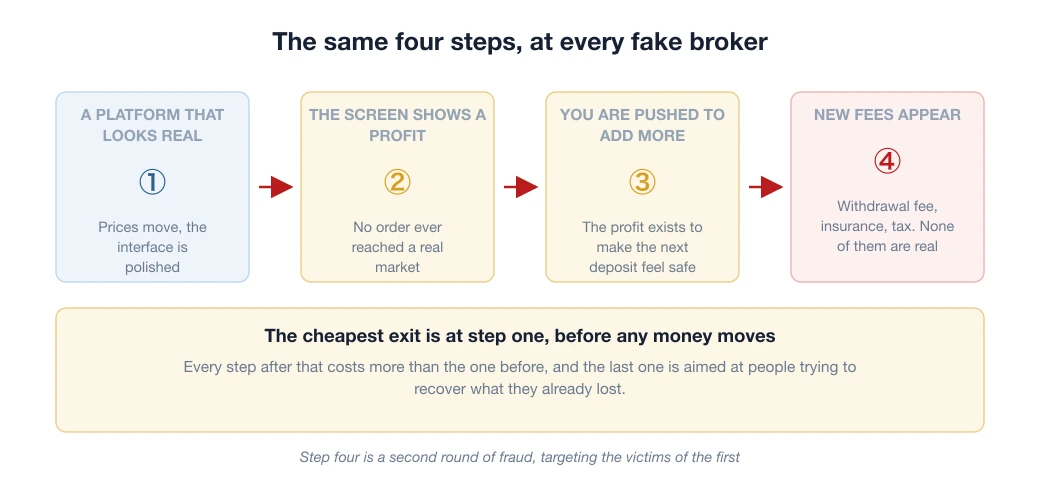
Four kinds of fraud that wear forex as a costume
- Fake or self-built platforms. The website looks professional, prices move, the account shows a profit. All of it is software: no order ever reaches a real market, and the “profit” is only a number to pull in the next deposit. Read why traders get pushed into depositing more to recognise the script early. Vietnamese police have named Fnory.com and a long list of similar platforms. Identifying marks: a domain a few months old, no licence you can look up, and pressure to send money to a personal bank account inside the country.
- Clones of real brands. They imitate the names Exness, OANDA, Tickmill, FXCM and others to borrow trust that already exists. The victim “did their own research”, looked up the real broker, then deposited with the fake one. Both the FCA and Vietnamese police have had to publish clone lists. Full identification method and the cases already named: our warning on cloned brokers.
- Discretionary management, guaranteed returns, financial MLM. “Send your capital, an expert trades it for you, 5 to 15% a month, bring in other people and earn commission.” This is a classic Ponzi scheme in forex clothing: the earlier investors are paid out of the later investors’ capital, and when it stops everyone loses. Every large forex case in Vietnam belongs to this group. The iron rule: a guaranteed return means fraud, with no exception anywhere in a real financial market.
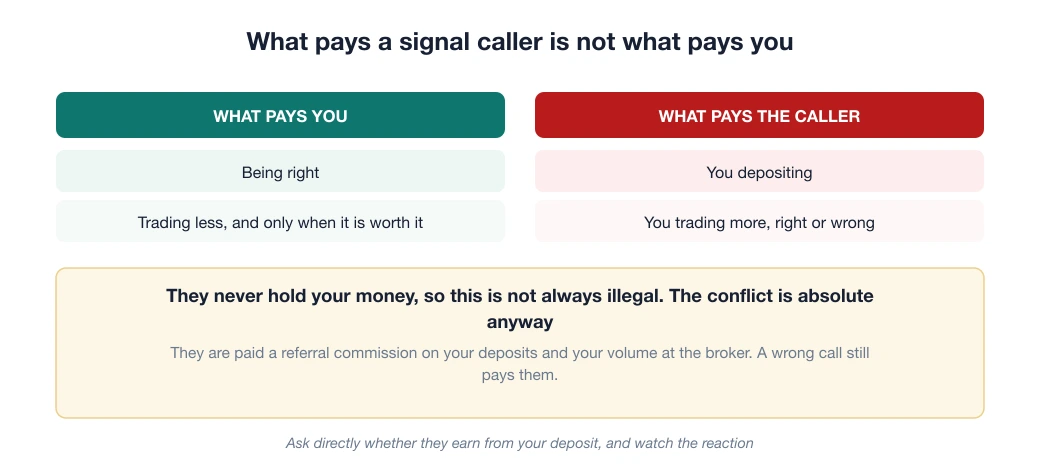
- Signal groups and VIP mentors. More sophisticated, because they never hold your money. They earn a referral commission on your deposits and your trading volume at the broker. The mentor calls it wrong, you lose money, the mentor is still paid. Not necessarily illegal in every case, but the conflict of interest is absolute: what pays the person calling trades is that you trade a lot, not that you trade well.
So what does the real part of forex look like?
It does not appear in advertising, because it promises nothing.
You learn to analyse the market yourself, with our free technical analysis series. You trade on an account in your own name, at a broker holding a strong licence such as the FCA, ASIC or CySEC; see our vetted ranking.
You accept that some months are green and some are red. And you treat the figure European brokers are required to publish, that most retail accounts lose money, as a serious warning rather than a formality.
Nobody commits to anything. That absence of a promise is the mark of a real market.
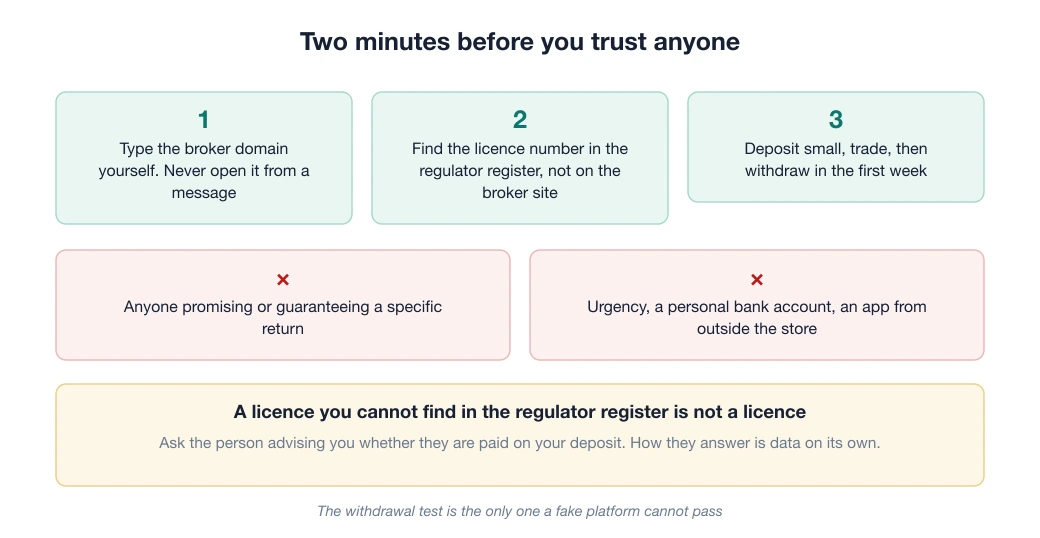
A two-minute check before you trust anyone
- Can the licence be traced to its source on the regulator’s own website (the FCA Register, ASIC Connect and so on)? Do the licence number and the domain match the record?
- Is anyone promising or guaranteeing a specific return? Stop there. The iron rule above has no exceptions.
- Are you being hurried with “the opportunity is only today”, asked to transfer to a personal bank account, or told to install an app from outside the app store? Stop.
- Does the person advising you earn money from your deposit, through commission or an affiliate arrangement? Ask directly. How they react tells you a great deal.
- Can you test with a small amount and actually withdraw it? Deposit small, place a few trades, then withdraw inside the first week, before you deposit anything more.
Already caught: what to do right now
- Stop depositing, absolutely, including any “withdrawal fee”, “insurance fee” or “tax” the other side invents. That is a second round of fraud, aimed squarely at the urge to win it back.
- Collect the evidence: bank statements, screenshots of the messages and group chats, the website details and the account that received the money.
- Report to the police early. Several networks have been broken up because enough reports were filed. Staying quiet out of embarrassment only keeps the people running it safer.
- Be wary of “fund recovery services”. That is a third wave, hunting the victims of the first.
If you want to carry on with your eyes open, start with the guide to opening an account as a beginner, which contains the “are you ready” checklist we suggest reading before you even choose a broker.
Frequently asked questions
Is forex a multi-level marketing scheme?
Forex itself is not. But many frauds using the forex name do run as multi-level schemes: they pay you a commission when you pull other people in to deposit. If a “forex opportunity” is more interested in recruiting than in trading, that is the sign.
Why do so many people lose money trading forex?
Mostly from thin knowledge, overusing high leverage, no risk management, or falling into a fake platform or a discretionary management fraud. The real forex market is hard and genuinely risky, and most beginners lose in the early stage because the discipline is not there yet.
How can I tell whether a broker is trustworthy?
Check the licence (FCA, ASIC, CySEC), how long it has operated, whether fees are stated openly, and whether withdrawals actually work. Be wary of any broker promising a fixed return, or one whose licence you cannot look up. Our vetted ranking of brokers is a starting point.
- CFTC (United States). Forex fraud advisory: the signs include promises that there is “no down market”, pressure to send money quickly, and difficulty finding background information on the person or firm. The CFTC recommends checking registration status before taking part
- Vietnam Government Portal (19/08/2021). The Ministry of Public Security (A05) warns that binary option platforms are running unlicensed multi-level businesses and appropriating assets in Vietnam
Spotted something inaccurate? Tell us and we will check it and publish a correction.