
Letting someone trade for you: 41 offers under one post
Whoever holds your money to trade on your behalf sits under no regulator. Neither does the broker they use: the State Bank of Vietnam states it has not licensed any forex broker in Vietnam.
So money you hand to an individual for them to "trade and split the profit" sits outside every framework the law protects. But rather than stop at that sentence, I did something else: I counted the comment section under one post asking exactly this question.
In August 2026, someone posted publicly in a Vietnamese trader group that they had lost roughly 560,000 USD over two years, and closed with a question: "should I deposit and let someone trade for me and split the profit?"

I counted the 129 comments below it by hand. The result is the answer on its own.
41 sales pitches, 9 warnings
Someone who had just lost over half a million dollars, describing themselves as "no longer in a state of mind to play", asked whether to hand money to a stranger. Of the 129 comments:
- 41 (32%) were offers of a service: managing the account, selling an automated bot, selling signals, inviting "cooperation", leaving a Zalo number or proposing to meet in person.
- 9 (7%) advised against handing money to anyone.
- The rest were fellow sufferers, expressions of sympathy, or technical discussion.
Pitches outnumbered warnings by 4.6 to one. The person asking walked into the comment section looking for advice, and what they mostly met was a queue already formed.
This is the part most worth noting, and it needs nobody's judgement: the frequency of the pitches is itself the answer to the question.
If handing your account to someone else really produced steady returns the way the pitches claim, anyone with that ability would use their own capital. One comment in the group put it exactly: "if he were that good he would trade his own money, why would he need to solicit yours".
Auditing the numbers that were promised
Of the 41 pitches, 11 quoted a specific return. You do not need to know who made the promise; compounding the figure is enough:
| Return promised | 10,000 USD becomes, over that period |
|---|---|
| "Bot runs at 10% a day", compounded over 2 months | ≈ 3 million USD |
| "I run the account at 30% a day" (1 month) | ≈ 26 million USD |
| "5k capital, 300 USD a day" (≈6% a day, 1 year) | ≈ 21 billion USD |
| "Runs at 1 to 2% a day" (1 year) | ≈ 414,000 USD |
| "Steady 20% a month" (1 year) | ≈ 89,000 USD |
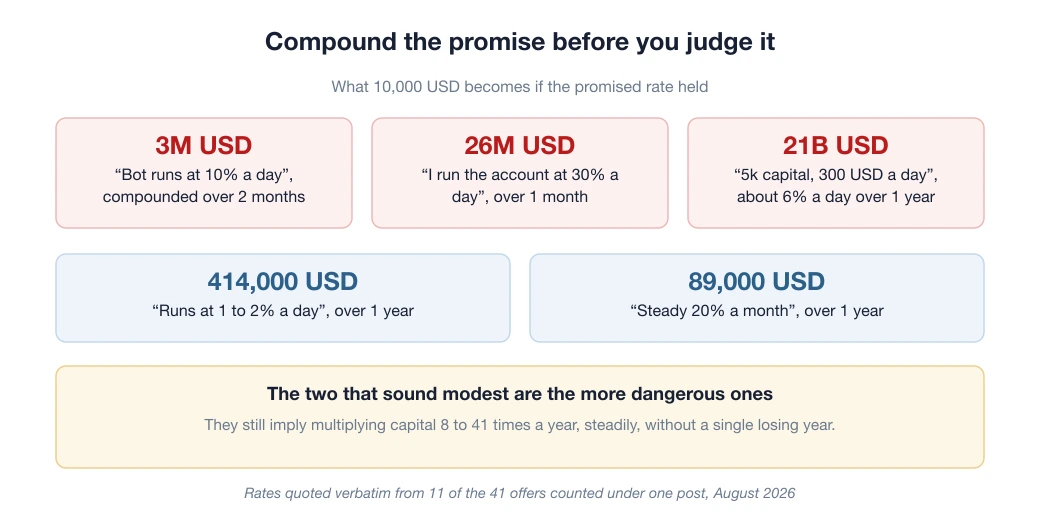
Look at the third row: if that rate were real and sustained, the person promising it would pass the wealth of the richest people on earth within a year, starting from ten thousand dollars. This multiplication does not require you to believe or disbelieve anyone; it requires a calculator.
The last two rows sound more "modest" and are therefore more dangerous: they are small enough to seem plausible. But they still imply multiplying capital 8 to 41 times a year, steadily, without a single losing year. No investment fund in the world publishes a curve like that.
The reassurance used repeatedly: "they only hold MT5, they cannot withdraw"
Four separate comments used almost the same phrasing: the person managing the account only holds the MT5 login so they cannot deposit or withdraw, and therefore "you keep full control". One added a condition that sounds very responsible: "down 20% and we stop immediately".
That statement is technically true. And that is exactly where it misleads. An MT5 account allows placing orders, not withdrawing funds. But:
- Nobody needs to withdraw your money for you to lose all of it. A large enough position does it.
- A "down 20% and we stop" commitment has nothing to enforce it. No contract, no adjudicating body. The moment the account is down 20% is also the moment whoever is placing orders has the strongest incentive to double up and win it back.
- Some arrangements also earn from volume-based commission, so the more orders placed the better for whoever holds the account, regardless of whether you profit or lose. That mechanism is explained in introducers who skim your rebate.
Someone who had been a victim wrote in that same comment section, and the line is worth reading closely: "even if you give it to someone who cannot withdraw, only the MT5 login, nobody is going to try hard to make you win". The writer said they had blown 16,000 USD and had previously been defrauded through copy trading.
Three details showing this is organised activity
- Phone numbers written with separators to evade filters. One comment left a phone number with a full stop between every digit, in the form
0.x.x.x.x.x.x.x.x.x. We deliberately do not reproduce the real number. That way of writing has one purpose: avoiding the platform's automated detection. - Actively pulling the conversation out of public view. Many comments asked for a phone number rather than replying in the group, and one explained that the account was "under verification so it cannot reply to messages". Leaving the place where other people can read is the first step of almost every script.
- Screening by capital size. One comment set the condition outright: only taking people with capital from "500, 1 billion, several billion" VND, and "small capital I do not take". That is not helping. That is selecting clients by value.
What happened while the post was still being discussed
The person who asked replied in their own comment section, a few days apart:
"It is so hard to stop! I keep wanting to win it back! This past week I lost nearly another 100 million dong"
"Three weeks now and another 100 million gone!"
Which means the losses continued while the search for advice was going on. That is characteristic of this state: the most urgent problem is not choosing who to trust, it is stopping first.
Where this stands legally
Three things often get called by one name and need separating:
| Arrangement | Where the money sits | Note |
|---|---|---|
| Copy trading on the broker's platform | An account in your name | You can disconnect at any time. Still carries real loss risk, see the Vietnamese analysis of copy trading |
| Handing the MT5 login to an individual | An account in your name, but someone else places the orders | No contract, no adjudicating body. Lose the money and there is almost no way to recover it |
| Transferring money to an individual | Someone else's wallet | Highest risk. No forex broker is licensed by the State Bank, so no third party adjudicates |
Three sourced facts you can check yourself:
- In its report for a National Assembly questioning session (May 2025), the State Bank of Vietnam stated it has not licensed any forex trading platform in Vietnam, and that the activity of these platforms falls outside permitted foreign exchange operations.
- Also per the State Bank, "every act of payment and transfer of money abroad connected to forex platforms is a violation of foreign exchange management rules".
- The "give your money to someone to trade and split the profit" model is not hypothetical. In the Hitoption case handled by A05 (Ministry of Public Security), investors were invited to "entrust the platform's autobot to place bets on their behalf" with committed returns of 6 to 15% a month. See the Vietnamese analysis of the Hitoption case.
To state it at the right strength: this does not mean everyone who offers to trade for you is committing a crime. It means that if the money is lost, you have no framework to recover it: no recognised contract, no adjudicating body, and the money flow itself already sits outside what is permitted.
Not everyone making an offer has bad intent. Among those 41 there are certainly people who genuinely believe they can help. But you have no way to tell from the outside, and the structure is identical in both cases: no contract, no supervision, no route to recovery.
If you are in exactly that situation
- Stop live trading for a few days. Not "trade smaller", stop. The figures above show the losses kept running while the person was out asking for advice.
- Do not deposit more to win it back. Losing 50% requires a 100% gain to break even, and the pressure to recover pushes position size up at exactly the wrong moment. See the Vietnamese article on drawdown mathematics.
- Read your own performance table, separating gross profit from gross loss. It tells you which part is broken, and it is usually not the part you think.
- For every offer, ask one question. "If this method returns that steadily, why do you need my capital?" The answer tells you enough.
- Do not transfer money, do not hand over a password, and do not leave a public channel for a private one before you can verify anything.
The right question is not "who should I get to trade for me" but "why am I in a state where I want to hand money to a stranger?" Answer that one and the first question disappears on its own.
Frequently asked questions
Is letting someone trade for you and splitting the profit legal in Vietnam?
Accepting investment mandates without a licence is not lawful in Vietnam. Beyond that, a profit-split arrangement between two individuals over forex trading has almost no legal standing for recovering your money in a dispute, because retail forex itself has no domestic licensing framework.
They only hold the MT5 login and cannot withdraw. Is that safe?
No. An MT5 account allows placing orders but not withdrawing funds, so the holder cannot take the money out, but they do not need to take it out for you to lose all of it; a large enough position does that. A commitment like "down 20% and we stop" has no enforcement mechanism, since there is no contract and no adjudicating body.
Are any of the people offering to trade for you decent?
Certainly some genuinely believe they can help. The problem is that you cannot tell from the outside, and the structure is the same in both cases: no contract, no supervision, no route to recovery. The risk is not in that person’s intent, it is in your having nothing to protect you if the intent turns out to be wrong.
What monthly return should look suspicious?
Compound the figure rather than judging it by feel. 20% a month sustained for a year means multiplying capital nearly nine times; 1 to 2% a day means multiplying it more than forty times a year. No investment fund publishes a curve like that. Anyone promising a fixed daily or monthly number is describing something that does not exist.
Is copy trading the same as having someone trade for you?
They are not the same. Copy trading on a broker platform keeps the money in an account in your name and you can disconnect at any time, though real loss risk remains. Handing an account or transferring money to an individual has no equivalent layer of protection. The two get called by one name, and the gap between them is your entire capital.
- VnExpress (07/05/2025). State Bank of Vietnam: no forex broker is licensed in Vietnam
- Phap Luat TP.HCM (09/05/2025). State Bank warns about unlicensed foreign exchange platforms
- Nhan Dan (26/07/2021). Forex: an unlawful and high-risk investment channel (the Hitoption case, A05 Ministry of Public Security)
Spotted something inaccurate? Tell us and we will check it and publish a correction.