
Hitoption: a binary option platform on the police blacklist
If fraudulent platforms were arranged as a museum, Hitoption would belong in the main hall.
Not because it was the largest or the most brutal, but because it is textbook down to the last detail: a perfect specimen of the generation of binary option platforms built in Vietnam and dressed as international, which boomed through 2020 and 2021.
It sits inside the blacklist published by the Ministry of Public Security, alongside Wefinex, Deniex, Raidenbo, Pocinex and Binanex. That is the group of platforms showing signs of unlicensed multi-level trading and of appropriating other people’s assets.
Once you have taken Hitoption apart, you can recognise the whole family, including the names that do not exist yet. And we will take it apart properly: from the fake international shell, down through the commission machine, to where a deposit actually goes.
The shell and the inside
The formula investigators have taken apart in this group of platforms has two deliberately opposite layers.
- The shell: a polished English-language website calling itself an “international financial technology platform”, servers abroad, payment in USDT. Everything is built so that you believe you are touching a global product.
- The inside: operated entirely by domestic teams, from the marketing staff to the training “mentors” and the agent network, aimed at exactly one market. Vietnamese people, in Vietnamese, over Zalo and livestreams.
Why bother with the international shell?
Because “an American platform, a British platform” sounds trustworthy. And, more importantly, because when it collapses the victims will assume the people responsible are on the other side of an ocean, out of reach of the Vietnamese police.
Both assumptions are wrong. But by the time a victim understands that, it is usually late.
And the product inside that shell? A casino with the losing side programmed towards you.
The thirty-second machine: win 95, lose 100
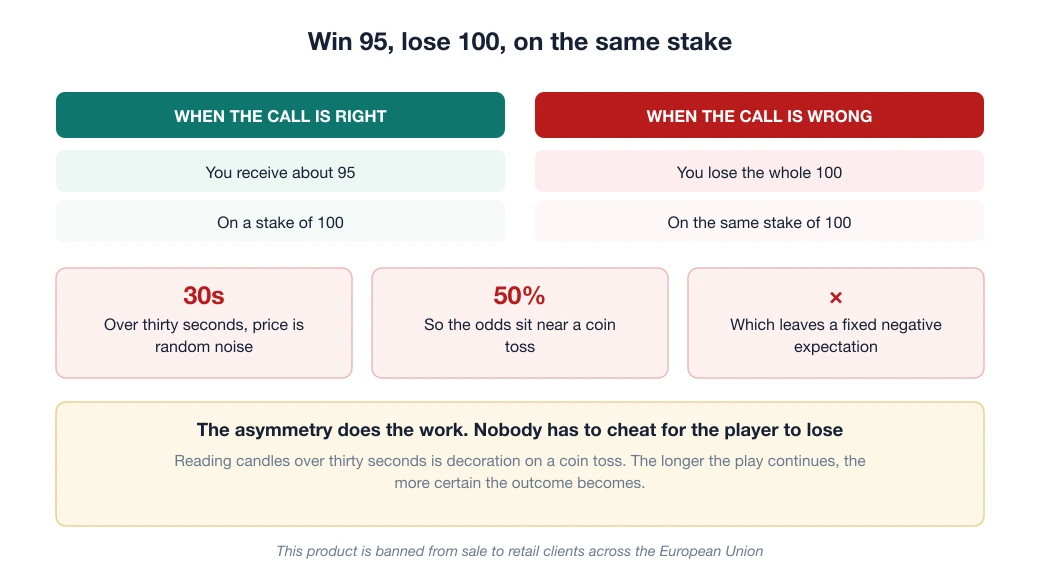
Hitoption’s core product was a thirty-second bet on whether the price would rise or fall, paying out at roughly 95%.
Over that time frame, price is random noise. Every “thirty-second candle reading technique” taught in those Zoom classes is decoration on a coin toss.
Odds near 50%, multiplied by an asymmetric payout where a win returns 95 and a loss costs 100, produce a fixed negative expectation. The player bleeds at a rate you can calculate in advance on a pocket calculator.
And that is before the larger question: were the “results” genuinely random at all, when the entire system sat in the platform’s own hands?
The full analysis of why the European Union banned this model outright is in our article on binary options.
But the casino is only where money is worn away. To see how it is divided, you have to follow one specific deposit.
Where 500 USD goes: the money is split before the first bet
Say you deposit 500 USD, usually as USDT into a system wallet.
From the second the money leaves your wallet, roughly 30 to 40% flows straight into the multi-level commission system, paying the “mentor” who brought you in and the lines above that mentor.
The rest feeds an “operating fund”: marketing spend, events, and paying the small withdrawals of earlier arrivals to keep belief alive.
And the 500 USD you see in your account? That is a record in a database the platform can edit at will.
“Winning” and “losing” from that point are a psychological management script. You win when they need another deposit, and you lose when the attrition phase arrives.
Once you see that, every argument about whether binary options can be traded “with technique” becomes meaningless. The hand ended at the deposit, not at the candle.
The case file, updated 04/08/2026
This is one of the few cases where the investigation results were published in detail, and the numbers show the real scale:
- Hai Phong City Police broke the case on 22 June and arrested two people. Nguyen The Duong, born 1996, was identified as the person who created and ran
hitoption.netfrom June 2020. - The platform advertised itself as “British in origin”, promising a stable return of 6 to 15% a month, with principal and interest withdrawable at any time.
- On Hitoption.net alone: 969 participants, with a balance of more than 629,000 USDT, around 15 billion dong, at the time of inspection.
- Widening the investigation uncovered a network of 16 platforms covering forex, binary options and virtual currency, holding 115,726 accounts and a combined balance of more than 7,505 billion dong.
The investigation conclusion adds one more technical detail.
Investigators concluded that Duong used an automated bot he could intervene in, adjusting it so that a client won or lost as he chose.
When an investor asked to withdraw, Duong refused and set the bot so that they lost continuously until the account was burnt out.
Why the figure of 16 platforms and 7,505 billion dong matters more than the Hitoption case itself: it shows that Hitoption was not a standalone platform but one link in a production line. Take one name down and the rest keep running. That is why recognising the model matters more than remembering the name.
A collapse on schedule, and the victims nobody mentions
The Hitoption life cycle ran on the rails of its whole generation: an explosion of dirty marketing with signal livestreams, screenshots of profits and mass agent recruitment, then warnings from the authorities and the press, then withdrawal problems, then “maintenance”, then the community dissolving.
Part of it was “migrated” to a successor platform, the same change-of-clothes move used by the Wefinex ecosystem.
Players lose money twice. Once because the binary option arithmetic wears the account down bet by bet. Again when whatever balance is left evaporates with the platform. But there is one group of victims that warning articles tend to forget: the low-tier agents.
They lose their own money, they lose standing with the friends and relatives they invited in, and they carry real legal exposure. Multi-level binary option cases have prosecuted upstream lines that played an active role in growing the system, not only the platform owners.
If you are one of those agents, the first thing to do is stop recruiting. The second is to gather evidence and take legal advice. For everyone not yet involved, the three questions below are a shield that lasts a lifetime.
Three questions that stop every future Hitoption
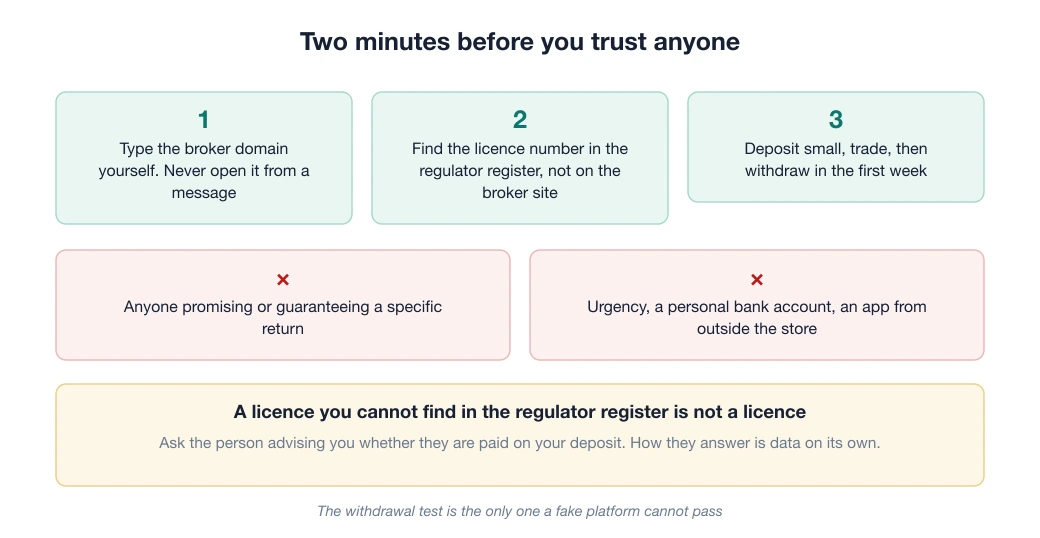
- “Where does the income of the person introducing me come from?” If it is a commission on my deposits or on the volume I bet, then every piece of advice they give is contaminated at the root. There are no exceptions.
- “Does this product exist at a broker regulated by the FCA or ASIC?” Thirty-second binary bets do not exist at any strictly regulated broker, because they are banned from sale to retail clients. A product that can only live where there is no rule has already answered the question about its own nature.
- “If this website disappears tonight, where do I go to claim my money?” No specific answer, meaning no legal entity, no regulator and no compensation mechanism, means you are about to buy a lottery ticket rather than open an investment account.
Hitoption failed all three. And every “Hitoption 2026 edition” will fail them in exactly the same way, however handsome the new domain looks.
Read the connected files on the same blacklist: Wefinex, the parent ecosystem and Coolcat. And if what you actually want is to learn to trade a real market, it is slow and it is hard, but it is a skill that accumulates.
The right door is our technical analysis series from zero and the brokers holding real licences. That is the only place where question three above has a decent answer.
Frequently asked questions
Is Hitoption on the Ministry of Public Security warning list?
Yes. Hitoption is named alongside Wefinex, Deniex, Raidenbo, Pocinex and Binanex in Ministry of Public Security warnings about binary option platforms showing signs of unlicensed multi-level trading and of appropriating assets.
Does money deposited with Hitoption reach a real market?
There is no evidence that any bet was placed on a real market. In a self-operated binary option model, the “results” and the balances are data inside a system the platform controls completely.
Is there legal exposure from having been an agent for a platform like this?
There is. Multi-level binary option cases have prosecuted not only platform owners but also upstream lines that played an active role in growing the system. If you are still involved, the first step is to stop recruiting, then gather evidence and take legal advice.
- Bao Dau Tu. Hitoption.net broken up, a network of 16 fraudulent platforms found, more than 7,500 billion dong appropriated
- VOV. Case broken involving online foreign exchange trading fraud affecting tens of thousands of people
- Ministry of Public Security, via Bao Quang Ninh. Warning on signs of fraud from binary option platforms, with Hitoption named in the list
- Dong Thap Provincial Police. Warning on methods used to draw people into online securities and forex platforms
Spotted something inaccurate? Tell us and we will check it and publish a correction.