
Coolcat scam: 700 complaints and a fake 100% insurance rule
Four days.
That is the span from 19/04/2021, when Ho Chi Minh City police received the first 600 complaints after Coolcat stopped operating, to 23/04, when 100 more arrived.
That figure is not our estimate. It comes from a named official:
“To date, the city police have received complaints from about 700 people accusing the Coolcat trading platform of fraud, with total assets estimated at more than 200 billion dong.”
The numbers are shocking enough. But what makes the Coolcat scam worth reading closely is not its size. It is how sophisticated it was.
Coolcat did not make the bare “you cannot lose” promise of its predecessor. It gamified that promise into a rule that sounded perfectly reasonable: lose six times in a row and the insurance repays 100%.
That plausible shell is what brought 700 people to the same police reception room.
Take this trap apart one layer at a time, because an upgraded version of it may well be running ads somewhere in your news feed.
What “rules” did the Coolcat scam run on?
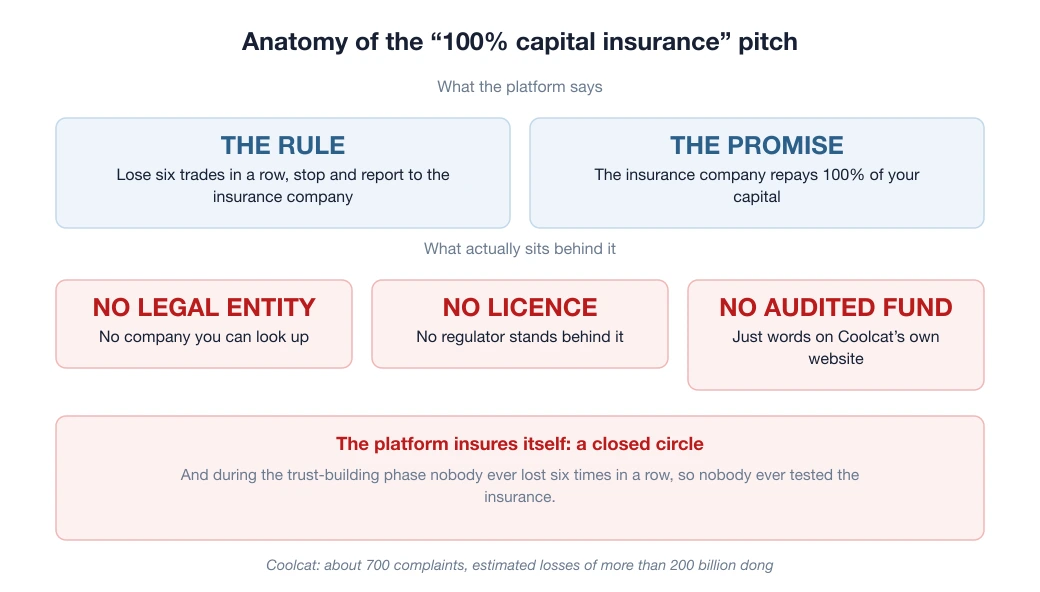
Coolcat appeared as an “automatic money-making” app: a game-like interface, daily missions, a busy chat community. Packages were tiered by deposit size, and the bigger the deposit, the higher the “insurance benefits”.
The headline rule: trade by the system, and if you lose six times in a row, stop and report to the “insurance company” to get 100% of your capital back.
Compared with the blunt “guaranteed profit, you cannot lose” line of Busstrade, this design was far more skilful. It had conditions, a procedure, limits. It sounded like a financial product someone had worked out carefully.
Listeners nodded along: “they only pay out after six losses in a row, a rule that tight must be real.” And nobody ran the question backwards: with a rule that tight, who stands behind the guarantee?
That question, as always, is the thread that unravels the whole ball of yarn.
Why does “100% insurance” never have to pay out?
The trap has three layers, each nastier than the one before:
- The shell: the “insurance company” has no legal entity, no licence and no audited fund. It is just words on the Coolcat website. The platform insures itself: a closed circle that means nothing.
- The mechanism: the “trading results” sit inside a system they draw however they like. During the trust-building phase, nobody suffers “six losses in a row”; everyone wins a little, steadily. The result: the whole community believes the insurance is real while NOT ONE PERSON has ever tested it. Collective trust built on zero checks.
- The exploitation: the feeling of “absolute safety” turns into a deposit pump. “I can’t lose anyway, so why not take the VIP package”: agent packages, guarantee levels tied to deposit size, a flood of deposit promotions. The moment the offers get craziest is the moment the countdown reaches its final beats.
And in April 2021, the clock hit zero.
The Coolcat collapse: more than 200 billion dong gone in the blink of an eye
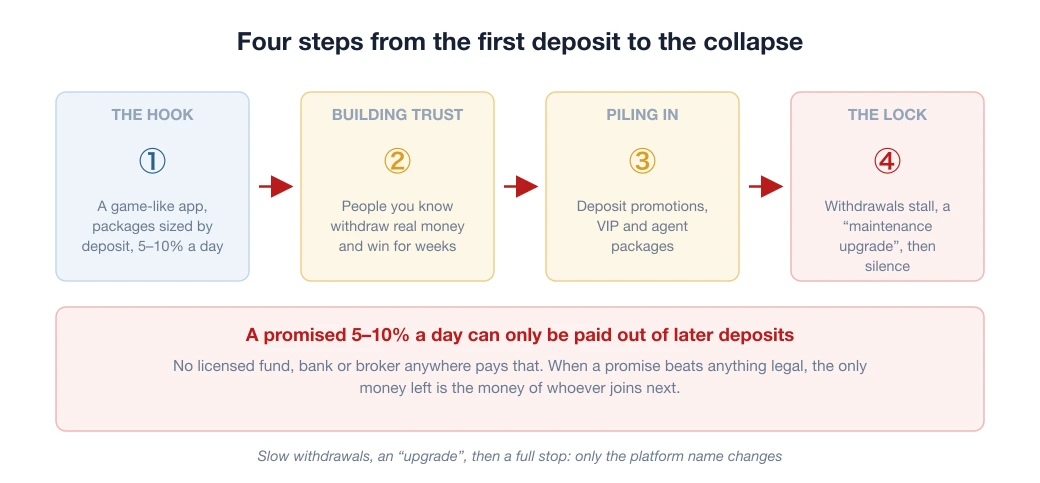
The collapse script was nothing new: withdrawal problems, “maintenance and upgrades”, then permanent silence.
But the complaints piled up very fast: 600 on 19/04 alone, and 100 more by 23/04.
The people who came to report covered every walk of life: factory workers, homemakers, retirees.
And one painful detail kept coming back: many had just bought large packages during the final promotion, the classic last sweep that every Ponzi scheme makes before it collapses.
More than 200 billion dong, including savings and borrowed money, vanished together with an “insurance fund” that never existed.
The obvious question follows: were all 700 people simply gullible? The real answer is far more serious than that.
Figures from the investigating authority, updated 04/08/2026
- About 700 complaints filed with Ho Chi Minh City police: 600 received on 19/04, and 100 more by 23/04. Reported losses: more than 200 billion dong.
- Colonel Nguyen Sy Quang, deputy director of Ho Chi Minh City police, said these complaints were being sorted for investigation and verification.
- The return Coolcat promised: 5–10% a DAY, packaged as an “insurance investment package with returns”.
The 5 to 10% a day converts into a simple multiplication.
Compounded at 5% a day, 100 million dong grows to more than 1.7 billion in two months.
No licensed fund, bank or broker anywhere in the world can pay that. If they could, they would not need your money.
When the promised return far exceeds anything legal, the only source of money left is the people who join later.
There is one more bitter detail. Tuoi Tre newspaper reported that Coolcat victims, after losing their money, were then lured into forex and online card games to “win it back”.
The group that has already lost money is the group targeted a second time. Read the section below before you trust anyone who promises to get your money back.
700 victims were not “foolish”: they were designed to believe
The “how could they be so stupid” reflex is the most dangerous one to have when you read about platform collapses, because it lulls you into thinking you are immune.
Look back at the chain of decisions a typical Coolcat victim made:
- they see an acquaintance withdraw REAL money, which means the trust-building phase ran entirely on real money;
- they hear about an insurance mechanism with conditions and a procedure;
- they try 5 to 10 million dong, an amount small enough to switch off their guard;
- they win steadily for a few weeks;
- they deposit more when a promotion comes along.
No step is stupid. There is only a chain of steps that each look reasonable, each reinforced by a real reward.
That is behavioural manipulation designed by professionals. It beats educated people and people who have read plenty of warnings alike.
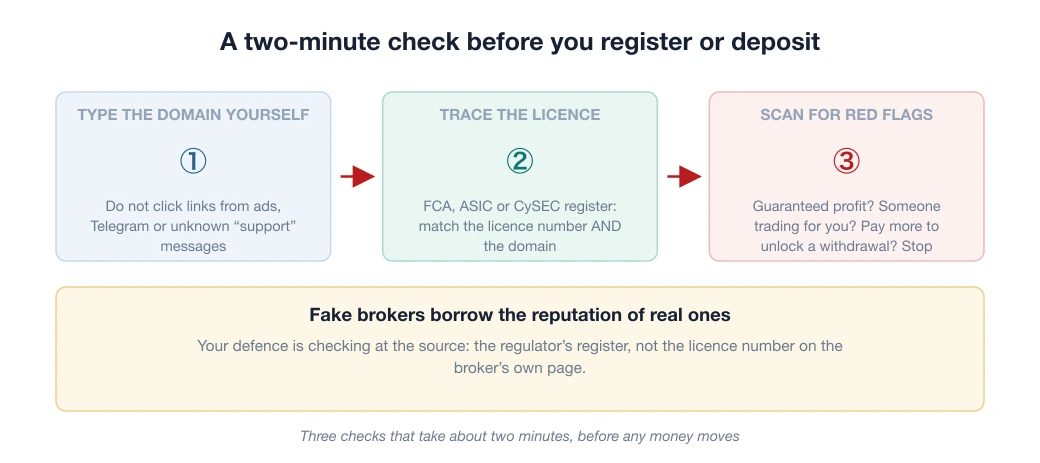
The only vaccine is a mechanical, emotionless verification routine that you run before any money goes in: check the legal entity, meaning the specific company that signs the contract with you, then check the licence and ask for the insurance licence number. The full checklist is in is forex a scam.
Mechanical, because your emotions are exactly what they are best at manipulating.
If you or someone close to you fell for a Coolcat-style scheme: 4 steps, in this order
- Stop depositing, completely. Any “verification fee” or “insurance unlock fee” that appears after the collapse is a second round of fraud aimed at the urge to win back what you lost.
- Freeze the evidence right away: transfer statements (receiving account number, time, amount), screenshots of the app, group messages, the identities of the leaders, before everything gets wiped the way the Busstrade chat group was.
- Report to the police where you live with that evidence. Coolcat’s 700 complaints were the pressure that got the case handled seriously, and your complaint always adds to the total.
- Block every “frozen fund recovery service” that contacts you first. The third wave of fraud specialises in hunting the victims of the first.
Related files in the same series: Busstrade, the twin that collapsed the same month and FX Trading Markets/Lion Group, the 40,000-person case. And if Coolcat’s 200 billion dong teaches only one thing, it is this.
In real finance, high returns that come with a promise of no capital loss do not exist. There are only regulated brokers, and they tell you plainly that trading carries risk, like every name in our vetted broker ranking.
That sounds a lot less exciting. And that is exactly what the truth sounds like.
Frequently asked questions
When did Coolcat collapse, and how much was lost?
In April 2021. Between 19 and 23 April alone, Ho Chi Minh City police received about 700 complaints, with estimated losses of more than 200 billion dong.
What was special about Coolcat’s “lose six times, get 100% back” rule?
It gamified the promise of capital insurance into a rule that sounded like a real procedure. But the “insurance company” did not exist, and the platform itself controlled the trade results, so the payout condition almost never triggered during the trust-building phase.
How do I recognise a Coolcat-style investment app?
The set of signs: returns or benefits tied to deposit packages, “capital insurance”, a gamified interface, a flood of deposit promotions, and no legal entity or licence you can find with any regulator.
- Tuoi Tre. Coolcat victims, having lost hundreds of billions, are lured into forex and online card games to “win it back”
- Thanh Nien. Coolcat accused of fraud worth more than 200 billion dong; the deputy director of Ho Chi Minh City police on 700 complaints
- Kiem Sat Online. Coolcat collapse: more than 200 billion dong vanishes, 700 people file complaints
- VietnamNet. “Ghost” financial investment platforms keep vanishing
Spotted something inaccurate? Tell us and we will check it and publish a correction.