
Busstrade scam: the “100% capital insurance” trick
Busstrade has collapsed, and there is nothing left to weigh up. The platform promised 20–30% a month along with the advertising line “100% capital insurance”, then in May 2021 it disappeared together with every one of its chat groups.
On 23/4/2021, Busstrade members received a notice so familiar that nobody worried: “system maintenance”.
On 5/5, good news spread through the groups: the platform would reopen soon, with a bonus on top. A few hours later, every Zalo and Telegram group, where members showed off their profits day after day, disappeared at once as if it had never existed.
No final notice. No address. Not a single name taking responsibility.
Within a few days, more than 400 complaints alleging fraudulent appropriation of property had reached the police investigation agency. Tuoi Tre and VietnamNet both reported players “in tears”, some of whom had lost billions of dong.
The Busstrade collapse left behind a scam trick that is still reused unchanged today: 100% capital insurance. The trick runs in one fixed sequence, from the first sales pitch to the final deletion of the chat groups.
What trick did the Busstrade scam use? “You cannot lose money”
Busstrade’s approach script hit the biggest fear of people who have never invested: the fear of losing. The promised return of 20–30% a month was tempting enough. But the closing move was the magic line:
“If you lose, insurance pays back 100% of your capital. You cannot lose money.”
The closing line in Busstrade’s sales script
It sounds like a deal entirely in your favour: you keep the profit, and someone else covers the loss. Who could say no?
A great many people did not say no.
And that is exactly the moment for a question nobody in the Zalo group asked: which insurance company, what licence number, and who audits the compensation fund?
Dissecting “100% capital insurance”: a product that does not exist in real finance
No legitimate insurer anywhere in the world sells a product that “covers all speculative losses”. The reason is pure arithmetic: any business selling it would go bankrupt immediately.
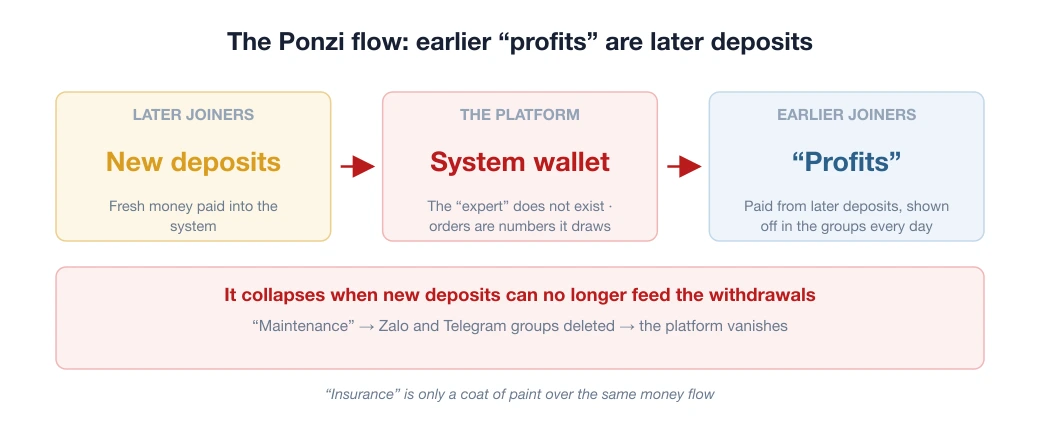
Busstrade’s “insurance company” existed only as a few lines of text on the platform’s own website. The platform insured itself, which means there was nothing behind it except your trust.
The cunning part is that the trick never has to pay out. The “trading results” shown in the account were drawn by the system itself, so during the trust-building phase almost nobody was “eligible” for compensation: everyone was winning a little at a time.
Everyone believed the insurance was real. Nobody ever verified it.
With the same formula, at the same time, a “twin” platform pulled in even more victims: Coolcat, with 700 complaints and more than 200 billion dong. Two names, the same script.
“Automatic expert copying”: when you do not have to do anything, including understand where your money goes
Busstrade had a second layer of bait: accounts were set to automatically copy the orders of an “expert”. Players did not need to know anything about trading. They only had to deposit and watch the balance jump.
Sounds like legitimate copy trading? The line between the two comes down to a single question:
Where is your money actually sitting?
Real copy trading, at a licensed broker, keeps the money in an account in YOUR name. Orders are filled on the real market, and you can disconnect whenever you choose. We analyse this in detail in our article on whether copy trading is worth it.
The Busstrade model was the opposite: the money sat in the SYSTEM’s wallet, the “expert” did not exist, and the “orders” were numbers drawn to manage your emotions. You were allowed to win when they needed you to deposit more, and made to lose when they needed to wear you down.
The show ran smoothly until new deposits could no longer feed the withdrawals. That is when the collapse timeline began.
The Busstrade collapse: how did the last 12 days play out?
- Before 23/4: withdrawals started slowing down here and there, blamed on the “system being overloaded”. In the groups, anyone who asked questions was shouted down by leaders and “decoys” posting screenshots of winning orders.
- 23/4/2021: the official maintenance notice. This was the point of no return that the people inside did not recognise: no fake platform ever finishes “maintenance” and then pays out.
- 5/5/2021: word that the platform would “reopen soon” was pumped out, the classic stalling move to hold back an early wave of complaints and buy more time to move the money away.
- Right after that: the Zalo and Telegram groups were deleted all at once. The curtain came down; more than 400 complaints began their long, hard legal journey.
Learn this 4-step rhythm by heart, because many fake platforms after Busstrade have replayed it, changing only the dates. If you are inside any “system” and see step 1 appear: withdraw at any cost, today. And if you have already reached step 4, the next part is for you.
Case file, updated 04/08/2026
For a platform that has already collapsed, there is no longer a register (the regulator’s public record of licensed firms) to check. The primary records are the documents of the investigating authorities and the mainstream press. This is what could be verified:
- Ho Chi Minh City police have opened a criminal case for “fraudulent appropriation of property” linked to the website
busstrade.com. - The police investigation agency is searching for 4 people: Ha Cong Tai (born 1992, Thanh Hoa), Huynh Thich Nhan (born 1996, Ba Ria – Vung Tau), Trinh The Thang (born 1996, Thanh Hoa), Nguyen Tran Xuan Trong (born 1999, Binh Phuoc).
- On 23/04/2021, the website announced that the virtual money in users’ accounts would be converted into a kind of “Btoken”, then stopped operating; users could neither log in nor withdraw money.
Opening a criminal case does not mean getting the money back.
The case is still at the stage of searching for the suspects, and the investigating agency has also published a notice asking victims to come forward and report. That means many victims have never filed a report.
What you need to do right away is still to file a complaint with evidence. If your name is not on the list of victims, you are not considered for compensation, should the case ever reach trial.
Can Busstrade victims get their money back, and what should they do?
The chance of recovery is low, because the money passed through many layers of intermediaries, the operators are anonymous, and the transactions sit outside any protective legal framework.
But “low” does not mean sitting still. Four things, in exactly this order:
- Stop depositing completely, including any “verification fee to withdraw” that appears after the platform collapses. That is the second round of the scam.
- Freeze the evidence: transfer statements, the receiving account numbers, screenshots of the chat groups, details of the leaders. Do it before those disappear as well.
- Report to the police where you live. Every complaint adds weight to the case file, and the Busstrade case has more than 400 complaints like that.
- Block every “fund recovery service” that contacts you on its own. That is the third wave of the scam, which hunts victims in despair.
Then there is a fifth step, for the future: a single question to screen every investment invitation.
The one-question test for any “guaranteed profit, insured capital” offer
From now on, whenever you get an investment invitation, you only need to send back one line:
“Let me check the insurer’s legal entity and the platform’s licence on the regulator’s website. Send me the licence number.”
A real broker answers with a link you can check. The step-by-step method is in our article on whether forex is a scam.
A fake platform will reply with screenshots of winning orders, with a jibe that you have a “goldfish brain”, or with silence.
More than 400 people once wished they had asked that question before April 2021. You still have time, and if you want to trade seriously with money held in an account in your own name, the list of properly licensed brokers is the right place to start.
Frequently asked questions
When did the Busstrade platform collapse?
Late April to early May 2021: the platform announced “maintenance” on 23/4/2021, promised to reopen, and right after that its Zalo and Telegram groups were wiped. More than 400 people filed complaints alleging fraudulent appropriation of property.
How did Busstrade’s “100% capital insurance” work?
It did not work, and no real insurance company stood behind it. No legitimate insurer sells a product that “covers all speculative losses”, because that model bankrupts itself. It was a trick selling a false sense of safety, which Coolcat also used at the same time.
Can Busstrade victims get their money back?
It is very difficult: the money went through many layers of intermediaries, the operators are anonymous, and the transactions sit outside the legal framework. Victims should gather evidence and report to the police, and stay alert to “stuck fund recovery services”, the third wave of the scam aimed at the victims themselves.
- Cong an Nhan dan (People’s Public Security newspaper). A warning about fraud through the Busstrade electronic trading platform
- Thanh Nien. Ho Chi Minh City police search for the ringleaders of the Busstrade virtual currency platform
- Tuoi Tre. Now the “guaranteed profit” Busstrade platform suddenly “vanishes”, leaving players in tears
- VietnamNet. Busstrade collapse: investors lose billions of dong chasing high returns
Spotted something inaccurate? Tell us and we will check it and publish a correction.