
Copy trading: not passive income, and not a scam either
Copy trading is not passive income. You hand the button to somebody else, and every bit of the risk stays in your account. It is not a fraud either. It is a way of trading that has been advertised wrongly.
Copy trading is a legitimate tool if you treat it as a high-risk investment that requires you to assess the master account you are copying. It is a trap if you treat it as passive income where a better trader does the work for you.
The same button, two frames of mind, two outcomes. This article stands firmly with the first.
The real mechanism: who is paid what when you press Copy
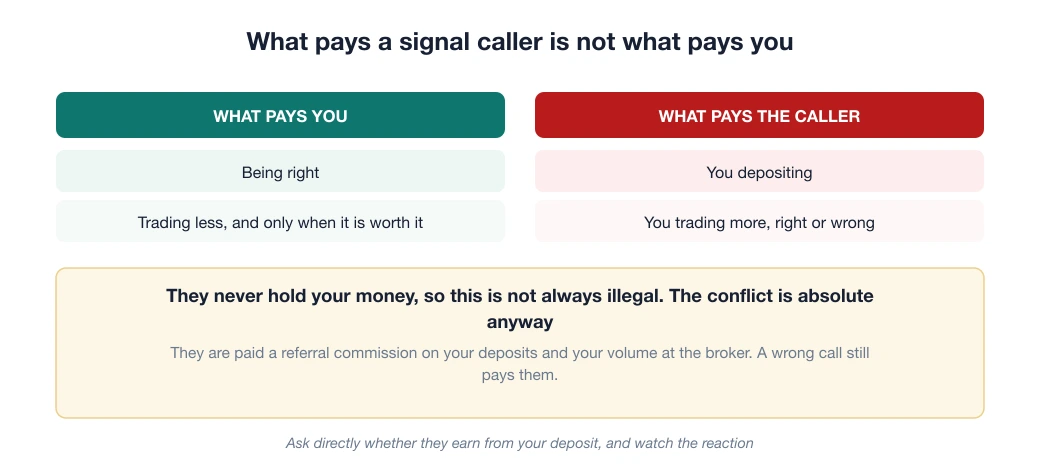
- The leader is paid a copy fee or a share of your profit, and on many platforms a commission based on the VOLUME traded by the people copying them. That last detail is the root of everything: a leader has an incentive to trade A LOT and to attract A LOT of copiers, and neither of those means trading WELL.
- The platform or broker is paid the spread or a fee on every copied order, multiplied by the number of copiers.
- You receive the leader’s result MINUS every layer of fee above, plus copy slippage, because your order fills a beat later than the original.
There is nothing improper in that mechanism. But once you see it clearly, you understand why “copy whoever is top of the leaderboard” is not as simple as pressing a button.
Why leader statistics mislead: four common tricks
- Holding losers to flatter the win rate. A leader wins 95% of trades by never cutting a loss. The losing positions hang open, outside the statistics, until the day they all detonate together. Look at the drawdown, meaning the maximum fall in capital, not at the win rate.
- Martingale in disguise. A profit that grows evenly every single month is usually doubling up after a loss. It is smooth until the day it burns. An unnaturally smooth equity curve is a red flag, not a selling point.
- Survivorship. The leaderboard only shows the people currently winning. The hundreds of leaders who burnt their accounts have already disappeared from it. You are looking at the survivors, not at the real probability.
- A short history. Eighty percent over three months in a favourable market says nothing about three years. A minimum of twelve months covering at least one bad market period is the point where a record becomes worth reading.
A real leader and copier pair, and the number that reverses the comparison
The theory above says a copying account does not behave like the account it copies. What follows is a measurement on a real pair, sent to us by a reader: two trading screenshots taken at the same moment, 11:30 on 14/08/2026, one leader account and one account copying it.
Both were holding gold positions (XAUUSD) and both were losing. The original screenshots are below. Note the clock in the status bar of each: both read 11:30, so the two screens are the same moment and every number can be compared.


| Figure on screen | LEADER account | COPIER account |
|---|---|---|
| Balance | 9,192.23 USD | 14,000.55 USD |
| Floating loss | −4,084.10 | −4,273.35 |
| Equity | 5,108.13 | 9,727.20 |
| Margin in use | 824.11 | 4,124.98 |
| Margin level | 619.84% | 235.81% |
Read the last row first. The copier has a balance 52% larger, but a margin level, the money locked up to hold the open positions, of only about one third of the leader’s.
Margin level is the distance to a margin call and to a burnt account: the lower it is, the closer the edge. So the copier, despite holding more capital, was standing considerably closer to that edge than the person they were copying.
Why they diverged: the two accounts were NOT holding the same book
Add up the order volumes on both screens and the mismatch appears immediately:
| XAUUSD volume | LEADER account | COPIER account |
|---|---|---|
| Sell orders | 7 orders × 0.35 = 2.45 lots | 1 order = 0.57 lots |
| Buy orders | 2 + 2 + 0.35 = 4.35 lots | 4.61 + 4.70 + 0.77 = 10.08 lots |
| Net position | net long 1.90 lots | net long 9.51 lots |
The leader was net long 1.90 lots, a lot being the unit of order size, where one standard lot is 100,000 units. The copier was net long 9.51 lots, five times as much, on capital that was only 1.5 times larger.
That works out at roughly 3.3 times the directional risk per unit of capital. The margin figures confirm exactly that ratio: 4,124.98 against 824.11 is also five times.
Note the detail that is easy to miss. The sell side was barely copied at all, 0.57 against 2.45 lots, while the buy side was multiplied. So the two accounts differ not only in size but in the shape of the risk. The copier was holding a book the leader never held.
An estimate: who burns first
The two tables above give the distance to the stop-out threshold. Assuming a stop-out level of 50%, the level at which positions are closed automatically so the account cannot go further into deficit, which is the common setting on MT4 and MT5. Every broker differs, so check yours.
- The leader account needed to lose roughly a further 4,696 USD. At 1.90 net lots, where every 1 USD move in gold is worth about 190 USD, that is gold moving against the position by about 25 USD.
- The copier account needed to lose roughly a further 7,665 USD. But at 9.51 net lots, where every 1 USD move is worth about 951 USD, that is gold moving against the position by about 8 USD.
Gold was around 4,334 USD at the time, so 8 USD is under 0.2%, a range gold passes through within minutes of an ordinary session.
The copier had more money and would have been swept out first, on a move the leader could have sat through. And once the copier has burnt, every later scenario about “holding on until price comes back” no longer has anything to do with them.
Stating the limits plainly: this is an estimate built from one slice at one moment, not a forecast. Margin changes as positions open and close, stop-out levels differ by broker, and offsetting positions may be margined differently on each platform.
The balance, margin and margin level figures are read directly from the screenshots. The distance to stop-out is our own calculation. We keep those two apart. We also cannot establish which broker the screenshots come from, and that does not change the arithmetic: it holds on any copying platform.
Three things you can use immediately
- Do not compare yourself to the leader’s percentage gain or loss. Compare YOUR OWN margin level. It is the only number that tells you how far you are from the edge, and it is the number the leader’s statistics page never shows.
- Check the copy ratio straight after the first trade. Open both order lists, add the volumes, divide by capital. If the volume ratio is larger than the capital ratio, you are carrying more risk than the leader. Lower the copy coefficient, and do not wait.
- A book that is both long and short the same instrument, with no stop on any position, is a sign of holding losers rather than of hedging. In this pair both directions were losing at once, meaning the positions were opened against each other at different times and both were wrong, not that the risk was balanced.
If you still want to try: five criteria and a capital rule
Choosing a leader:
- a history of at least twelve months
- a maximum drawdown under 20 to 30% that you could ACTUALLY LIVE WITH if it repeated tomorrow
- an equity curve with natural ups and downs rather than artificial smoothness
- order sizes that stay even rather than doubling after a loss
- and a clearly described strategy instead of the slogan “double the account every quarter”
Allocating capital: at most 10 to 20% of your total investment capital for ALL copying activity, divided between two or three leaders with different styles. Set an account-level stop for the copy portfolio from the start, meaning you disconnect at a fixed percentage loss. And read the results by QUARTER, not by week.
Choosing a platform: only copy at a broker with a genuine licence. We analyse the copy trading side in our Vantage and LiteFinance reviews, the two platforms most used in Vietnam, each with its own strengths and weaknesses. Read the limitations section in both.
Copy trading against learning it yourself: a fair comparison
People choose copying because they have no time to learn. That is reasonable, but compare both sides properly. Copying still demands time to reassess the leader periodically, a few hours a month if you do it seriously. It still carries the full market risk. And your own skill after two years of copying is still zero.
Learning yourself costs six to twelve hard months, but the asset stays in your head permanently.
The grown-up answer is usually a combination: a small, controlled share of capital copying so that you are present in the market, alongside learning through our technical analysis series and a Cent account. Two years later you can decide for yourself which side you belong on.
Absolute red flags: if you see these, leave
- “Discretionary management” in the sense of transferring MONEY to an individual who trades for you. That is entirely different from copying on a broker platform, where the money stays in your account. It is the classic appropriation model. Read is forex a scam.
- A leader or group committing to a fixed monthly return. The iron rule: a guaranteed return means fraud.
- Being hurried into a “VIP position closing today”. Manufactured scarcity is a sales technique, not an investment opportunity.
The forms of copying, and choosing the right door
- Social or copy trading on a broker platform, which is what this article discusses: the money stays in YOUR account and the system replicates the master’s orders at a ratio. You can disconnect whenever you want. The main risk is choosing the wrong master.
- PAMM and MAM: the capital of many people is POOLED for one manager to trade together, with profit and loss split by contribution. It still sits inside a licensed broker’s infrastructure, but your control is lower than ordinary copying. It suits only people who already understand the allocation and withdrawal terms.
- Off-platform “discretionary management”: transferring money or account access to an individual to trade for you. This is NOT copy trading, however often it borrows the name, and it is the model behind most forex fraud cases in Vietnam. The golden boundary: money leaving an account in your own name means stop.
How copying fees eat into the return: an arithmetic that sobers people up
Suppose master B genuinely returns 30% a year, which is very good. The journey into your pocket: subtract the profit share paid to the master, commonly 20 to 30% of the profit, leaving roughly 21 to 24%.
Subtract the spread, the gap between the buy and sell price and therefore the fee you pay, along with per-order costs on each copied trade, at roughly 2 to 4% a year with an active master. Subtract copy slippage, where your fill differs from the price you saw, at roughly 1 to 2%.
What reaches you: roughly 15 to 20% a year, in the scenario where you picked a genuinely good master. Still worth it with spare capital and realistic expectations.
The fantasy of doubling an account every year through copying has already been answered by the subtraction above. And remember the other direction: in a year the master loses, you carry the full loss, and nobody shares it with you.
Thirty minutes a month, for anyone copying seriously
- Check the current drawdown of each master against their historical drawdown. Exceeding the historical figure is a signal that their system is meeting a market it has not seen.
- Check for behaviour change: have order sizes grown unusually? Are losses being held longer? Many masters “change character” once they have a large following, under pressure to hold a leaderboard position, which is exactly when to watch most closely.
- Check against the limit you set: if the total loss limit is hit, for example minus 20% of copy capital, disconnect as planned and do not negotiate with yourself.
- Rebalance: if one master has grown to more than half of your copy capital because they did well, take some back to the original weighting. It sounds backwards, but letting profits run with a single master concentrates your eggs in a basket you are not holding.
Those thirty minutes are the real cost of income advertised as passive. Anyone not prepared to pay it should go back to learning it themselves, through the technical series and a Cent account. Slower, but the asset accumulates and it is permanently yours.
Frequently asked questions
Is copy trading passive income?
Not in any accurate sense. You still carry the full market risk and you still have to assess and monitor the leader periodically. Treat it as a high-risk investment that needs managing, not an automatic money printer.
What criteria should I use to choose a leader?
A history of at least twelve months, a maximum drawdown under 20 to 30%, a natural equity curve rather than an artificially smooth one, even order sizes with no martingale, and a clearly described strategy. A high win rate is NOT a good criterion and is usually a sign of losses being held open.
How is copy trading different from handing money to someone to manage?
Copying on a broker platform keeps the money in an account in your own name and lets you disconnect at any time. Discretionary management means transferring money for somebody else to hold, and that model produced most of the forex fraud cases in Vietnam. Never confuse the two.
- ESMA (27/03/2018). CFD leverage limits for retail investors: 30:1 down to 2:1, a 50% margin close-out rule and negative balance protection; 74 to 89% of retail accounts lose money
- Bao Nhan Dan (26/07/2021). The Ministry of Public Security (A05) on the model of entrusting an autobot to place trades on your behalf, in the Hitoption case
Spotted something inaccurate? Tell us and we will check it and publish a correction.