
Forex money management: the 1–2% rule and lot sizing
Money management is the set of rules that controls how much you put on each trade, so that no single losing trade can break you.
Put simply: your strategy decides when you enter, money management decides how long you survive. Most newcomers who blow an account do not do it through bad analysis. They do it by placing trades that are too big, so one move against them wipes everything out.
If the basic mechanics are new to you, start with what forex is.
Why does money management matter more than strategy?
A system that wins 60% of the time can still lose 5–6 trades in a row, and if you trade long enough that will happen. If you risk 20% of the account on each trade, five losses in a row take about two thirds of the account, even though the system is profitable over the long run.

Money management exists so that you are still around when your statistical edge starts to pay. That is why professionals say: “Take care of the risk and the profit will take care of itself.”
Before you fix anything: read your own performance table
The rest of this article is about prevention. But if your account is losing right now, there is one thing to do first, and it takes exactly two minutes.
Open the Performance section in your broker's client area. Almost every broker has one, and almost everyone glances at exactly one number: net loss. That number is the least informative thing on the screen.
The figures worth looking at sit just below it, usually in smaller print: gross profit and gross loss, shown separately. Once you have those two numbers apart, you can diagnose what is actually wrong.
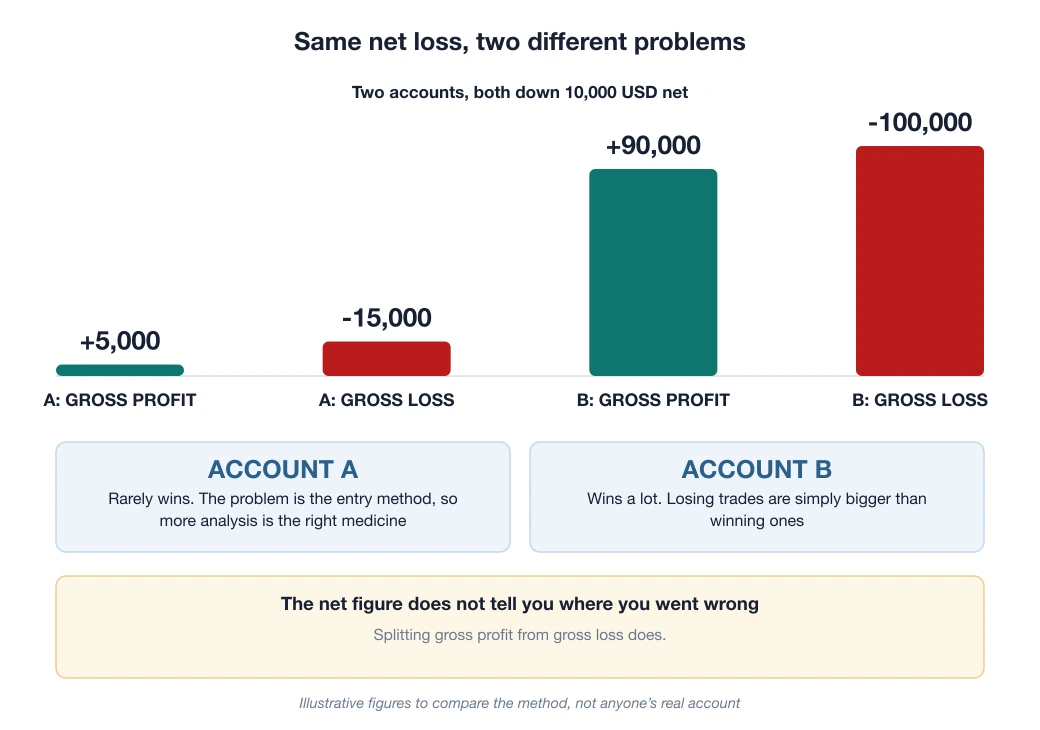
Both accounts in the chart are down 10,000 USD net. But:
- Account A has 5,000 in gross profit and 15,000 in gross loss. This trader rarely wins. The problem lies in the entry method, and learning more analysis is the right medicine.
- Account B has 90,000 in gross profit and 100,000 in gross loss. This trader wins a lot. Telling them to “go learn more analysis” is the wrong prescription: they read the market reasonably well, they just let losing trades grow bigger than winning ones.
Three divisions, three answers
Take exactly three numbers from the screen and divide:
| Division | What the result tells you |
|---|---|
| Gross loss ÷ gross profit | Close to 1 but still a net loss → trading costs are eating the difference. Above 2 → losing trades are far too big compared with winning ones. That is a money management problem, not an analysis problem. |
| Worst week's loss ÷ the year's loss | If one week accounts for more than half of the year's damage, you do not have a long-term problem. You have an event. The cure is a hard stop-loss, not a new strategy. |
| Largest single loss ÷ starting capital | Above 5% means you have ignored the 1–2% per trade rule. Above 20%, and the account survived by luck, not by being right. |
Why the second division matters: the most common way accounts blow up in the Vietnamese trader community is not “losing steadily all year”.
It is losing in dribs and drabs, then losing everything in one session, usually by holding on to a loser, adding to it to win it back, or getting caught by a news release without a stop.
A real case, where the numbers tell the opposite of what people assume
In August 2026, an account was shared publicly in the Vietnamese trader community together with its full performance table. We were given permission to use the table as an example and have removed every identifying detail; what remains is exactly what the broker's app displayed:
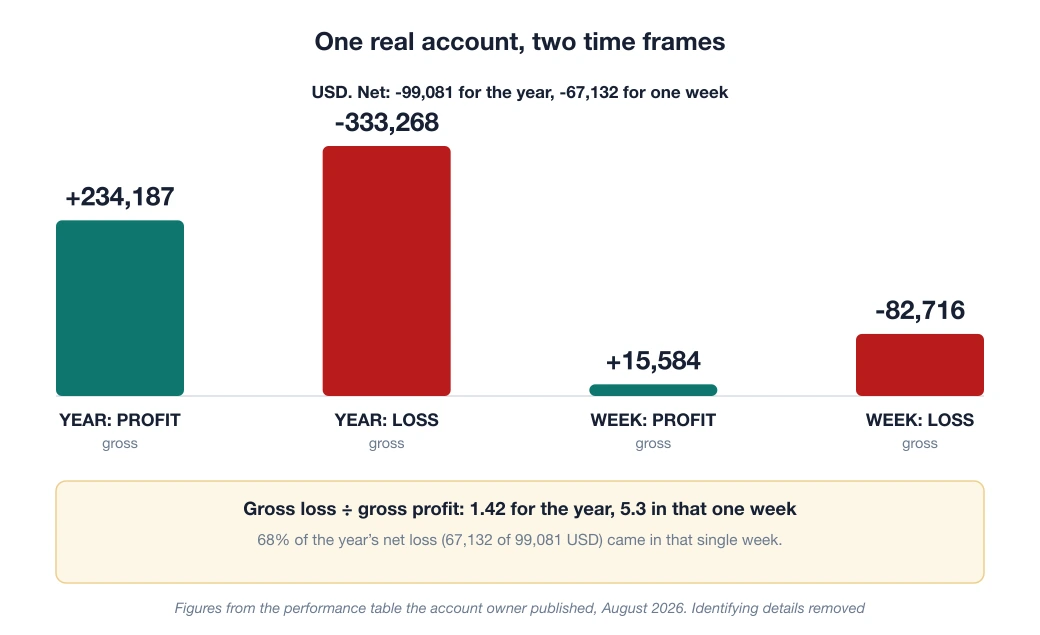
Three numbers in it deserve a close read by anyone who is currently losing:
| Period | Gross profit | Gross loss | Net |
|---|---|---|---|
| Whole year | +234,187 | −333,268 | −99,081 |
| One week | +15,584 | −82,716 | −67,132 |
Figures in USD. Taken from the performance table the account owner published publicly.
Read this table through the three divisions above:
- Gross profit for the year was 234,000 USD. This is not someone who misreads the market. A great many of their trades were right.
- Gross loss ÷ gross profit for the year = 1.42. Losses were only 42% larger than profits. Bad, but the slow-death kind of bad, and still fixable.
- In the final week, that ratio jumped to 5.3. And 68% of the whole year's damage was concentrated in that one week, according to the account owner mostly within about two hours.
The community's reflex in cases like this is usually to advise “learn more analysis” or “find a better system”. The performance table says the opposite: this person's system produced 234,000 USD of gross profit in one year.
What killed the account was not the direction of entry. It was one single time without cutting the loss, at a position size that 1–2% of capital would never have allowed.
That is also why this section comes before every rule in the article. If you are losing and have not read your performance table, you may be treating the wrong illness, spending months learning more indicators when the thing that needs fixing is one stop-loss line.
The second case: cutting position size and still blowing up, and why
If you stop reading here, the easy conclusion is “just trade smaller and you are done”. Another case, also shared publicly in August 2026, shows that is not enough.
This person described their own two years in their own words:
- Two years ago: opened orders of 1, 2, 3 and 5 lots, added more when losing, traded almost only one direction. Lost about 500,000 USD.
- This year: scared by then, cut down to 0.2–0.3 lot, ten times smaller or more. But still DCA'd up to 1 lot whenever a trade went against them. Lost more than 60,000 USD on top.
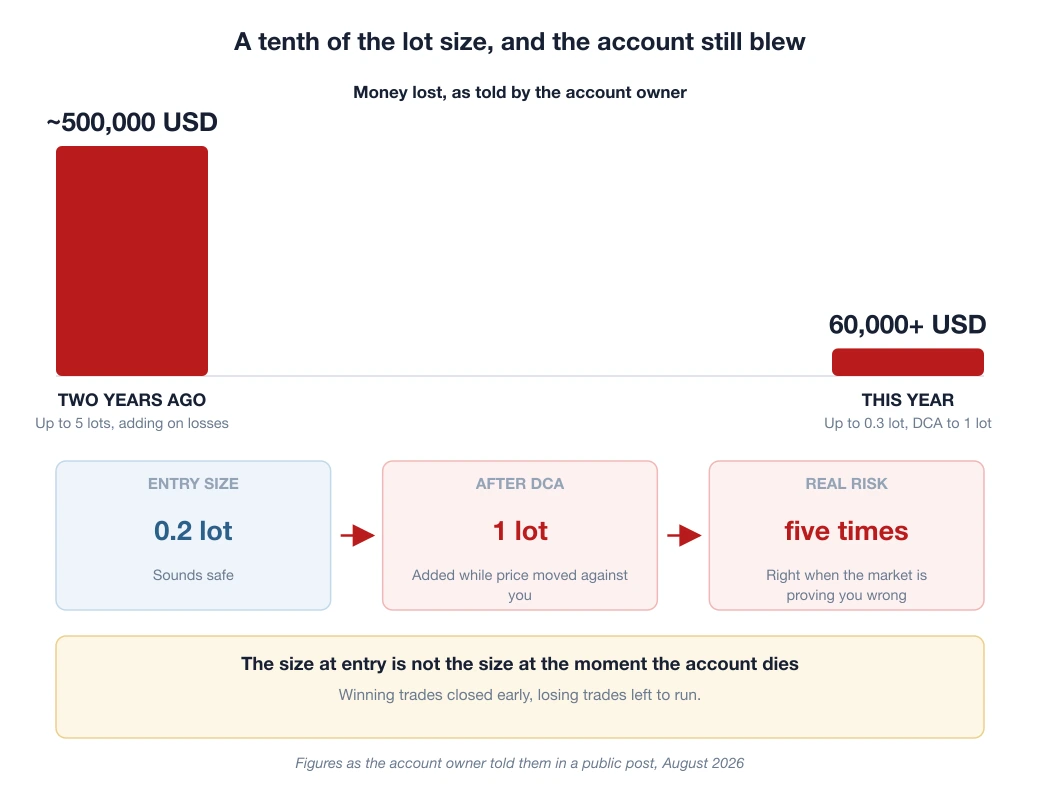
Starting position size cut to a tenth, and the account still blew. Why? Because DCA hands back exactly what was just cut away. Entering at 0.2 lot sounds safe. A lot is the unit of order size, and one standard lot is 100,000 units.
But average up to 1 lot as price moves against you and the real risk is already five times larger, and it happens exactly when the market is proving you wrong. The size at entry is not the size at the moment the account dies.
The same person diagnosed the problem precisely in one sentence, perhaps without realising it: “Ăn không dám ăn, lỗ thì gồng”, roughly “too scared to take the profit, hanging on to the loss”.
That is the whole problem in seven Vietnamese words: winning trades closed early for fear of losing the gain, losing trades left to run in the hope of a turnaround.
Put those two habits together and, even when you win more than you lose, the account still goes down, exactly like the performance table in the first case.
No. Handing money or an account to an individual to trade on a “profit share” is a classic misappropriation scheme, and in Vietnam accepting investment mandates without a licence is not legal. The people making that offer target exactly the group that has just lost money and is no longer thinking clearly, which is the very state the writer described: “I have no mind left to trade, but I still want to win it back”.
Be clear on the difference: copy trading on a broker's platform, where the money stays in an account in your name and you can disconnect at any time, is completely different from transferring money to a person. The two often get called by the same name, and the gap between them is your entire capital.
Four pieces of advice you always see when someone blows an account, and what the numbers say
Every time a blown account is shared in Vietnamese trader groups, the comments almost always repeat the same four directions. Put each one next to the performance table above and it becomes clear which one fits the illness:
| Advice | What the numbers say |
|---|---|
| “Learn more analysis, find a better system” | ✘ Wrong illness. Gross profit for the year was +234,187 USD. This system made real profits, many times over. More indicators cannot fix a trade that was never cut. |
| “Deposit more to win it back, double up to get back to shore” | The most dangerous one. Oversized positions created the loss in the first place. The pressure to win it back pushes size up even further; see the drawdown table below: lose 50% and you need a 100% gain just to break even. |
| “The broker hunted the stops, the broker took the money” | ✘ Does not match the numbers. The same table shows trading costs of 0.00 USD. Even if that figure is not complete, trading fees cannot produce a gross loss of 333,268 USD. |
| “Trade smaller, go back to demo” | ✔ The right direction, and the advice with the fewest likes. It targets the one variable the numbers point to: position size. |
Why three of the four pieces of advice miss: they are all about the entry point, where to buy, where to sell, which indicator, which broker fills orders nicely. Execution is the moment your order is actually filled.
But the performance table says nothing about this person entering badly. It says they exited badly: winning trades closed early, losing trades left to run.
This is a systematic blind spot in the trading community, not anyone's personal failing. Content about entry points is attractive: it has charts, indicators, and it starts arguments easily.
Content about position size and stops is dry, nothing but arithmetic, so it gets talked about far less than its importance deserves.
Rule number 1: risk only 1–2% of capital per trade
This is the foundation. On each trade, the most you accept losing (if the stop-loss is hit) should not exceed 1–2% of the account. Newcomers should start at 1% or lower.
- A 1,000 USD account at 1% risk → maximum loss of 10 USD per trade.
- Even if you lose 10 trades in a row, you lose only about 10% of capital, which you can fully recover from.
The number sounds “slow”, but that slowness is exactly what keeps you in the game.
How to calculate position size (lot) from your risk
The formula for position size from your risk level and stop-loss distance:
That trade also locks up margin, the money set aside to keep an open position: the position value divided by the leverage.
Position size (lot) = Risk amount ÷ (Stop-loss in pips × Pip value per lot)
A concrete example: a 1,000 USD account, 1% risk (= 10 USD). You enter EUR/USD with a 20-pip stop-loss. On EUR/USD, 1 pip on 1 standard lot ≈ 10 USD (0.1 lot ≈ 1 USD per pip).
- Risk amount: 10 USD
- Stop-loss: 20 pips → if the SL is hit, you lose 20 × (pip value)
- Pip value needed: 10 USD ÷ 20 pips = 0.5 USD per pip
- 0.5 USD per pip corresponds to 0.05 lot (because 0.1 lot ≈ 1 USD per pip)
So you enter 0.05 lot, not “1 lot to get rich fast”. This calculation is what keeps your risk at exactly 1%, whether the stop-loss is wide or tight. The wider the stop-loss, the smaller the lot has to be, and vice versa.
The risk:reward (R:R) ratio, your account's lifeline
R:R is the ratio between the money you accept to lose and the money you expect to make. If you risk 10 USD to make 20 USD, that is an R:R of 1:2.
Why it matters: with an R:R of 1:2, you only need to win about 33% of trades to break even; win 45–50% and you are clearly profitable.
The other way round, with a poor R:R (risk 20 to make 10), you have to win more than 67% just to break even, which is very hard to sustain. The principle: favour setups with an R:R of at least 1:1.5 to 1:2, and do not move your stop-loss further away to “hold on” to a losing trade.
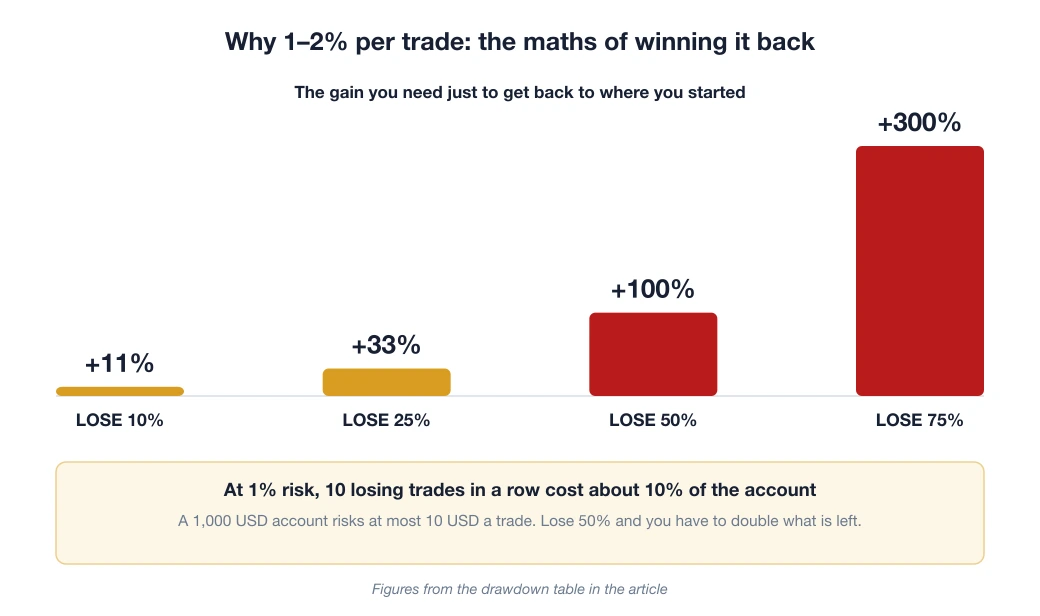
Drawdown maths: why losing capital is more dangerous than you think
Losses and recoveries are not symmetrical. The more you lose, the more the percentage needed to get back grows, and not in a straight line:
| Loss | Gain needed to recover |
|---|---|
| 10% | +11% |
| 25% | +33% |
| 50% | +100% |
| 75% | +300% |
Lose 50% of the account and you have to double what is left just to get back to where you started. That is why “keep the account small and survive” is worth more than “make a big win and then blow up”.
Stop-loss and discipline: the mistakes that kill accounts
- Not setting a stop-loss. Without an SL you have no control over your maximum loss, and one unexpected piece of news can wipe out the account.
- Moving the stop-loss further away to “hold on” to a loser. This is how a small losing trade becomes a disaster. Once you have set an SL, respect it.
- Adding to losing positions / averaging down (martingale, undisciplined DCA). Doubling the position after a loss sounds tempting, but it is the shortest road to a blown account when the market runs one way.
- Revenge trading. Taking a bigger trade right after a loss to “win it back” is emotion, not a system.
Leverage is not your real risk
Many people confuse “high leverage” with “high risk”. In reality, your real risk lies in position size and the stop-loss, not in the leverage figure.
Leverage of 1:1000 or 1:100 makes no difference if you enter 0.05 lot with a 20-pip SL: your maximum loss is still 10 USD. Leverage only decides how much margin you need to open the position. See what forex leverage is for the full picture.
Trading journal and psychology
Money management only works if you apply it consistently. Two tools help you stay disciplined. The first is keeping a trading journal (for every trade: reason for entry, % risk, R:R, result) so you can see whether you are sticking to your rules.
The second is starting on a demo account until working out the lot from your % risk becomes a reflex. Only use spare money, money you are prepared to lose without it affecting your life.
Frequently asked questions
What is forex money management?
Forex money management is the set of rules that controls how much you put on each trade so that no single losing trade can blow up the account. It covers: limiting the risk on each trade (1–2% of capital), calculating the lot size from the stop-loss, keeping a sensible risk:reward ratio, and respecting the stop-loss.
What percentage of capital should I risk per trade?
The common rule is a maximum of 1–2% of the account per trade; newcomers should start at 1% or lower. With a 1,000 USD account, 1% risk means a maximum loss of 10 USD per trade, so even after many losses in a row you can still recover.
How do I calculate lot size from my risk?
Position size = Risk amount ÷ (Stop-loss in pips × Pip value per lot). Example: risk 10 USD, a 20-pip stop-loss on EUR/USD (0.1 lot ≈ 1 USD per pip) → you need 0.5 USD per pip → enter 0.05 lot. The wider the stop-loss, the smaller the lot has to be.
Which matters more, money management or strategy?
Money management matters more. Even a good strategy has losing streaks; if your trades are too big, a normal losing streak is enough to blow the account before the statistical edge has a chance to work. Money management keeps you alive long enough for the strategy to make money.
- ESMA (27/03/2018). CFD leverage limits for retail investors: 30:1 down to 2:1, a 50% margin close-out, negative balance protection; 74–89% of retail accounts lose money
- ASIC (in force from 29/03/2021). CFD product intervention order: the same 30:1 to 2:1 leverage scale; retail clients of 13 providers lost a net of more than AUD 774 million in March and April 2020 alone
Spotted something inaccurate? Tell us and we will check it and publish a correction.