
How to open a Tickmill account and pick Raw (2026)
With most brokers, step one of an account-opening guide is “go to the website”. With Tickmill, step one has to be checking that you are on the right website, because it is one of the most heavily impersonated brand names.
People who land on a fake broker do not lose “a little”; they usually lose the whole deposit. So this guide is written as a complete safe account-opening process: verify the real broker → choose an account by the numbers → register → the first week.
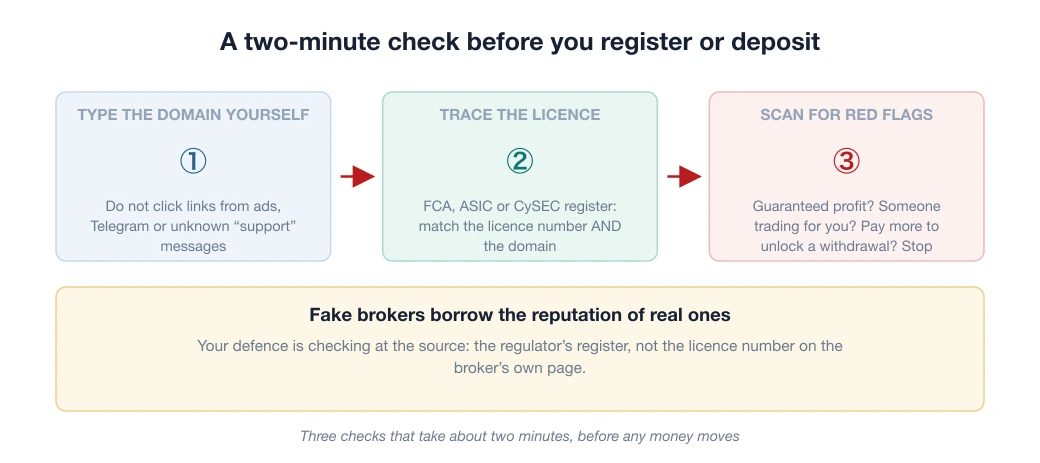
Step 0: Verify the real broker (3 minutes, mandatory, do not skip)
- Type tickmill.com by hand into your browser. Do not click links from Facebook ads, Telegram groups, or messages from any “support person”, even one who claims to work for the broker. A real broker does not send private messages inviting you to open an account.
- Cross-check on the FCA Register (register.fca.org.uk): type “Tickmill”, and the real entity shows as Authorised with number 717270. Any website calling itself Tickmill that cannot be matched to this number is a copy, no argument needed. This takes 2 minutes and puts you in the most careful 5% of users.
- Someone offers a “Tickmill VIP account with an expert trading for you, profit guaranteed”? Block them. No regulated broker operates that way, and “we trade for you, profit guaranteed” is the opening line of every investment scam script the police have warned about.
Step 1: Choose the account type: the same 100 USD deposit, but a different way of charging
| Account | Spread | Commission | All-in EUR/USD |
|---|---|---|---|
| Raw | from 0.0 pip | ~3 USD/lot per side (6 USD round trip) | ≈ 0.6 pip, in the cheapest group on the market |
| Classic | from 1.6 pip | 0 | ≈ 1.6–1.8 pip |
| Raw (TradingView) | from 0.0 pip | ~3.5 USD/lot | ≈ 0.7 pip, trading on TradingView |
The table shows something unusual: the gap between Raw and Classic at Tickmill is abnormally wide (0.6 vs 1.6+ pip, nearly three times), wider than the equivalent gap at IC Markets or Vantage.
That means at this broker, picking Classic “to keep it simple” costs you real money. Unless you trade very rarely and truly dislike numbers, Raw is the answer. Not used to converting commission into pips yet? The article on what spread is has a two-line formula.
A worked example, using the convention that 1 pip on 0.1 lot (a unit of order size; 1 standard lot is 100,000 units) ≈ 1 USD: a trader places 30 trades of 0.1 lot a month.
Raw all-in ~0.6 pip ≈ 0.6 USD/trade → ~18 USD/month; Classic ~1.6 pip ≈ 1.6 USD/trade → ~48 USD/month. The difference is ~30 USD a month on a very modest volume, and it grows in proportion if you trade more.
Step 2: Registration and KYC
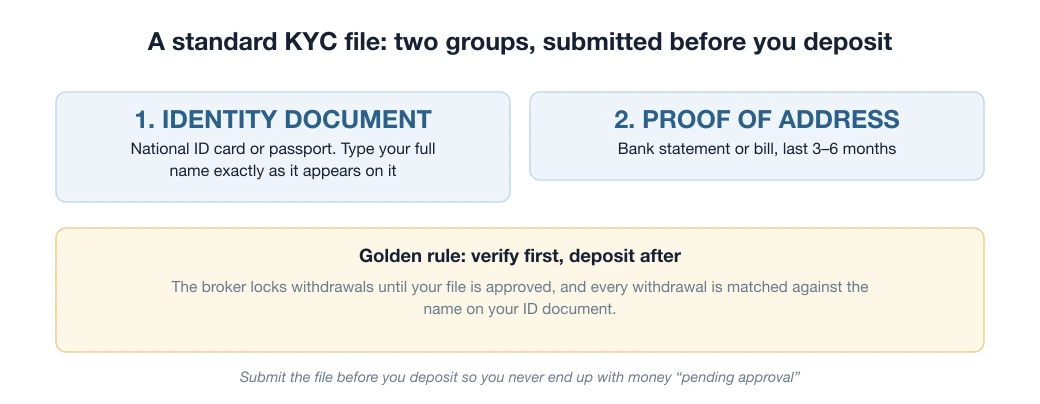
- On tickmill.com (glance at the address bar once more: a one-second habit that protects the whole account), choose to open a live account. Enter your name exactly as on your national ID card or passport, without Vietnamese diacritics, plus a real email and phone number.
- Choose a platform: MT4/MT5, or TradingView if that is where you do your analysis (in that case pick the Raw TradingView account so the two match).
- KYC: an identity document plus proof of address from the last 3–6 months, with the name matching the bank you deposit from and withdraw to. It is the standard pair, and approval usually comes within the working day.
- Deposit from 100 USD by bank transfer, card, e-wallet or crypto. The order never changes: KYC approved → then deposit.
What to know before depositing: Tickmill has no Vietnamese dong channel
This is the biggest difference between Tickmill and the brokers usually placed next to it, and almost no Vietnamese-language guide mentions it. Tickmill’s own deposit and withdrawal conditions page does not list any local VND method: no Vietnamese bank transfer, no Vietnamese e-wallet.
| Method | Minimum deposit | Minimum withdrawal | Fee | Withdrawal time |
|---|---|---|---|---|
| International bank transfer | 100 USD | 25 USD | Free (the broker pays bank fees on deposits over 5,000 USD) | Reaches your account in 2–7 days |
| Cryptocurrency | 100 USD | 25 USD | Free | 12–48 hours |
| Visa / Mastercard | 100 USD | 25 USD | Free | Up to 8 working days |
| Skrill / Neteller | 100 USD | 25 USD | Free | Instant |
Source: Tickmill’s own deposit and withdrawal conditions page, data as of 28/07/2026. The 100 USD minimum deposit is cross-confirmed in the broker’s own FAQ, with a note that the figure may change with the account currency.
What this means in practice for Vietnamese traders: you have to go through an international transfer, a card, an international e-wallet or crypto, and each route has its own price. An international wire gets cut by intermediary bank fees along the way.
A card deposits instantly, but a withdrawal can take up to 8 working days. Skrill/Neteller is the fastest, but you have to open an extra wallet account and pay a fee to load money into it.
For comparison: Ultima Markets has a free VND channel processed within 1 hour, and HFM also has a deposit table shown directly in dong. Tickmill does not.
If you value the convenience of Vietnamese dong, this is a real drawback to weigh first. It is not a reason to rule Tickmill out, because its trading costs are still in the cheapest group, as the table above shows.
It is a trade-off you need to know about to match the broker to the right person and the right job.
If that drawback is the obstacle for you: the lack of a Vietnamese dong channel does not make Tickmill worse; the broker still has a Tier-1 licence and low costs. Tier-1 is the group of the strictest regulators, for example the FCA and ASIC.
But if you want to deposit and withdraw directly in VND through a domestic bank instead of opening an extra intermediary wallet, that is something Tickmill cannot provide, and there is no way around it.
Exness is ranked 2nd in our broker ranking (4.9 points, behind only XM) and has a low first deposit that depends on the payment method.
If what you need is a low-cost Raw ECN model (orders passed straight to the market, not through the broker’s dealing desk) closer to Tickmill, the nearer choice is IC Markets; the reasons are in the Tickmill review. Read first, then decide:
The first week: check what the broker promised
- Measure the real spread at the hours you usually trade. “From 0.0 pip” is the ideal condition; your figure depends on the time of day. Note it over a few sessions so your expectations are right.
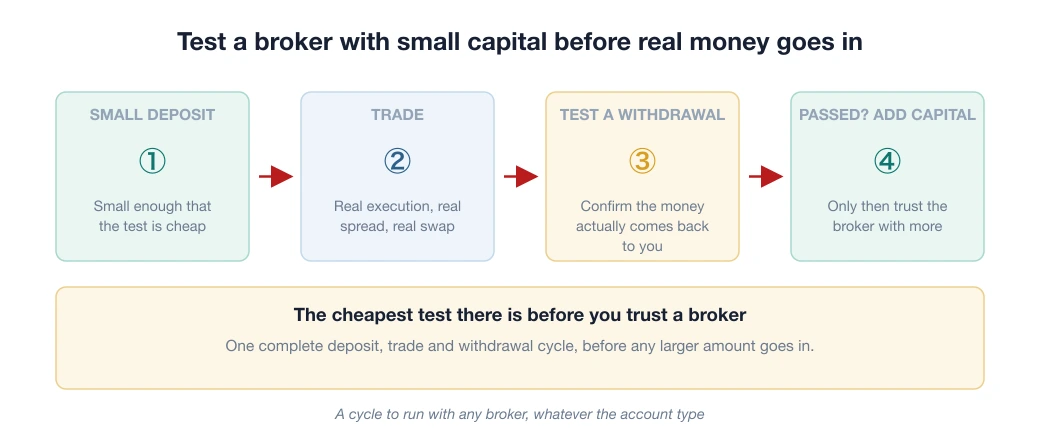
- Make a small test withdrawal after your first few trades, and confirm the full cycle before adding capital. It is our usual rule for every broker.
- Do not worry that the broker has few “events” and no loud bonuses. Tickmill competes purely on fees and regulation; that is its culture. Anyone who wants a buzzing promotional atmosphere will find this broker... dull, and that is a backhanded compliment.
Why do low-cost traders still pick Tickmill despite its quiet brand?
Because the combination of FCA + CySEC + all-in ~0.6 pip has almost no rival at this price: a Tier-1 licence with segregated client money and real compensation, alongside trading costs in the cheapest group on the market. What is the trade-off?
A quiet brand, few promotions, and past complaints that led WikiFX to lower its score. We wrote about that part plainly too in the Tickmill review 2026 (with a screenshot of the official licence page so you can compare). If you are torn within the ECN group, see IC Markets vs Tickmill, the closest head-to-head in the segment.
The three Tickmill account types, and the real cost
Source: tickmill.com/trading/accounts-overview, data as of 28/07/2026. Broker conditions change over time; check again before you deposit.
| Classic | Raw | TradingView Raw | |
|---|---|---|---|
| Minimum deposit | $100 | $100 | $100 |
| Spread from | 1.6 pip | 0.0 pip | 0.0 pip |
| Commission | None | $3 / lot / side | $3.50 / lot / side |
| Maximum leverage | 1:1000 | 1:1000 | 1:1000 |
| Account currencies | USD, EUR, GBP, ZAR | USD, EUR, GBP, ZAR | USD only |
| Platforms | MT4 / MT5 | MT4 / MT5 | TradingView |
Do not choose Raw just because you see “0.0 pip”. A commission of $3/lot/side means $6 round trip for every lot, which works out to about 0.6 pip on EUR/USD. Added together, the real cost of Raw is roughly 0.6–0.8 pip, while Classic is 1.6 pip with no commission.
Raw really is cheaper, but the gap is much narrower than the advertised figures suggest. And for someone who trades rarely, a few trades a week, that difference is almost negligible compared with picking the wrong entry point.
To work it out for your own volume, multiply the gap in pips by the pip value of the lot size you trade.
Tickmill deposits and withdrawals: no VND channel at all
This is the biggest difference between Tickmill and brokers such as HFM or Ultima Markets, and it is something to know before you open an account.
Source: tickmill.com/conditions/deposit-and-withdrawal, data as of 02/08/2026. Broker conditions change over time; check again before you deposit.
| Method | Minimum deposit | Minimum withdrawal | Fee | Time |
|---|---|---|---|---|
| Bank transfer | $100 | $25 | Free; Tickmill pays bank fees on deposits over $5,000 | Processed in 1 working day, reaches your account in 2–7 days |
| Cryptocurrency | $100 | $25 | Free | Instant deposit 24/7 · withdrawal 12–48 hours |
| Visa / Mastercard | $100 | $25 | Free | Instant deposit · withdrawal up to 8 working days |
| Skrill / Neteller | $100 | $25 | Free | Instant both ways |
The broker’s own deposit and withdrawal page lists no local VND method at all: no Vietnamese bank transfer, no Vietnamese e-wallet. Vietnamese traders have to go through an international transfer, a card, an international e-wallet or crypto.
The practical consequence: your deposit and withdrawal cost and time will depend on the intermediary bank, not on Tickmill. And the $100 minimum on every account type means Tickmill is not the choice for someone who wants to test with very small capital, unlike HFM (deposits from 250,000 ₫).
Not yet determined: which legal entity (the specific company that signs the contract with you) serves Vietnamese clients. The page lists 4 entities (Seychelles, the UK, Europe, South Africa) but does not say which one covers Asia. Read the company name in the contract carefully when you register.
The figures above were read directly on Tickmill’s pages, with the check date noted at each table. The page does not name the entity serving Asian clients, so I left that blank instead of guessing. Account-opening conditions change from round to round; check again at the moment you click register.
Frequently asked questions
What is the minimum deposit at Tickmill?
Tickmill requires a minimum deposit of about 100 USD, applied to every account type (Raw, Classic). It is a mid-range level, suitable for both beginners and experienced traders.
Should I choose the Tickmill Raw or Classic account?
Raw has spreads from 0.0 pip but charges a commission of ~3 USD/lot per side, best for people who trade a lot. Classic has no commission but spreads from 1.6 pip, simple for beginners. Compare the total cost (spread + commission).
Is Tickmill trustworthy enough to deposit with?
Tickmill is licensed by the FCA (UK) and CySEC (Cyprus), Tier-1 regulators with investor compensation schemes, and its regulatory record is transparent. However, the broker is not licensed in Vietnam, so you still need to assess the risk yourself.
Spotted something inaccurate? Tell us and we will check it and publish a correction.