
How to verify a forex broker before depositing (2026)
Verifying a forex broker before you deposit takes about 15 minutes, and it can save your entire capital. Most victims of fake or fraudulent brokers skip this step because they trust an advert or a referral. Below is a 6-step checklist you can run yourself, with no expertise needed.
One example shows why you have to trace things back to the source: with DBG, the ASIC licence is real, but most of the domains carrying the broker’s name are either for sale or dead. See our DBG cross-check.
Summary: 6 steps, how long each takes, when to stop
| Step | Time | Stop immediately if… |
|---|---|---|
| 1. Trace the licence to its source | 3 minutes | It cannot be found, or the company name does not match |
| 2. Identify your legal entity | 3 minutes | The contract does not say which entity |
| 3. Check the domain | 2 minutes | Contact is only through a personal Zalo/Telegram account |
| 4. Read independent complaints | 5 minutes | Many reports of people unable to withdraw |
| 5. Deposit small, test a withdrawal | 1–3 days | The withdrawal is delayed, or you are asked to deposit more |
| 6. Watch for behavioural red flags | Ongoing | Any sign from the red-flag list appears |
Steps 1–4 can be done in about 15 minutes on your phone. Step 5 is the decisive one and takes a few days, but those are days worth spending before you hand money to a stranger.
Step 1: Look up the licence DIRECTLY on the regulator’s website
Do not trust the licence number a broker shows off on its own site. Go straight to the regulator’s website and look that number up: FCA (register.fca.org.uk), ASIC (asic.gov.au), CySEC (cysec.gov.cy).
If it cannot be found, or the company name does not match, or there is only a “certificate” from a self-regulatory association (not a state body), that is a warning sign.
Found it? Then what do you read? This is the part most people skip: a result appears and they relax. Four things to check in the record:
- Status, which must be active/authorised. If it says expired, revoked or restricted, treat it as no licence at all.
- Legal entity name, which must match exactly the company name on your contract, not merely share the brand name.
- Scope of authorisation: some firms are only licensed for ancillary services, not brokerage. If the scope does not include trading, that licence means nothing to you.
- Registered address & website: the regulator lists the official website. If the domain you are looking at is different from the domain in the record, you are very likely on a fake site.
Three sophisticated tricks that get past a careless check
If you only “trust it because there is a licence number”, you can still walk into the trap. These are the three most common tactics:
- Clone firm. The fraudster takes the real name and licence number of a licensed company, then builds their own website with their own contact details. You look up the licence number, and it is real. But the money goes to the impostor. How to counter it: check the website and contact details in the registration record, not just the licence number. Regulators such as the FCA themselves regularly publish warnings about clone firms.
- Swapping the regulator. The broker displays a “licence” from an organisation that sounds impressive but is really just a self-regulatory association or an ordinary business registry, with no power to supervise financial services. A business registration certificate is not a brokerage licence.
- Real licence, different entity. The group holds a real FCA licence, but the account you open belongs to a subsidiary somewhere else entirely. Not illegal, but the level of protection is very different from what the advertising suggests. This is exactly why Step 2 exists.
Step 2: Identify the LEGAL ENTITY you are actually opening an account with
A broker can hold an FCA licence and still place Vietnamese clients with an offshore legal entity (the specific company named on your contract, registered in an island jurisdiction where supervision is much lighter) in Belize, Seychelles, SVG and the like, with much lower protection.
Read the client terms or agreement carefully to see which entity you are signing with. A Tier-1 licence (FCA/ASIC/CySEC) only protects you if your account belongs to that very entity.
Step 3: Check the domain & website
Fake brokers often imitate the name or domain extension of large brokers. So: type the official address yourself (do not click links from unknown messages). Check that the site uses HTTPS; be suspicious if the domain is brand new, full of spelling mistakes, or offers contact only through a personal Zalo/Telegram account instead of official channels.
Step 4: Read independent reviews & complaints (including the negative ones)
Search the broker’s name together with words like “scam”, “cannot withdraw” or “exposed” on forums (TraderViet, VOZ), WikiFX and Forex Peace Army. But put them in their proper place: these are private sites and forums, not regulators.
They are useful for spotting recurring complaint patterns: stuck withdrawals, frozen accounts. But they must never be used as the sole basis for a legal claim.
Labels such as “Suspicious Clone” or a score of 8.5/10 on those sites are their own assessments, not the conclusion of any authority. When the two disagree, the register in Step 1 (the regulator’s public register) wins.
Do not read only the 5-star PR pieces. Read the complaints too, to learn which problems keep coming up. In our review section, every broker has a “Real experience” section setting out both strengths and weaknesses, with sources.
The 6 steps applied to 10 brokers: what the registers show
For 10 brokers being advertised in Vietnam, the regulators’ registers contradict information widely circulating in Vietnamese-language articles in five places.
| What many sources say | What the register actually shows |
|---|---|
| RoboForex holds CySEC licence 191/13 | That licence is in the name of Robomarkets Ltd, a different entity and a different brand. RoboForex Ltd only has an FSC Belize registration (Active until 31/12/2026) |
| JustMarkets holds CySEC 401/21, so clients are protected in the EU | The licence is real, but the register lists the approved domain as justmarkets.eu. Vietnamese clients go to justmarkets.com, a Seychelles entity, outside the scope of that licence |
| Weltrade had its Belize licence revoked | FSC Belize’s own warning archive and suspension/revocation archive do not list Systemgates or Weltrade. This allegation could not be confirmed |
| The BCSC warns about an entity called “Fake DBG Markets” | The BCSC names “DBG Markets” directly and does not use the word fake. What gives away that this is not the original broker is the pair of domains m.dbg-coltdfx.cc and pc.dbg-coltdfx.cc |
| GTCFX was warned by AMF Québec | GTCFX was not found on the AMF Québec warning list. The warning that could be confirmed comes from Japan’s Financial Services Agency, in a notice issued in 03/2026 |
Three lessons you can apply right away to the broker you are looking at
1. Licence numbers copied from elsewhere are often wrong. For RoboForex alone, aggregator sites give four different numbers for the same entity: 000138/210, 000138/32, 000138/7, 000138/437.
The broker’s own site gives 9759600 under the Securities Industry Act 2021. None of those four numbers match it. This is why Step 1 requires opening the register, not reading a review.
2. The register also records the DOMAIN, and almost nobody checks that field. The JustMarkets case shows why it matters: a real licence, a real number, a real regulator.
But the domain you are on falls outside the scope of that licence. When you check, compare three things: the entity name, the licence number, and the domain.
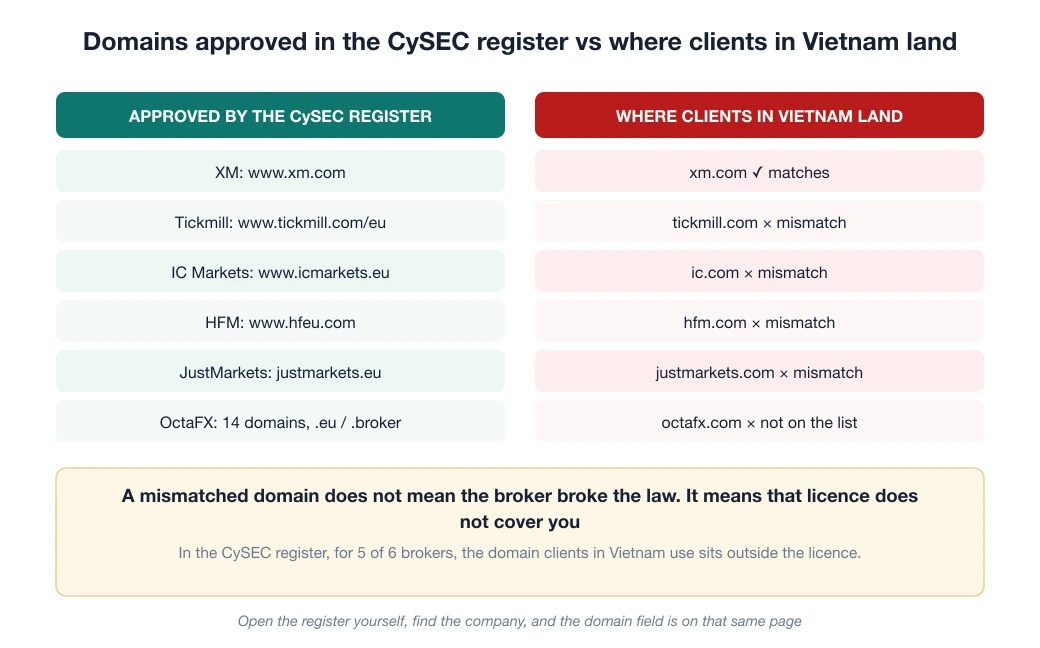
For 5 of the 6 brokers below that hold CySEC licences, the domain Vietnamese clients use is NOT on the approved list:
| Broker | Domains CySEC approved for the Cyprus entity | Domain Vietnamese clients go to | |
|---|---|---|---|
| XM | www.xm.com · www.trading-point.com | xm.com | ✔ matches |
| Tickmill | www.tickmill.com/eu | tickmill.com | ✘ mismatch |
| JustMarkets | justmarkets.eu | justmarkets.com | ✘ mismatch |
| OctaFX | 14 domains, all .eu / .broker / .trading | octafx.com | ✘ not on the list |
| IC Markets | www.icmarkets.eu · www.ic.com/eu | ic.com | ✘ mismatch |
| HFM | www.hfeu.com | hfm.com | ✘ mismatch |
The table does not say the 5 brokers with mismatched domains are scams; all of them hold real licences that are currently valid. It says something more specific and less widely known: the European licence displayed in the advertising is tied to a domain you do not use.
In a dispute, the authority you can complain to is the one that licenses your legal entity, usually in Seychelles, Belize or Vanuatu, where there is no compensation fund. A compensation fund is a fund that pays clients when a licensed company goes bankrupt.
And the XM case shows why you still have to check the next step: the domain matches. But clients outside the EU usually still sign with XM Global Limited (FSC Belize), not the Cyprus entity.
The right domain is a necessary condition, not a sufficient one. Step 2, reading the company name on your confirmation email, is the step that settles it.
3. “Not found” does not mean “clean”. For Neotech, FSP licence 54192 cannot be confirmed in the FSP search tool of South Africa’s FSCA, which the FSCA itself labels this group of tools “legacy system and are currently being updated”.
The enforcement archive is accessible and does not list Neotech, but it only covers recent decisions. In a case like this, the right conclusion is “not yet verified”, not “no problem”.
All 10 profiles, with links to the registers, are in the lookup table of brokers showing signs of fraud or risk: 73 sources from 38 domains.
Step 5: Test a small deposit and withdrawal first
Before trusting a broker with a large deposit, deposit a small amount, place a few trades, then try withdrawing.
This is the cheapest and most reliable test: if a broker makes withdrawal hard, or keeps changing the conditions, even on a small amount, do not deposit any more under any circumstances. Complete KYC verification from the start so the withdrawal does not get stuck.
Step 6: Recognise the red flags that mean STOP
- Commitments or guarantees of profit, “can’t lose”, “losses covered”.
- Someone offering to “trade your account for you”, asking for your password, or inviting you to pool capital or hand over funds to be managed.
- Pressure to deposit more to “unlock a withdrawal” or to claim a bonus.
- A licence that cannot be verified; only an opaque offshore entity.
- Time pressure (“limited-time offer”) so you do not get the chance to check.
If even one of these signs appears, stop. See also how fake brokers impersonate reputable ones and the list of brokers to be wary of. Remember: no forex broker is licensed in Vietnam, so the verifying is entirely up to you.
Frequently asked questions
How can I tell whether a forex broker is real or fake?
Look up the licence number directly on the regulator’s website (FCA/ASIC/CySEC), identify the legal entity you are actually opening an account with, check the official domain, read the negative reviews too on forums and WikiFX, and test a small withdrawal before depositing a large amount. Be wary of any promise of profit or any offer to “trade for you”.
Where can I look up a forex broker’s licence?
Go straight to the relevant regulator’s website: the FCA (UK) at register.fca.org.uk, ASIC (Australia) at asic.gov.au, CySEC (Cyprus) at cysec.gov.cy. Enter the company name or the licence number the broker publishes. If it does not match or cannot be found, that is a warning sign.
Is a broker with an FCA licence guaranteed to be safe?
Not necessarily. Many brokers hold an FCA licence but still place Vietnamese clients with an offshore legal entity (Belize, Seychelles…) that offers lower protection. A Tier-1 licence only protects you if your account belongs to that very licensed entity. Read the terms carefully.
- FCA Register (UK): look up authorised legal entities, including their registered domains
- ASIC Connect (Australia): professional registers, AFSL lookup
- CySEC (Cyprus): register of investment firms; each firm’s page also lists its approved DOMAINS
- FSC Belize: LicenSys lookup portal (public register)
- FSC Belize: warning archive and licence suspension/revocation archive
- Japan FSA: list of unregistered entities offering OTC derivatives
- BCSC (British Columbia, Canada): Investment Caution List
- FCA: Warning List of unauthorised firms and clone firm warnings
- FSCA (South Africa): lookup portal for licensed entities
- State Securities Commission of Vietnam: official site, look up entities licensed in Vietnam
Spotted something inaccurate? Tell us and we will check it and publish a correction.