
ECN vs STP vs market maker: who takes the other side?
“That broker takes the other side of your trades, stay away.” It is a familiar verdict in every Vietnamese trader group, usually delivered in a very confident voice, and usually without any evidence attached.
To judge for yourself instead of going on rumour, you need to understand three abbreviations.
ECN and STP are broker models that PASS your order on to the market and charge an intermediary fee.
Market Maker (MM) is the model where the broker STANDS AS your counterparty itself. When you win, the broker loses that amount, and vice versa.
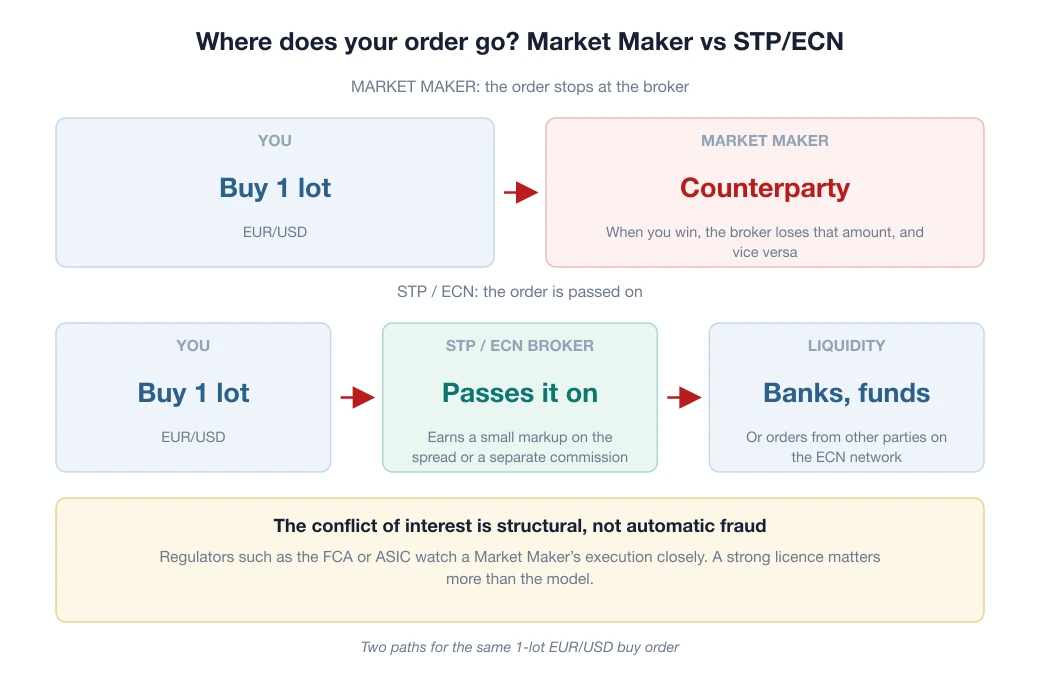
The diagram above draws exactly those two paths. The question underneath them is: when you lose, where does the money go? And the line between the models is far blurrier than the advertising suggests.
Three models: explained with a single example
You place a buy order for 1 lot of EUR/USD (the unit of order volume; 1 standard lot is 100,000 units):
- Market Maker (MM): the broker “sells” to you itself, the order is filled instantly against the broker and goes nowhere else. When you win, the broker loses that amount, and vice versa. In exchange, an MM fills orders smoothly, the spread is usually fixed and the minimum deposit is low: a model often found at brokers that serve beginners.
- STP (Straight Through Processing): the broker sends your order straight to liquidity providers (banks, funds) and takes a small markup added to the spread. The broker is the postman, not your opponent.
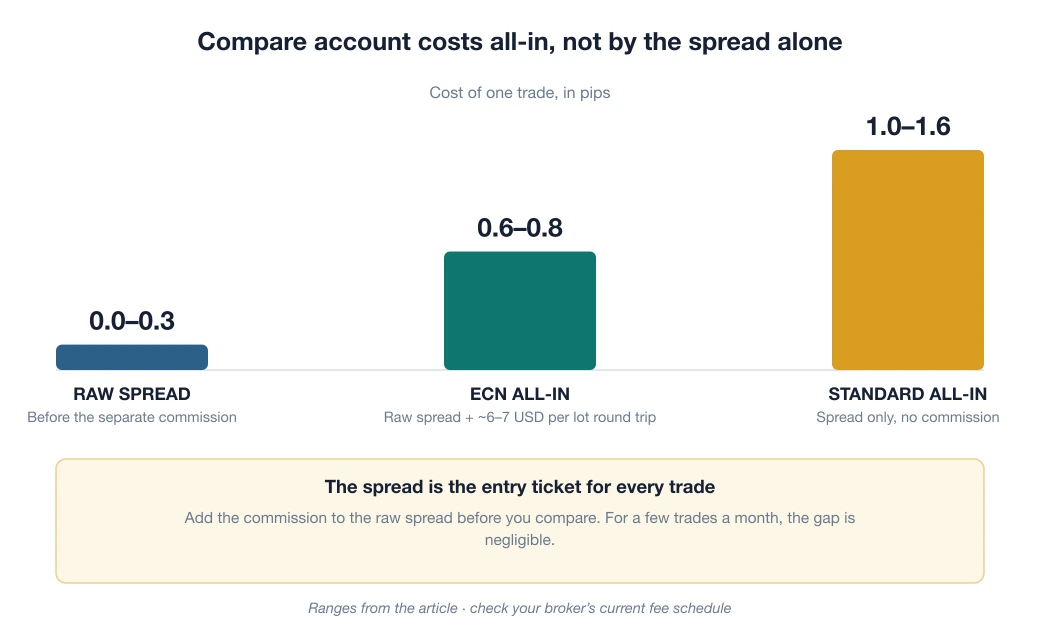
- ECN (Electronic Communication Network): your order enters a shared matching network alongside orders from other parties. You see a raw spread close to 0 and pay a separate commission (for example ~6–7 USD per lot round trip). It is the most transparent model and the standard for high-volume traders; we compare the brokers in this group directly in our top low-spread brokers.
Is a Market Maker a “scam”? A fair answer
Not automatically. The conflict of interest exists structurally, that much is true. But two forces pull the other way.
The first is supervision. An MM holding a strong licence such as FCA or ASIC is scrutinised very closely on the fairness of its execution, meaning the moment your order is actually filled.
The second is the business case. A decent broker earns far more steadily from the spread of tens of thousands of clients trading over the long run than from “eating” the money clients lose.
The spread is the gap between the buy and the sell price, which is the fee you pay on every trade. If clients blow up fast, the broker runs out of clients too.
The FXCM 2017 case is one where a regulator reached a conclusion: the broker was permanently banned in the US for secretly trading against its clients while advertising “No Dealing Desk”.
Fraud DOES happen. And strong regulators DO catch it. So the lesson is not “avoid MMs”, but to trade only with a broker under strict enough supervision.
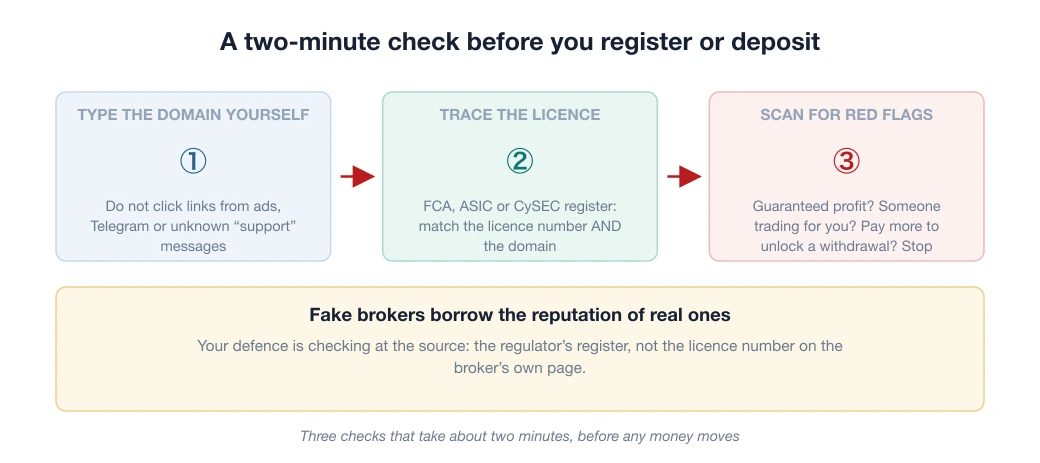
Many large brokers run a hybrid model, and clients cannot see which part goes where
- Many large brokers run a hybrid model: some orders are passed to the market, others are handled internally (B-book) depending on each client’s risk profile. An algorithm decides, and the client cannot see it.
- An “ECN account” at many brokers is a trade name for a fee structure (raw spread + commission), not a guarantee that 100% of orders enter a real ECN network.
- So instead of trusting the label, look at what can be verified: the fee structure, the actual execution quality and the licence.
How to “examine” your broker: 4 practical tests
- Fee structure: a raw spread of ~0.0–0.3 pip + a separate commission = an ECN-style structure; a fixed, bundled spread = MM-style. This is the most honest of the signals.
- Execution during news: a broker that passes orders to the market will show slippage in BOTH directions during big news (sometimes in your favour). A “broker” that only slips one way against you, with constant requotes, is a red flag.
- Maximum leverage: brokers under a strict licence (the original FCA/ASIC entity) have capped retail leverage. Leverage of 1:2000 is not bad in itself, but it tells you that you are with an offshore entity; read what leverage is carefully.
- Client terms: the “execution policy” section states whether the broker acts as principal (counterparty) or agent (intermediary). Ten minutes reading it is worth more than ten promotional articles.
Which model should you choose? It depends on your profile
- Beginners, small capital, few trades: the model is not the top priority; the licence and deposits and withdrawals are. A Standard account at a broker whose licence you can look up (see the broker rankings) is enough.
- High-volume trading, scalping, EAs: an ECN structure is close to a requirement, because the fee gap decides your monthly profit or loss. Compare all-in costs in the top brokers for scalping and EAs.
- Whatever your group: a strong licence comes before the model. A Market Maker under the FCA is more trustworthy than a “self-proclaimed ECN” registered on an island nobody supervises.
A quick glossary of terms you often see next to ECN/STP
- NDD (No Dealing Desk): an advertising label that groups STP and ECN together, meaning there is “no dealing desk” intervening. Remember the FXCM 2017 case: a broker advertising NDD can still do the opposite behind your back, and a label is no substitute for supervision.
- DD (Dealing Desk): another name for the Market Maker model.
- Requote: the broker says “the price has changed, accept the new price?” instead of filling your order. It is a hallmark of the instant execution used by old-style MMs. Modern brokers use market execution, so requotes are close to extinct; frequent requotes in 2026 are a sign of a problem with the broker’s technology.
- Slippage: a fill at a different price from the one you clicked. It is normal when the market moves fast, and honest when it goes BOTH ways (sometimes in your favour). Only one-way slippage against you is a red flag.
- Liquidity Provider (LP): a bank or fund that supplies prices to STP/ECN brokers, the grey boxes in the diagram near the top of this page.
“So which broker is a real ECN?” Nobody outside the broker can prove it
Nobody outside the broker, and its regulator, knows exactly where each order goes. So “100% real ECN” is something that cannot be proven from the outside.
Anyone who insists absolutely in either direction is overstating it.
There are three things you can verify:
- an ECN-style fee structure, meaning a raw spread plus a publicly listed commission;
- execution quality, which can be measured;
- a licence heavy enough that the broker would not dare play games.
By those criteria, the group we place here includes IC Markets, Tickmill and Vantage (Raw ECN). We compare each broker’s total cost in the low-spread table. And if someone declares “broker X trades against its clients”, ask them one question back: “based on what evidence?”
Usually, the answer is silence.
Is a Market Maker ever better for you?
Yes. And saying so is what makes this fair.
A beginner trading 0.01 lot needs stable execution, easy deposits and withdrawals, and a low entry amount. The MM model serves those needs very well. And the fee gap against ECN at that volume is only a few thousand VND per trade.
The ECN-vs-MM debate is really a debate for people who trade large volumes.
Choose according to your own stage, and upgrade when your volume makes the case, following the roadmap in the main guide.
Frequently asked questions
How is an ECN broker different from a Market Maker?
An ECN passes your order into a shared matching network with other parties and charges a commission; a Market Maker acts as the counterparty to your order itself and earns from the spread. The core difference is who stands on the other side of your order.
How can I tell whether a broker takes the other side of my trades (B-book)?
You cannot know for certain for each order, and many brokers run a hybrid model. Practical signals are the fee structure, execution behaviour during news, the leverage level and the execution policy in the terms. The most important thing is still which regulator supervises the broker.
Is an ECN account worth the money?
For high-volume traders, yes: all-in costs of ~0.6–0.8 pip compared with 1.0–1.6 pip on a bundled-spread account, and the gap multiplies with volume. For someone who places a few trades a month, the difference is negligible.
- CFTC (US). Forex fraud advisory naming entities that "claim you can trade on the interbank market"; this is the key point for telling a real execution model from a counterparty dealer
- ESMA (27/03/2018). Requires negative balance protection per account and a 50% margin close-out, applying to every execution model
Spotted something inaccurate? Tell us and we will check it and publish a correction.