
Five Exness account types: which one should you pick?
When you open an Exness account you have to pick one of five types, and most newcomers pick on instinct: "whichever has the lowest spread". That instinct costs money.
Spread is the gap between the buy and the sell price; a lot is a unit of position size, one standard lot being 100,000 units of the base currency; a pip is the smallest price step of a pair.
Liquidity is how easily a pair can be bought and sold.
Exness splits the five into two groups: Standard (Standard, Standard Cent) and Professional (Pro, Raw Spread, Zero).
The quick answer: beginners take Standard, high-frequency or high-volume traders take Raw Spread or Zero. But the "why" is the part worth money, especially once you count the rebate into the real cost.
The five Exness account types compared
| Account type | Minimum deposit | Minimum spread | Commission | Suits |
|---|---|---|---|---|
| Standard | Low, depends on payment method | 0.20 points | None | Beginners, occasional trading |
| Standard Cent | Low, depends on payment method | 0.30 points | None | Practice, very small capital |
| Pro | 200 USD | 0.10 points | None | Experienced, wants tight spread without commission |
| Raw Spread | 200 USD | 0.00 points | Up to 3.50 USD per lot per side | Scalping, large volume |
| Zero | 200 USD | 0.00 points | From 0.05 USD per lot per side | Zero-pip spread on popular pairs |
Updated 26/07/2026 from the Exness account opening screen. Leverage is the mechanism that lets you control more money than your own capital. Leverage on all types: high, with the specific level depending on account type, equity and the applicable regulations. Spreads can fluctuate and widen due to market volatility, news events, market open/close and other factors.
The Standard group: Standard and Standard Cent
Standard is the correct default for almost every beginner: a low first deposit that depends on the payment method, no commission, and every cost wrapped inside the spread so there is little to calculate.
Standard Cent works like Standard but shows balance and volume in cents (1 USD = 100 cents), which makes the numbers on a trade look "bigger". That helps psychologically when practising with very small capital, but the underlying risk is unchanged.
If your aim is to learn and trade live on modest capital, stopping at Standard is enough. Do not jump to the Professional group just because "pro" sounds better.
The Professional group: how Pro, Raw Spread and Zero differ
All three require a 200 USD minimum first deposit (per the Exness help centre, updated 19/09/2026) and target serious traders, but they charge differently:
- Pro: tighter spread than Standard (from 0.10 points), and still no commission. Suits someone who wants Standard's simplicity at a better cost and dislikes a separate commission line.
- Raw Spread: spread from 0.00 but a fixed commission of up to 3.50 USD per lot per side (about 7 USD round turn per lot). Transparent, easy to compute, suits scalpers.
- Zero: zero-pip spread on popular pairs, with commission charged separately from 0.05 USD per lot per side depending on the instrument. Suits someone concentrating on a few highly liquid pairs.
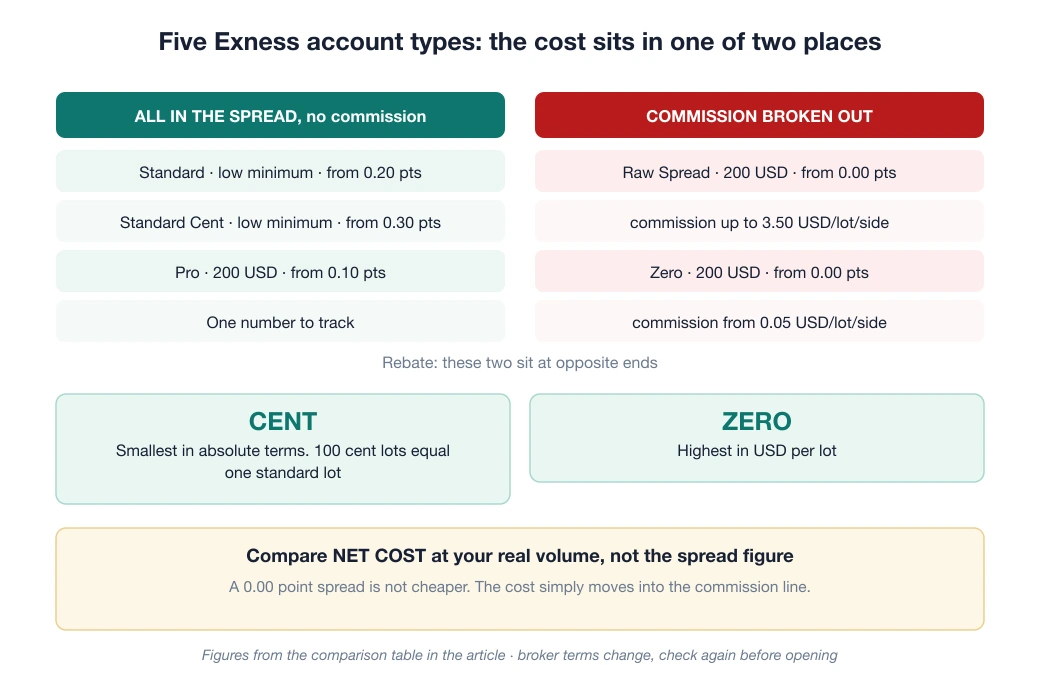
The point beginners get wrong: a "0.00 spread" account is not free. Raw Spread and Zero move the cost from the spread into the commission. Total cost can be lower than Standard, but only if you trade enough for the spread saving to outrun the commission.
How to choose: look at net cost, not at the spread
The most common mistake is picking the account with the smallest spread figure.
What deserves your attention is net cost = spread + commission minus rebate.
This is where the rebate changes the game: each account type carries a different rebate rate, and once it is deducted, the ranking of "which type is cheapest" can invert.
We compile the rebate rate per instrument and per account type in the Vietnamese article on the Exness rebate. Check the pair you actually trade before deciding.
By style:
- Starting out, capital under 200 USD: Standard. Simple, good enough, no commission to compute.
- High frequency, scalping or large volume: Raw Spread or Zero. Net cost is usually lower once the rebate is added in.
- Want a tight spread but dislike commission: Pro.
Rebate by type: Cent and Zero sit at opposite ends
Rebate rates are always quoted per standard lot. That is where the Cent account is most often misunderstood.
Per Exness's own documentation, one cent lot equals 1,000 USD while one standard lot equals 100,000 USD.
In other words one cent lot is only 0.01 of a standard lot. You have to trade 100 cent lots to equal one standard lot, and only then do you earn one full rebate unit.
| Type | Commission? | Rebate in practice |
|---|---|---|
| Standard Cent | No | Very small in absolute terms, since 100 cent lots equal one standard lot |
| Standard | No | Calculated on the spread, moderate |
| Pro | No | Similar to Standard |
| Raw Spread | Yes | Larger base to calculate on, so the rebate in USD is usually higher |
| Zero | Yes | The highest rebate in USD per lot of the group |
Exness confirms in its help centre that trading commission applies only to the Zero and Raw Spread types; the other three are exempt.
Precisely because Zero and Raw carry that extra commission, the base the rebate is calculated on is larger for those two, and the amount coming back to you is larger too.
The familiar paradox turns up again: the account type that looks more expensive can be cheaper once the rebate is deducted.
To get the figure for your own case, enter your spread, commission and rebate rate, then subtract the rebate, all in USD per lot.
Three things to know before picking Cent because it feels safe
- Cent is real money, not a practice mode. It is the only Exness account type with no demo version. To practise without risking money, open a demo on one of the other types.
- The balance shown in cents is easy to misread. Deposit 5 USD and the screen shows 500, and that three-digit number makes many beginners feel their capital is larger than it is.
- The rebate on Cent is close to negligible. If your reason for choosing Cent is to collect a rebate, that is the wrong reason. Choosing Cent to keep risk small while starting out is the right one.
Three notes before you commit
If you already have an account and cannot remember which type it is, Exness gives the route:
"Log in to your Personal Area. Select My accounts.
Open the menu with the 3-dot icon for the trading account you want to check, then select Account information. The trading account type appears in the Type field."
That step is worth doing before comparing fee tables, because every figure above changes with the account type.
- You can open several accounts: Exness allows multiple trading accounts under one profile, so you can try Standard first and add Raw Spread later without registering from scratch.
- The 200 USD first deposit for the Professional group is not a reason to move up: do not pile in your whole capital just to qualify for Pro, Raw or Zero. Money management matters more than account type.
- Attach the rebate when you open: open through a partner to receive one. See the Vietnamese guide on opening an Exness account. An account opened directly usually cannot have a rebate attached afterwards.
Frequently asked questions
Which Exness account type is best for a beginner?
Standard is the most sensible choice for a beginner: a low first deposit that depends on the payment method, no commission, and all cost inside the spread so there is nothing to calculate. Once you are used to it and trading more, you can add a Raw Spread or Zero account.
How do the Exness Raw Spread and Zero accounts differ?
Both have spreads from 0.00 and charge commission separately. Raw Spread has a fixed commission of up to 3.50 USD per lot per side; Zero charges from 0.05 USD per lot per side depending on the instrument and gives a zero-pip spread on popular pairs. Zero suits someone concentrating on a few highly liquid pairs.
Is the Exness 0.00 spread account free?
No. Raw Spread and Zero move the cost from the spread into a commission charged per lot. Total cost can be lower than Standard, but only when volume is large enough for the spread saving to outrun the commission.
What should I actually compare when choosing an Exness account type?
Net cost = spread + commission minus rebate, not the spread alone. Beginners or small accounts take Standard; high-frequency traders take Raw Spread or Zero. Always check the rebate rate for the pair you actually trade before deciding.
- Exness help centre, “What is the minimum amount needed to start trading?” (Vietnamese version, updated 19/09/2026): Standard and Standard Cent need a low first deposit that depends on the payment method; the Professional group needs a 200 USD minimum first deposit, subject to regional requirements. Read on 29/09/2026
- Exness, "Standard Cent account" (Vietnamese edition, broker updated 14/08/2026): 1 cent lot = 1,000 USD, equal to 0.01 standard lot; balance displayed in cents. Read 16/08/2026
- Exness, "Do trading accounts incur commission?" (Vietnamese edition, broker updated 16/04/2026): trading commission applies only to Zero and Raw Spread accounts
- Exness, "Real and demo accounts" (Vietnamese edition): every account type has a demo version except Standard Cent
- Exness. Account types (official page)
Spotted something inaccurate? Tell us and we will check it and publish a correction.