
Is Superfin legit? Three licences that do not check out
Deposit 1,000 USD with Superfin and you get another 300 USD in bonus money. You can open positions up to 500 times your capital, and withdrawals usually land within fifteen minutes.
The Vietnamese-language support answers through the night, on Telegram, in real Vietnamese that reads like a person typed it. Everything you can see runs smoothly, and that is exactly why you are weighing it up.
The real question does not live in the smooth days. It lives in the day a withdrawal is still pending on day three, the account is locked for “suspected unusual trading”, and support stops replying.
Whose door do you knock on then?
The broker has already answered that for you: its legal entity, meaning the specific company whose name is on your contract, is licensed in three places, one of them Australia.
None of those doors opens. The Australian licence does not show up in the register, the public list the regulator keeps. The company registration number the broker publishes does not even exist. One licence comes from an island that does not license this industry, and the last one sits with a regulator whose register does not open.

There are no grounds to conclude that Superfin is a scam. No authority has reached such a conclusion, and there is no evidence that the broker has held back client money. But as places for you to complain, those three licences are of no use right now.
The package you are looking at
According to aggregator sites, Superfin pitches Vietnamese clients with:
- a 30% deposit bonus, credited straight to the account and usable as margin, meaning the money locked up to keep open positions running
- leverage up to 1:500, meaning a ratio that lets you open positions 500 times larger than the capital you actually have, and higher still for so-called professional accounts
- MT4 and MT5, plus copy trading and trading robots
- More than twenty deposit and withdrawal channels, processed in ten to fifteen minutes
- Vietnamese-language support 24/7
The package is aimed squarely at beginners. Its mechanism lies in the bonus being added to margin, so you can open positions larger than the money you actually put in.
In Europe, regulators cap retail leverage at 1:30 and ban this type of promotion outright, precisely because it pushes beginners into positions bigger than they can withstand. The figure 1:500 is almost seventeen times that cap.
None of this is illegal. But it tells you which group of clients the broker is serving, and why the question “if something goes wrong, who do I go to” needs an answer before you deposit.
Three licences, checked one by one
| Where it is claimed | Number the broker publishes | Does it check out |
|---|---|---|
| Australia · ASIC | Superfin CORP PTY LTD, ACN 687 282 499 | no |
| St. Vincent & Grenadines | 1671 CTD 2024 | this jurisdiction does not license forex |
| Belize · IFSC | IFSC/60/292/TS/19 | register would not open |
Australia. ASIC publishes its full list of licensed entities as open data, downloadable as a spreadsheet. The 19/08/2026 edition holds 6,510 licences, and not one row carries the name Superfin or variants such as “SUPER FIN”.
Australia has one more door. A company without its own licence can still operate legally as an authorised representative of a licensed entity. That register holds 362,694 records, and it has no matching row either.
The ACN string the broker publishes does not exist in the Australian business register.
St. Vincent. The regulator there lists the scope of what it supervises: limited liability companies, mutual funds, international banks, international insurance and money services businesses. Forex brokerage is not on the list.
That means an “SVG licence number” for a forex broker does not correspond to any licensing regime, because the jurisdiction does not license this industry. The number 1671 CTD 2024 is most likely a company registration number.
The same pattern turned up with Dupoin, where a UK company had only a company registration number and no regulator reference number.
Belize. The public register cannot be reached. A licence you cannot check yourself has already lost most of its value.
The wording trap many people fall into
This part works for any broker. For the opposite case, an ASIC licence that is real and does check out while the risk sits somewhere else, see the profile of DBG Markets.
Australia has two quite different things, both run by ASIC, with names that sound alike:
| What it is | How you get one | |
|---|---|---|
| ACN | Company registration number. Proves the company exists | A few hundred dollars, done online |
| AFS Licence | Licence to provide financial services | Months of review, capital required, staff required, subject to inspections |
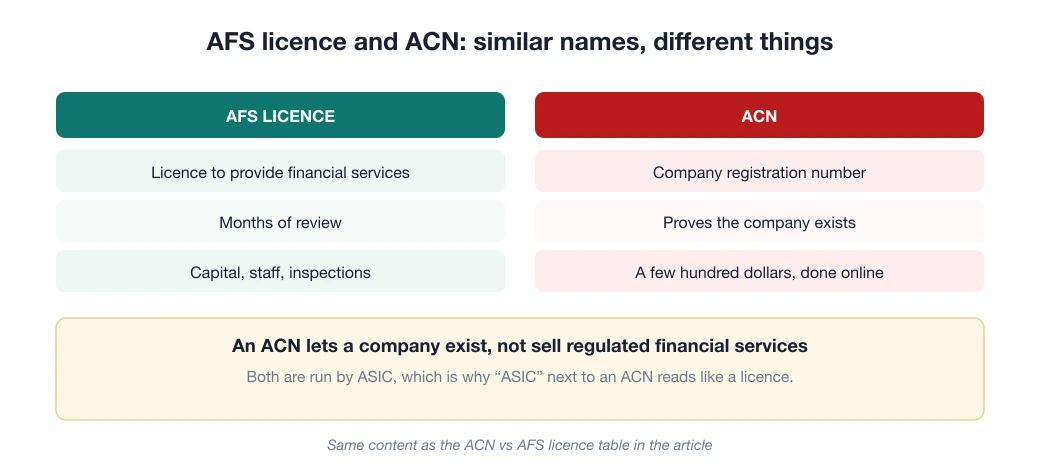
A company with an ACN may exist in Australia, but it may not offer regulated financial services. Putting the word “ASIC” next to an ACN string is a very effective play on words: the reader sees the name of the Australian regulator and fills in the rest in their own head.
With Superfin it does not even get that far, because that string does not check out.
Incidentally, there is a real company in Australia called SUPERFIN PTY LIMITED, ABN 85 092 074 078. But its ACN is 092 074 078, it was registered in June 2000, and it holds no AFS licence. It is most likely just a name clash.
If you are thinking of depositing
The useful step is to know what you are buying before you decide to walk away or stay. You are sending money to a legal entity that, for now, cannot be tied to any regulator.
That does not mean the money will be lost. It means that if it is lost, there is no third party you can complain to.
If you still want to try it, there are three minimum steps:
- Go to the account terms and find the name of the company that signs with you. Write down the full legal entity name. The brand name is useless at the lookup stage.
- Deposit an amount you can afford to lose completely, then try withdrawing part of it within the first week, before depositing more. A successful withdrawal is not proof of safety, but a failed one is proof enough.
- Do not accept the deposit bonus before you have read the withdrawal conditions carefully. Bonus money added to margin usually comes with trading volume requirements, and it locks up your original capital too.
If you have already deposited and are worried
Do not deposit more to “win it back” or to meet the withdrawal conditions. That is a common trap.
Work in this order: today, before the account can be locked, take screenshots of your full balance, trading history and withdrawal history.
Then place a withdrawal for a small amount and note the time. Keep every message with the person who introduced you to the broker, Telegram messages included.
The detailed steps are in the article on what to do when your account is locked and you cannot withdraw. That file of evidence is the only thing of value if you later need to report the case to the police.
And in Vietnam, that is the only door left, because no regulator licenses forex brokers for you to complain to.
Check any broker yourself in about ten minutes
- Find the legal entity name in the account-opening confirmation email or in the website footer.
- Search for “ASIC AFS Licensee dataset data.gov.au”, download the CSV, open it in Excel and search.
- Also check the authorised representative register in the same place.
- Also check a broker you know for certain is licensed. If it does not come up either, the fault is in how you searched, not in the broker you are checking.
- For an ACN, look it up in ABN Lookup. A record means the company is real, not that it is licensed.
The full procedure for every kind of licence, with a link to each register, is in the article on how to verify a forex broker before you deposit.
Step 4 is often skipped. Typing “IC MARKETS”, for example, returns AUTOMIC MARKETS PTY LTD, just because the string of characters sits inside another name.
What this does not mean
A licence that does not check out does not make a broker a scam. Many brokers have operated for years and paid out in full while their paperwork sits in island states, and most international brokers serving Vietnamese clients place their entity outside the regions with strong licences.
Why a Tier-1 licence may still not protect you is covered across 20 brokers in a separate article. Fast withdrawals and good Vietnamese-language support are real too, and deserve credit.
The licence numbers above come from third-party aggregator sites. If Superfin publishes different numbers through an official channel, the conclusion about Australia could change.
⚠️ Risks to know before you deposit a single dollar. Forex trading uses leverage, meaning a ratio that lets you open positions larger than the capital you actually have. It magnifies both profits and losses, and it can cost you your entire capital.
Vietnam’s State Securities Commission has stated that it has not licensed any forex broker in Vietnam, so every dispute falls outside the country and beyond the protection of Vietnamese law. Beginners should start with a demo account.
If you believe any information above is inaccurate, especially a licence number or a legal entity name, please get in touch so we can correct it.
Frequently asked questions
Is Superfin a scam?
No authority has reached that conclusion, and there is no evidence that the broker has held back client money. What can be answered is this: the three licences the broker publishes cannot currently serve as a place to complain, because one does not check out, one belongs to a jurisdiction that does not license this industry, and the last sits with a register that is down.
The broker says it is “licensed by ASIC”. Why do you say it does not check out?
Because “ASIC” sits next to an ACN string, and an ACN is a company registration number, not a licence to provide financial services. The two are entirely different. In this case even the published ACN does not exist in the Australian business register.
I have money in a Superfin account. Should I withdraw it all right now?
Withdrawing everything or keeping it depends on the state of your account. The first thing to do is take screenshots of your full balance, trading history and withdrawal history, then try withdrawing a small amount to see whether the process works. Do not deposit more to meet the withdrawal conditions.
If withdrawals still arrive normally, does that mean the broker is safe?
No. A successful withdrawal only proves the broker is paying at that moment. Many incidents in this industry happen after a long period in which everything ran smoothly. A licence matters for a different reason: it is the third party you can complain to when the broker stops paying.
Is the 30% deposit bonus a trap?
It is not illegal, but read the conditions carefully. Bonus money added to margin lets you open positions larger than your real capital, and it usually comes with trading volume requirements before you can withdraw. In Europe, regulators ban this type of promotion outright for retail clients.
Can I check another broker’s licence myself?
Yes, and it takes about ten minutes. Take the legal entity name from the account-opening confirmation email, search the regulator’s open data, then also search a broker you know for certain is licensed to make sure your method works. The full steps are in the article linked in the section above.
- ASIC. AFS Licensee Dataset, the open dataset of the Australian Securities and Investments Commission. The edition downloaded on 19/08/2026 holds 6,510 licences; searching for Superfin and its variants returned no results.
- ASIC. AFS Authorised Representative Dataset, 362,694 records, searched on 19/08/2026. No record carries the name Superfin.
- ABN Lookup, the Australian business register. Searching ACN 687 282 499 on 19/08/2026 returned 'ACN not found'.
- Financial Services Authority, St. Vincent & the Grenadines. The official page listing its scope of supervision, read on 19/08/2026: forex brokerage is not included.
- Vietnam's State Securities Commission: no forex broker has been licensed in Vietnam.
Spotted something inaccurate? Tell us and we will check it and publish a correction.