
Running EAs and scalping on IC Markets: does it really fit?
IC Markets is a name that comes up often in Vietnamese groups that run EAs (automated trading robots) and scalping. The question is whether the broker really suits this style, or whether EA sellers simply recommend it through their partner links.
The honest answer: technically, it does suit, but many people running EAs still lose money, and the cause does not lie with the broker.
Why the IC Markets model suits this technically
For high-frequency trading, three factors decide the outcome: the cost per trade, execution speed and whether the broker bans your strategy. IC Markets meets all three:
- Raw spread from 0.0 pips plus a fixed commission (~3.5 USD per lot per side on the Raw Spread account). This structure matters to scalpers: the commission stays the same however much the market moves, while a spread-only account gets more expensive when spreads widen.
- An ECN/No Dealing Desk model, where orders go straight out to liquidity providers. The broker does not sit on the other side of your trade, so there is no “you win, the broker loses” conflict of interest.
- No ban on scalping or EAs. Many market-maker brokers restrict trades held for under a few minutes or ban certain EAs. IC Markets does not, and that is one reason the broker comes up often among algo traders.
- cTrader support alongside MT4/MT5, a platform with cAlgo that suits people who code their own strategies.
To compare other options on the same three criteria, see the list of brokers suited to scalping and EAs.
The cost maths: what does scalping really cost?
Newcomers tend to skip this part, then feel surprised when the account shrinks even though they “win more than they lose”.
On a Raw Spread account, each round trip of one lot of EUR/USD (a lot is the unit of order size; one standard lot is 100,000 units) costs ~7 USD in commission (3.5 × 2 sides), plus a very small spread (the gap between the buy and the sell price, which is the fee you pay):
| Trading frequency | Volume per month | Commission cost | Minimum profit to break even |
|---|---|---|---|
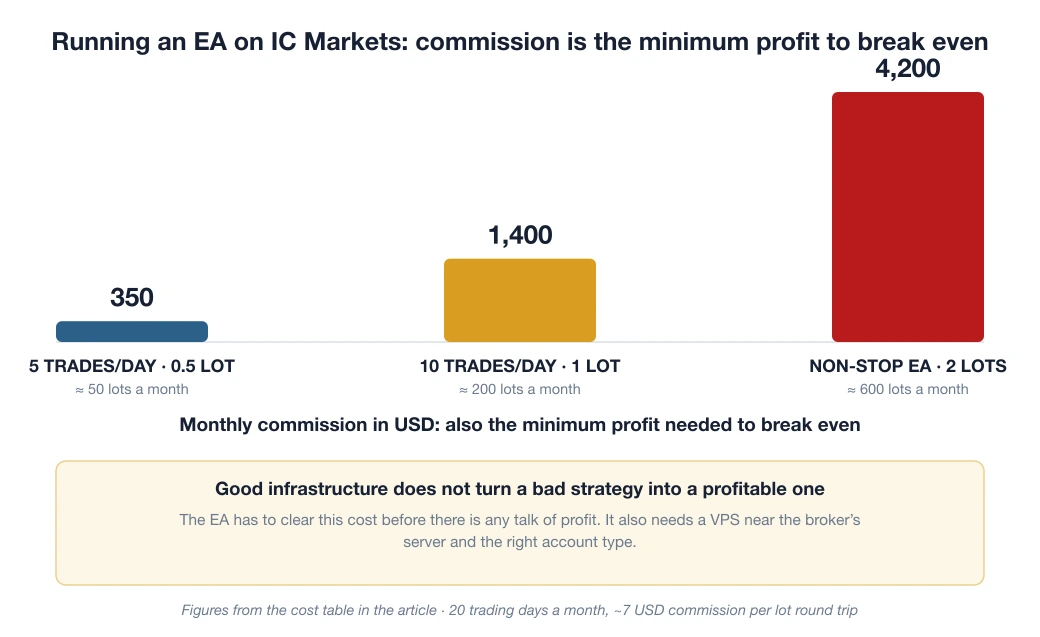
| 5 trades a day, 0.5 lot | ~50 lots | ~350 USD | 350 USD |
| 10 trades a day, 1 lot | ~200 lots | ~1,400 USD | 1,400 USD |
| EA running non-stop, 2 lots | ~600 lots | ~4,200 USD | 4,200 USD |
Assumes 20 trading days a month and commission of ~7 USD per lot round trip. The figures are illustrative, to show the scale; real costs vary by pair and account type.
What it means: an EA trading large volume has to produce thousands of USD in profit every month just to cover its fees.
That is why so many EAs show a beautiful equity curve in a backtest yet slowly lose money live: backtests often under-count commission, widening spreads and slippage (the fill landing away from the price you saw when you clicked). Before you trust any profit report, ask: have all the fees been deducted?
Three technical factors that decide whether an EA runs well
- VPS and latency. An EA running on a personal computer stops when the power or the internet drops, or when the machine goes to sleep. If you are serious, you need a VPS located near the broker’s server to cut latency; for scalping, a gap of a few tens of milliseconds is enough to change the result.
- Choose the right account type. Running an EA on a Standard account (spread ~1.0 pip, no commission) usually costs more than Raw Spread at large volume. If the EA trades rarely, on the other hand, the difference is negligible.
- Test on demo first, but do not trust demo completely. Demo does not reproduce slippage and liquidity depth accurately. After demo, trade live with the smallest size you can for at least a few weeks before adding capital.
MT4, MT5 or cTrader for automated trading?
IC Markets supports all three, and your choice directly affects whether you can find a ready-made EA or have to write your own:
- MT4 has a large EA library, and many robots sold on the Vietnamese market are written for MT4 (in the MQL4 language). Pick it if you buy a ready-made EA.
- MT5 is faster, with multi-threaded backtesting and more accurate tick simulation than MT4. Pick it if you write your own EA and need serious testing. The drawback: an EA written for MT4 does not run on MT5.
- cTrader has a modern interface, transparent market depth (DOM) and programming in C# through cAlgo. Pick it if you have a programming background and want to see liquidity clearly.
A practical suggestion: if you are starting out and plan to use someone else’s EA, MT4 gives you the least friction, with plenty of Vietnamese-language guides and help that is easy to find. For how to log in to the platform, see the MT4/MT5 login guide (the steps are similar at every broker).
Why the “steady-profit EA” promise does not hold up
Many Vietnamese traders lose money at this stage because the EA was sold with a promise attached, and the broker had little to do with it:
- “An EA making 20–30% a month that never blows up”: if it existed, the seller would run it themselves rather than sell it to you for a few million dong. A promise of fixed profit is a classic sign of a scam.
- A pretty equity curve built on holding losers. Many EAs (martingale or grid types) never cut a loss and keep adding trades until the price turns. They win month after month, then wipe out the account in a single session. The backtest looks good because it has not yet met a strong enough move.
- EAs sold with a partner link. The seller earns commission on the volume you trade, so the more trades the EA opens, the more they gain, whether you win or lose. This conflict of interest works the same way as an IB rebate.
- Letting a “guru” run it for you means handing over your money. If someone asks you to transfer money so they can install the EA and manage it for you, you are handing your capital to another person to trade, which is a sign of a scam. How to tell the two apart is in the article on copy trading vs handing over your money.
In short: IC Markets provides good infrastructure for EAs, but good infrastructure does not turn a bad strategy into a profitable one. The broker is only the runway; the plane is still your strategy.
If you still want to start
- Understand the EA’s logic before running it. If you do not know what conditions trigger its entries and how it cuts losses, you are handing your account to a black box.
- Insist on a stop loss. Reject any EA that does not set a stop-loss, however good its history looks.
- Run small capital for at least 1–2 months and compare the live results with the backtest. A large gap means the backtest under-counted costs.
- Limit your total risk. Decide in advance how much loss will make you switch the EA off, and stick to it; see money management.
- Check the broker first. Read the IC Markets review and is IC Markets a scam so you know the legal entity and the terms of your account.
Frequently asked questions
Does IC Markets allow scalping and EAs?
Yes. IC Markets does not ban scalping or EAs. That is one reason the broker comes up often among automated traders, alongside its low raw spreads and an ECN model that does not take the other side of client orders.
Which account type should I choose to run an EA on IC Markets?
Raw Spread (spread from 0.0 pips plus commission of ~3.5 USD per lot per side) is usually the best fit when the EA trades large volume, because the fixed commission does not rise when the market moves. If the EA trades rarely, the difference from the Standard account is negligible.
Why does an EA show a pretty profit in the backtest but lose money live?
Usually because the backtest under-counts real costs: commission, spreads widening around news, and slippage. At large volume, commission alone can reach thousands of USD a month. The EA has to clear that amount before it starts making a profit.
Can I trust an EA that promises 20-30% a month?
No. A promise of fixed profit is a classic sign of a scam. Many EAs have a pretty equity curve because they never cut a loss (martingale, grid): they win for months in a row, then wipe out the account in one volatile session.
Do I need a VPS to run an EA?
You should have one if you are serious. An EA running on a personal computer stops when the power or the internet drops, or when the machine goes to sleep. A VPS located near the broker’s server also cuts latency, which matters for scalping strategies.
Spotted something inaccurate? Tell us and we will check it and publish a correction.