
Copy trading on Exness: how it works and the real risks
Copy trading on Exness lets you automatically copy the orders of another trader into your own account. To a newcomer it sounds appealing: no need to know analysis, just pick someone with a good track record and “copy”.
But this is also where many Vietnamese traders lose money, not because of the broker, but because they misunderstand what it is: they confuse the mechanism, skip over the costs, and cannot tell legitimate copy trading apart from a managed-money scheme in disguise.
How it works: the account is still yours
The first key point is also the one that protects you: the money stays in the account in your name. The system only replicates order signals. The person you copy cannot touch your money and cannot withdraw it. You can stop copying at any moment.
The basic process:
- You open an Exness account (see the sign-up guide) and deposit funds into your own account.
- Browse the list of strategy providers, each with public performance statistics.
- Pick one, set how much capital to allocate, and start copying.
- Every order they open is opened correspondingly on your account, scaled to the capital you allocated.
- You can stop copying or close orders by hand at any time.
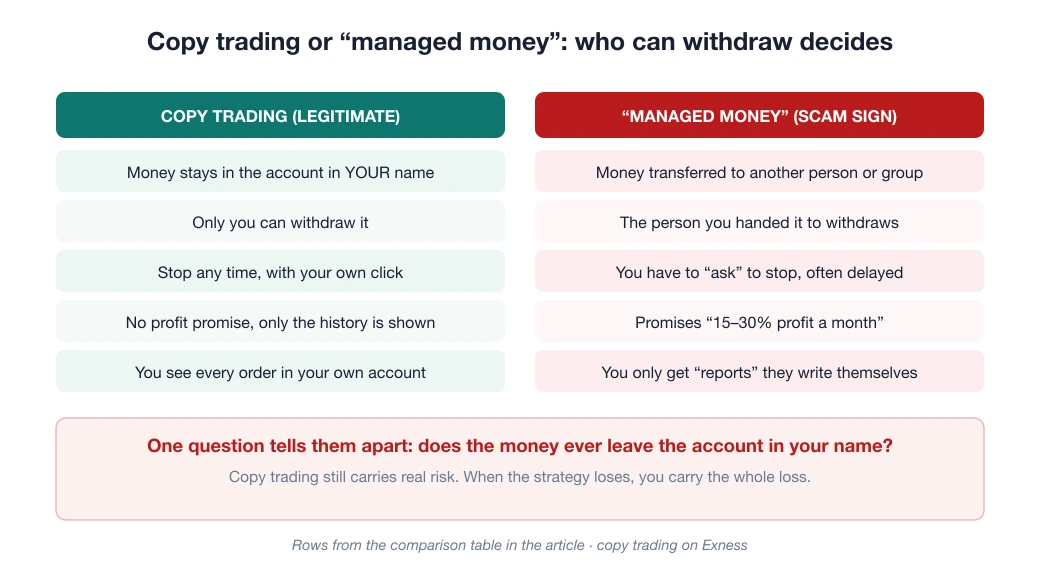
Copy trading is NOT handing over your money: the line that decides everything
This is where many scam victims have one concept swapped for another:
| Copy trading (legitimate) | “Managed money” (scam sign) | |
|---|---|---|
| Where your money is | In the account in your name | Transferred to another individual or group |
| Who can withdraw it | Only you | The person you handed it to |
| Can you stop? | Any time, with your own click | You have to “ask”, and it is often delayed |
| Profit promise | None, only the history is shown | “15–30% profit a month” |
| Order transparency | You see every order in your own account | You only get “reports” they write themselves |
If someone tells you to transfer money to them so they can “trade it for you”, that is not copy trading. It is managed money, and a classic sign of a scam.
DCTopTrade and brokers with a licence you can look up do not take money to manage in any form. See similar patterns in our scam warning files and in the article on whether copy trading is worth it.
Cost: what do you pay the person you copy?
Copy trading is not free. On top of the normal trading costs (spread and commission, see Exness fees), you usually have to give the strategy provider a share called a performance commission. The provider sets the rate and shows it publicly before you copy.
The consequence needs careful arithmetic. Say the strategy makes 10% in a month and the share is 30%: you keep only about 7% before trading costs. When it loses, on the other hand, you carry the whole loss. The strategy provider pays nothing back.
This “profits shared, losses yours” structure gives some providers a motive to trade aggressively for standout returns, because for them the risk is asymmetric.
Choosing whom to copy: do not look at the profit % alone
Leaderboards always push the prettiest profit figures to the top, and that is exactly the trap. Check these as well:
- Time in operation. A strategy that made 200% in 2 months says nothing statistically. Prefer a history of at least 6–12 months that has been through several market conditions.
- Maximum drawdown. This number matters more than the profit. A 60% drawdown means the account at some point lost 60% of its value. Could you sit through that?
- Consistency. An equity curve that climbs steadily is more trustworthy than a jagged one that shoots up and then collapses.
- Holding losers and adding to them. Many good-looking strategies owe their look to never cutting a loss and adding more orders until the price turns. It works... until the last time, when it wipes out the copiers’ accounts as well.
- Volume relative to capital. Someone using extremely high leverage produces impressive short-term returns with matching risk. The arithmetic is in the article on Exness leverage.
Four risks few people tell you about
- The past does not guarantee the future. A strategy suited to a trending market can collapse as soon as the market moves sideways. You usually start copying after its best stretch, just as the lucky run ends.
- You learn nothing. Copy trading does not teach you to trade. After a year of copying, if that person stops, you are back at the starting line. If your goal is skill, start with the Forex learning path.
- Psychological risk. Many people stop copying right at the bottom of a drawdown out of panic, lock in the loss for good, and then miss the recovery.
- Being used as bait. Some “gurus” show off a copy account to lure you into a private group, and only then suggest you transfer money for them to manage. Copy trading is the bait; managed money is the trap.
If you still want to try: how to keep it under control
- Start with small capital, an amount you accept losing entirely. Treat the first few months as the fee for watching and learning.
- Spread across several strategies instead of putting everything on one person.
- Set your own stop limit: decide in advance “if I lose X%, I stop copying”, and stick to it.
- Never transfer money to an individual. Everything happens inside your own account. If someone asks you to do it differently, stop right there.
- Check the broker first. Copy trading only holds up on a broker you can actually withdraw from. See the Exness review and the broker rankings.
Frequently asked questions
Is copy trading on Exness safe?
Safer than managed money, because the money stays in the account in your name, nobody else can withdraw it, and you can stop copying at any time. But safe in terms of who holds the money does not mean you cannot lose. You carry the full trading risk.
How is copy trading different from managed money?
Copy trading: the money stays in your account, only order signals are copied, and you can stop whenever you want. Managed money: you transfer money for someone else to manage. That is a classic sign of a scam. If anyone asks you to transfer money so they can “trade it for you”, stop right there.
How much does copy trading on Exness cost?
On top of the usual spread and commission, you usually give the strategy provider a commission on profits, which they set themselves and publish in advance. Note that when there is a loss you carry all of it; they pay nothing back.
What should I look at when choosing whom to copy?
Do not look only at the profit %. Check time in operation (prefer more than 6–12 months), maximum drawdown, how steady the equity curve is, and whether the strategy holds losing positions or keeps adding to them.
Should beginners try copy trading?
You can try it with small capital to observe, but do not treat it as passive income. Copy trading does not teach you trading skills: if the person you copy stops, you are back at the starting line.
Spotted something inaccurate? Tell us and we will check it and publish a correction.