
Forex account types: which one should you choose?
Every broker names its accounts its own way: Standard, Micro, Raw, Zero, Razor, cTrader, Ultra Low, Prime. Underneath the names there are only four groups.
What separates them is how the fee is collected, more than which one is cheaper. Either it is bundled into the spread (the gap between the buy and the sell price, which is the fee you pay), or it is split into a spread close to zero plus a commission.
Across the 20 brokers we track, 17 offer a Standard group, 13 offer a Raw/ECN/Zero group, and 11 offer both. So choosing an account type usually happens inside one broker, not between brokers.
Four groups, and how to recognise them whatever the name
| Group | Common names | How the fee is charged | Offered by |
|---|---|---|---|
| Fee in the spread | Standard · Classic · Micro | No commission, wider spread | 17/20 brokers |
| Spread ~0 + commission | Raw · ECN · Zero · Razor · Prime · Ultra Low | Spread from 0.0 pip, commission per lot | 13/20 brokers |
| Cent | Cent · Standard Cent | Like Standard, but the balance is counted in cents | 6/20 brokers |
| High capital requirement | Pro · VIP · Premium · Elite | Better conditions in exchange for a high minimum deposit | 4/20 brokers |
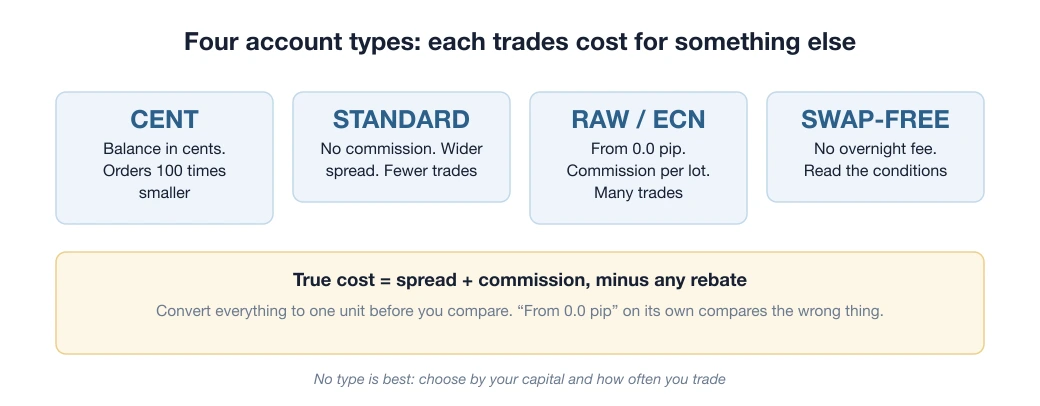
A quick way to tell them apart is to look at the commission. A lot is the unit of order size, and one standard lot is 100,000 units. If the account charges a commission per lot, it belongs to group two, whatever the broker calls it.
If there is no commission, the fee already sits inside the spread. No account type is free.
“0.0 pip” does not mean free
Misunderstandings come easily here, and they often lead newcomers to the wrong account.
A Raw account advertises “spread from 0.0 pip”, which sounds free. But it charges a commission, usually around 3–3.5 USD per lot per side, or 6–7 USD round trip. A pip is the smallest price step of a currency pair. Converted to pips on EUR/USD, 7 USD per lot equals about 0.7 pip.
True cost = spread + commission, converted to the same unit
Raw account at 0.0 pip + 7 USD per lot round trip ≈ 0.7 pip · Standard account at 1.0 pip with no commission = 1.0 pip. Raw is cheaper, but it is not “free”, and the gap is much smaller than “0.0 versus 1.0” makes it feel.
Convert everything to one unit of money before you compare. The full cost calculation is in the article on what spread is.
Three factors that reverse the conclusion
Commission is a fixed amount per lot and spread is charged in proportion to each lot, so the gap between the two account types barely changes with volume. Three other factors are what really change the conclusion:
- Minimum deposit. Many Raw accounts require far more capital: in our dataset one broker sets 200 USD for Raw, while its Standard account needs only 5–10 USD. For someone starting with small capital, this is usually the deciding factor, not a 0.3-pip difference.
- How often you trade. A 0.3-pip gap per lot is not worth worrying about if you place 2 trades a week. If you run an EA (an automated trading program) that opens dozens of trades a day, it adds up to real money.
- Rebates. A rebate is the part of your trading fee that a partner returns to you. On a Standard account it is usually much higher than on Raw, but only because the base cost is higher too. Subtract it before you compare.
Cent accounts: useful when used right, dangerous when misunderstood
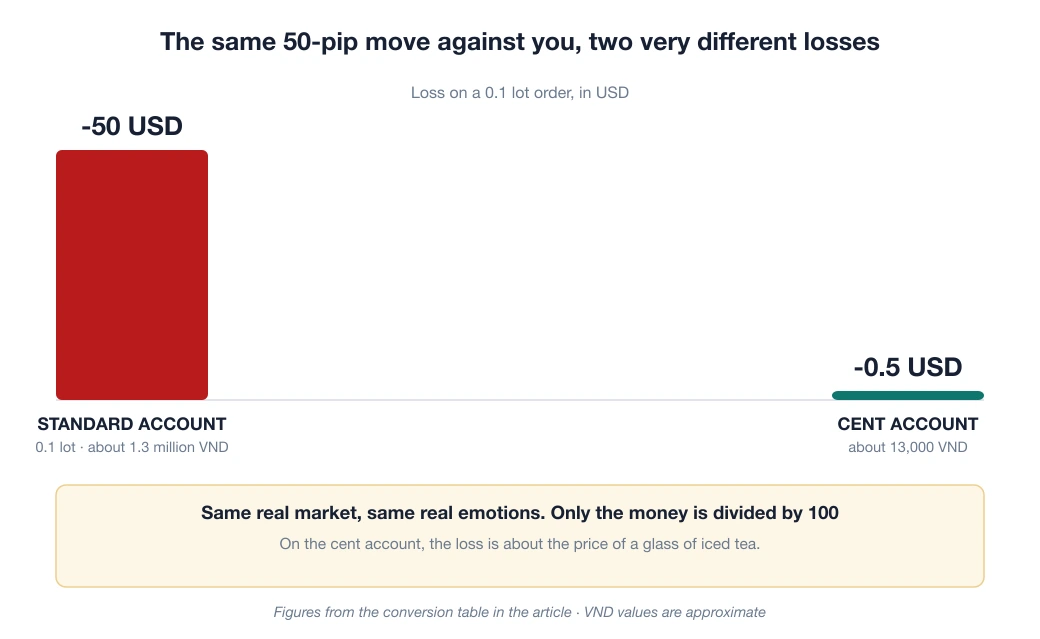
A cent account shows the balance in cents: a 10 USD deposit appears as 1,000 cents. Order size is 100 times smaller, so the risk on each trade shrinks by the same factor.
Used right: you practise your order routine with real money, at a loss you can accept. A demo account cannot reproduce this, because a demo puts no psychological pressure on you.
Misunderstood: you read 1,000 as “a lot of money”, trade freely, then carry that habit over to a real account. This is the real trap of the account type. More detail in the article on what a cent account is.
Swap-free: not “free”
A swap-free account (also called an Islamic account) charges no overnight fee, for people whose religion forbids receiving or paying interest. The broker does not work for nothing, though: it usually recovers the cost through a wider spread, or a daily admin fee once you have held a position for a set number of days.
So if you pick swap-free only to avoid overnight fees on long-held positions, read the conditions carefully, because in many cases the total cost comes out higher. See the article on what swap is.
How to choose: three questions, in this order
- Does your capital meet that type’s minimum deposit? If not, every comparison after this one is meaningless.
- How many trades do you place a week? Under 5, the cost difference between the two types is barely noticeable, so pick the simpler one. Over 20, or with an EA, work out the net cost carefully.
- Do you receive a rebate? If so, subtract it before comparing, because it can reverse the order.
What not to do: pick an account type by the biggest number in the advert, whether that is “0.0 pip” or “rebates up to $X per lot”. Both numbers are part of the cost, not the cost.
Brokers set the names and conditions of their account types, and they change them without notice. If a description here does not match what you see in your client portal, send us a screenshot.
To see which types each broker offers and the minimum deposit for each: the comparison table of 20 brokers.
Frequently asked questions
What types of forex trading account are there?
The names vary from broker to broker, but there are only four groups: accounts with the fee bundled into the spread (Standard, Classic, Micro), accounts with a near-zero spread plus commission (Raw, ECN, Zero, Razor, Prime), cent accounts with the balance counted in cents, and accounts with a high capital requirement (Pro, VIP). Of the 20 brokers we track, 17 offer the first group and 13 offer the second.
How do Standard and ECN accounts differ?
They differ in how the fee is collected, not in which one is cheaper. Standard bundles the whole fee into a wider spread and charges no commission; ECN/Raw has a spread from 0.0 pip but charges a commission per lot. You have to convert both to the same unit, USD per lot, before you can compare them.
Is a 0.0 pip spread account the cheapest?
No. A 0.0 pip account usually charges 3–3.5 USD commission per lot per side, or 6–7 USD round trip, which on EUR/USD equals about 0.7 pip. That is cheaper than a Standard account at 1.0 pip with no commission, but the gap is much smaller than “0.0 versus 1.0” makes it feel.
Which account type should a beginner choose?
Go through three questions in order: does your capital meet the minimum deposit, how many trades do you place a week, and do you receive a rebate. A beginner placing fewer than 5 trades a week will barely notice the cost difference between types, so choose the simpler one with a minimum deposit that fits your capital.
Is a swap-free account really free?
No. A swap-free account charges no overnight fee, but the broker usually recovers the cost through a wider spread or a daily admin fee after you have held a position for a number of days. If you choose it only to avoid overnight fees on long-held positions, read the conditions carefully, because the total cost can be higher.
- Exness, “Trading account types” (broker updated 30/07/2026): the list of account types with the minimum deposit, spread and commission for each
- ESMA (27/03/2018). Whatever the account type, ESMA’s leverage caps apply by asset: 30:1 on major currency pairs, 20:1 on gold and major indices, 5:1 on shares, 2:1 on crypto
Spotted something inaccurate? Tell us and we will check it and publish a correction.