
What is margin in forex? Margin level, call and stop out
On the night of the 15th of some month, an interest rate announcement is due. A 1,000 USD account opens 0.5 lot (the unit of trade size; 1 standard lot is 100,000 units) and is gone within 40 minutes.
The next morning the owner posts the familiar question in a group: “the broker closed my trades by itself, have I been scammed?”
No. You have just met a stop out, and the whole story of that night was decided the moment you set the trade size.
To never become the main character of this story, you only need to understand one concept properly: margin, the amount the broker “locks” as a deposit when you open a trade. It is not a fee, it is not spent, and it comes back in full when you close the trade.
It comes with a set of three indicators: margin level, margin call, stop out.
The thermometer in the opening image lines up the margin level zones, from safe down to stop out.
The running example: a 1,000 USD account
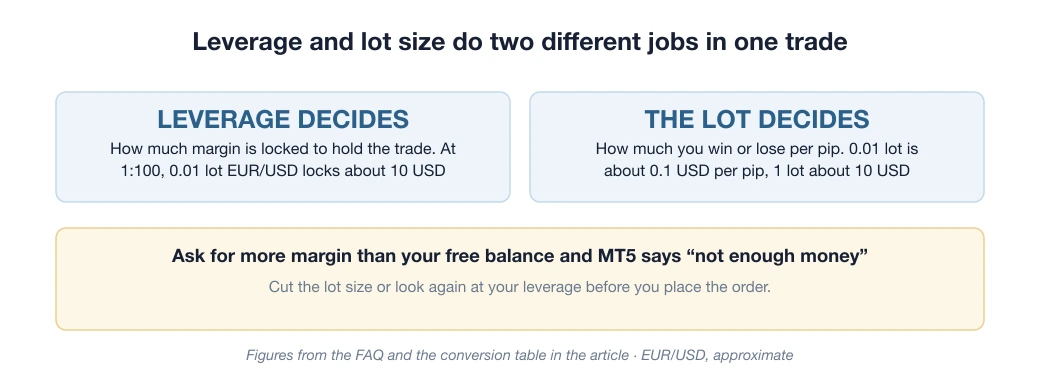
You have 1,000 USD and leverage of 1:100 (which lets you control more money than your real capital), and you open 0.5 lot of EUR/USD (position value 50,000 USD):
- Locked margin = 50,000 ÷ 100 = 500 USD. This figure stays put whether the trade is winning or losing.
- Equity (real capital) = balance ± open profit/loss. The trade is 200 USD down → equity = 800 USD.
- Free margin = equity − margin = 800 − 500 = 300 USD, your remaining “breathing room”: it is both how much more loss you can absorb and the limit on opening new trades.
- Margin level = equity ÷ margin × 100% = 800/500 = 160%, the number on the MT5 screen that beginners usually ignore.
Margin call and stop out: two alarms read off the margin level
- Margin call (usually around 100%, depending on the broker): equity has fallen to the amount of locked margin, and the broker warns you to deposit more or close some trades. This is the alarm, not yet the sentence.
- Stop out (usually 20–50% depending on the broker): the system AUTOMATICALLY closes trades, starting with the biggest loser, until the margin level recovers above the threshold. This is not the broker “stealing your trades”. It is an emergency brake that saves what is left of your capital. If this brake fires, the mistake happened when you chose the trade size, not when the market moved.
Continuing the example: the price keeps moving against you, equity (the real balance, including the profit or loss of open trades) drops to 500 USD → margin level 100% → margin call.
It drops further to 150 USD → 30% → stop out, the trade is closed. From 1,000 USD you are left with ~150 USD, and the whole scenario started with the decision to open 0.5 lot on 1,000 USD, an effective leverage of 50:1.
The “never hit a stop out” rule: just 2 numbers
- Effective leverage ≤ 10:1, meaning total position value no more than 10 times equity. With 1,000 USD, that is at most ~0.1 lot of open trades in total. Your margin level will always sit in the thousands of percent, and stop out becomes a theoretical idea.
- Risk 1–2% per trade through the stop loss, worked out with the formula risk ÷ (stop loss × pip value). With a proper stop loss, the trade is usually closed at the point YOU chose, instead of drifting to a point the broker picks for you.
Traders who get stopped out are usually traders who set no stop loss or trade more volume than their capital can carry.
Three misunderstandings about margin you see daily in trader groups
- “Margin is a fee the broker takes”. Wrong. It is a deposit, returned when you close the trade. The real costs are in the spread/commission and swap.
- “High leverage locks more margin”. The opposite: the higher the leverage, the LESS margin is locked for the same volume (1:500 locks 100 USD for 0.5 lot instead of 500 USD at 1:100). The danger of high leverage is that it LETS you open bigger, not the deposit itself.
- “Plenty of free margin means I am safe”. Not necessarily: free margin stretches and shrinks with open profit and loss. Several trades left to drift without a stop loss can eat all your free margin in a single news session. The numbers worth watching are the margin level and the total risk of your open trades.
A 10-second margin checklist before adding a trade
- Is your current margin level > 500%? (below this, for a beginner, means you are trading too big)
- If ALL your open trades hit their stop loss at once, is the total loss ≤ 5–6% of the account?
- Did you work out the size of the new trade from the stop loss, or are you picking the lot by feel?
Three “yes” answers, take the trade. One “no”, fix it first. Margin is the only subject in forex where a perfect score takes only discipline, not correct market predictions.
Reading the 4 margin numbers on MT5: a 2-minute exercise
Open MT5 → the Trade tab. The bottom row shows exactly the 4 numbers in this article, in order: Balance (the settled balance) → Equity (real capital = balance ± open profit/loss) → Margin (currently locked) → Free margin and Margin level %.
An exercise for beginners: open a 0.01 lot demo trade and watch these 4 numbers change in real time. 10 minutes of watching teaches more than 10 articles.
Note the most interesting moment: while the trade is losing, the balance STANDS STILL while equity shrinks. You will see at once why “it is not a loss until I close” is a dangerous lie to tell yourself: equity is your real money at every second, and stop out is calculated on equity.
Negative balance protection: when the market jumps past even the stop out
A rare but real scenario: shocking news makes the price gap past every level, the system cannot close trades at the stop out threshold in time, and the account is dragged into a NEGATIVE balance, which in theory means you OWE the broker.
This is where the negative balance protection clause decides the outcome: a broker with this policy wipes out the negative part and brings the account back to 0. You lose at most what you deposited, no more. European licences require this for retail clients.
With offshore brokers (registered on island jurisdictions where supervision is much lighter) it depends on each one’s policy. This is a line VERY worth checking in the terms before choosing a broker. We note it in our reviews when the broker states it clearly.
A lesson from history: the Swiss franc de-pegging in 2015 left countless accounts deep in the negative and drove some brokers bankrupt. In this market, “rare” means “certain to happen, the date just is not known yet”.
Quick questions: common margin questions
“Why can I not open another trade when I still have plenty of equity?”. Free margin is the limit on new trades, not equity. Your open trades (even winning ones) still lock their margin.
“Does closing some trades raise my margin level?”. Yes, in two ways at once: it releases locked margin (the denominator falls) and it books the profit/loss into the balance. Closing the BIGGEST LOSER is the fastest way to restore margin level, the same logic the automatic stop out follows, except that you choose the timing and the price.
“Does a hedge (two opposite trades on the same pair) cost double margin?”. It depends on the broker: many charge margin only on the net difference (netting) or on the larger side, and some charge for both.
Check the account specifications. And to be frank: beginners who hedge to “dodge a stop loss” are usually just putting off a hard decision with a more complicated position.
Frequently asked questions
What is a margin call, and does it mean I lose money?
A margin call is a warning when the margin level falls to a dangerous threshold (usually ~100%). You have not lost anything extra yet, but it is the signal to deposit more or close some trades before the system closes them for you (stop out).
At what level does stop out happen?
It depends on the broker, usually 20–50% margin level. When it is reached, the system closes the biggest losing trade first. The exact level is in each broker’s account specifications. We list it in our reviews.
How do I avoid ever being stopped out?
Keep effective leverage ≤10:1 (total positions no more than 10 times your capital) and give every trade a stop loss risking 1–2% of the account. These two rules keep your margin level high, far from the stop out threshold.
- ESMA (27/03/2018). CFD leverage limits for retail investors: 30:1 to 2:1, 50% margin close-out, negative balance protection; 74–89% of retail accounts lose money
- ASIC (effective 29/03/2021). CFD product intervention order: the same 30:1 to 2:1 leverage scale; retail clients of 13 providers made net losses of over 774 million AUD in March–April 2020 alone
Spotted something inaccurate? Tell us and we will check it and publish a correction.