
What is a pip in forex? How to turn pips into real money
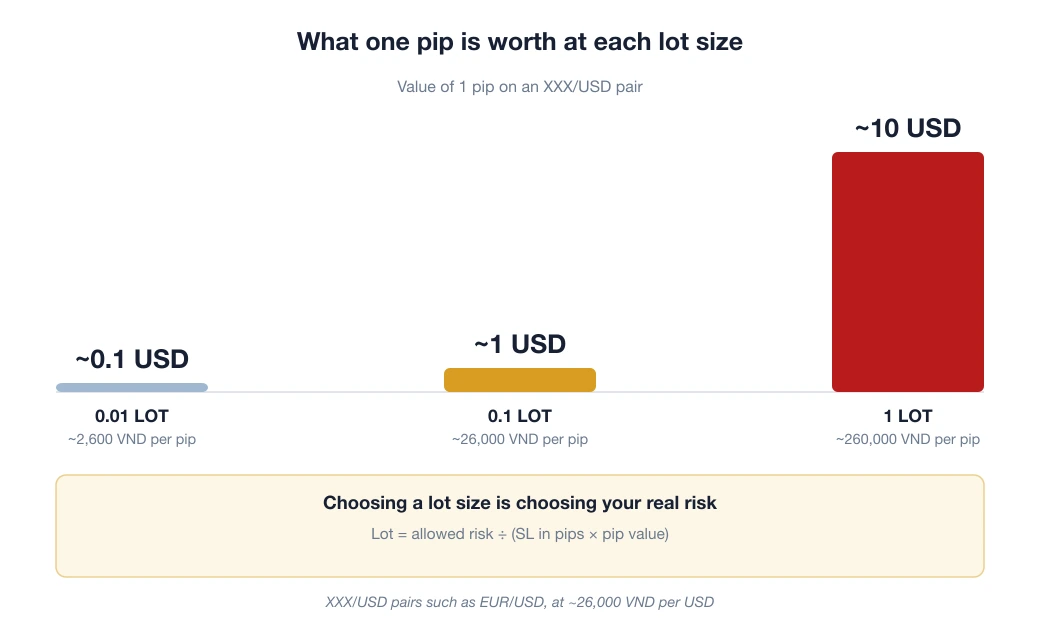
260,000 VND. That is what a trader on 1 lot of EUR/USD makes, or loses, every time the price moves by exactly ONE pip. The lot is the unit of trade volume, and 1 standard lot is 100,000 units. On the same move, someone trading 0.01 lot sees only 2,600 VND change hands.
Same pip, a gap of exactly 100 times, because the trade volume is different. A pip is the smallest price movement, by convention, for a currency pair; the word is short for percentage in point.
Usually the pip is the 4th decimal place (EUR/USD from 1.0850 to 1.0851 = 1 pip); for JPY pairs it is the 2nd (154.20 → 154.21).
That is all the definition says. The question worth your time is a different one: how much is each pip worth in YOUR money, and how do you use it to manage risk?
From pips to money: a one-line formula
Value of 1 pip = trade volume (units) × 0.0001 (or × 0.01 for JPY pairs), in the second currency of the pair. For XXX/USD pairs the result comes out directly in USD:
| Volume | 1 pip on EUR/USD is worth | In VND (~26,000 VND/USD) |
|---|---|---|
| 1 lot (100,000) | ~10 USD | ~260,000 VND |
| 0.1 lot | ~1 USD | ~26,000 VND |
| 0.01 lot | ~0.1 USD | ~2,600 VND |
Read the table once and you see why, on the same 50-pip move, one person loses the price of an iced tea while another loses half the account: the pip only measures distance; the trade volume decides the money.
The two ideas belong together, so read what a lot is for the other half.
Pipette: the confusing 5th digit
Open MT5 and you will see EUR/USD quoted to 5 decimal places (1.08507), not 4. The last digit is the pipette = 1/10 pip, which brokers add so they can quote prices more finely.
A quick way to read it without mistakes: the pip is the 4th digit, the pipette is the extra digit after it. A move from 1.08507 to 1.08557 = 5 pips (not 50).
Beginners easily get this wrong when setting a stop loss: entering “50 points” in MT5 sometimes means 5 pips, depending on whether the broker displays points or pips.
Three places pips show up in a trader’s life, and how to use them properly
- Measuring cost: the spread is counted in pips. A broker quoting a 1.2-pip spread means each 0.1-lot trade costs you ~1.2 USD as an “entry ticket”.
- Measuring risk: a 30-pip stop loss on 0.1 lot = 30 USD at risk. The standard position-size formula runs backwards from here: allowed risk ÷ (SL in pips × pip value) = lot.
- Measuring performance fairly: professional traders say “+180 pips this month” rather than “+500 dollars”, because pips measure pure skill whatever the size of the account. Pick up this habit early: keep your trade journal in pips, and comparing one week with another becomes fair.
JPY pairs and gold: two exceptions to remember
- USD/JPY, EUR/JPY…: the pip is the 2nd decimal place (154.20 → 154.21). The pip value also differs a little from XXX/USD pairs because it converts through the yen. Do not work it out in your head; check the pip value on the broker platform to get it right.
- Gold (XAU/USD): many brokers treat 1 pip as 0.1 USD of the gold price, but the industry has no single standard, so check your broker’s contract specification before you calculate risk. This is one reason people used to EUR/USD “blow up unexpectedly fast” when they first switch to gold: the same lot number, but each price step is worth something quite different.
Quick questions
“How much is 1 pip in Vietnamese dong?”. It depends on volume: 0.01 lot ≈ 2,600 VND/pip; 0.1 lot ≈ 26,000 VND/pip; 1 lot ≈ 260,000 VND/pip (XXX/USD pairs, at ~26,000 VND per USD).
“How many pips does EUR/USD move in a day?”. On average from a few tens to over a hundred pips, depending on the news that day. So a 5–10 pip stop loss on the H4 timeframe is very likely to be taken out by ordinary daily noise; the width of your stop has to match the timeframe.
“How many pips a month do I need to make a profit?”. A better question: is win rate × average winning pips larger than loss rate × average losing pips? 100 pips a month with an average SL of 25 pips is a far more realistic target than the “500 pips a week” promises you see online.
The full pip value formula, for every currency pair
The table above applies to pairs with USD in second place. The general formula to work out any pair yourself:
Pip value = (pip size ÷ current exchange rate) × volume in units
Example: USD/JPY at 154.50, a 0.1-lot trade (10,000 units): (0.01 ÷ 154.50) × 10,000 ≈ 0.65 USD per pip, lower than the ~1 USD of EUR/USD at the same volume. For a cross pair such as EUR/GBP, the result comes out in GBP and is then converted to USD at the GBP/USD rate. Sounds messy?
It is, so do not redo it in your head for every trade: work it out once for each pair you trade and write it down.
Understanding the formula still gives you something no tool can: you know why a USD/JPY trade is “lighter in dollars” than a EUR/USD trade of the same lot size, and the number on screen never catches you off guard.
From pips to percent of your account: 30 pips can be 15% of capital
Beginners count pips; traders who survive count % of the account per pip. Same example: a 200 USD account, a 0.1-lot trade → each pip = 1 USD = 0.5% of the account.
A 30-pip stop loss means staking 15% of the account on ONE trade, a self-destructive level the person placing it does not even notice, because the screen only shows “30 pips”, which sounds very small.
To see that number in money before you enter, multiply the pips by the pip value for the exact pair and size you plan to trade.
This 3-second conversion goes from pips to money, then from money to % of capital.
Pip, point and tick: an easily confused trio
- Pip: the forex convention unit defined above.
- Point (in MT4/MT5): the smallest unit the platform displays = pipette = 1/10 pip at brokers quoting 5 digits. EAs and stop settings in MetaTrader are usually counted in points. That is where SL orders set at “10 points” come from: the trader thought 10 pips, it turned out to be 1 pip, and the stop was hit for no good reason.
- Tick: one CHANGE in price (with no fixed size), a futures market term that sometimes leaks into forex through translated articles.
When you configure any tool, the first question is always: “does this box take pips or points?”. Ten seconds of checking saves you from a stop loss placed at exactly... 1/10 of the distance you intended.
Frequently asked questions
What is the difference between a pip and a point?
A point (pipette) is 1/10 of a pip at brokers that quote 5 digits. MT4/MT5 sometimes shows distances in points, so 50 points = 5 pips. Always check the unit before setting a stop loss.
How much is 1 pip on EUR/USD in USD?
On 1 standard lot: ~10 USD. On 0.1 lot: ~1 USD. On 0.01 lot: ~0.1 USD. Formula: volume in units × 0.0001.
How is a pip on gold (XAU/USD) calculated?
It is not consistent across brokers; many treat 0.1 USD of the gold price as 1 pip. Check the contract specification of the broker you use, or use the DCTopTrade pip calculator, which already handles it.
- Exness, “Forex”, official contract specifications (broker updated 24/07/2026): contract size 100,000 units, pip size 0.0001 to 0.01, minimum volume 0.01 lot. Read on 17/08/2026
- Exness, “About spread” (broker updated 29/07/2026): the spread is the difference between the buy and sell price, with an example of 1.11113 and 1.11125 giving a spread of 1.2 pips
- ESMA (27/03/2018). Why the value of a pip matters so much: the maximum leverage ESMA allows is 30:1 on major currency pairs and 20:1 on gold, so each pip of movement eats into capital many times faster than beginners imagine. ESMA found that 74–89% of retail accounts lose money
Spotted something inaccurate? Tell us and we will check it and publish a correction.