
Is forex profit taxable in Vietnam? The tax office answered
Short answer: the tax authority was asked this exact question, and the answer is that current tax law has NO specific provision.
Not "exempt", and not "you owe 20%". It is no specific provision yet, which is a different state entirely.
From the source, not hearsay. Updated 04/08/2026
On 10 July 2026, the Vietnam Government Portal published the tax authority's reply to this question. Verbatim, in translation:
"Current tax law has no specific provision on taxable income in respect of profit from capital investment on a foreign exchange trading platform of a foreign country."
The reply cites Decree 253/2026/ND-CP (issued 30/06/2026) on income from capital investment, Article 3 of the 2025 Personal Income Tax Law, and Articles 4 and 36 of the 2005 Ordinance on Foreign Exchange (as amended in 2013).
The tax authority said it would report to the Tax Department for guidance, meaning that at the time of the reply there was no definitive conclusion.
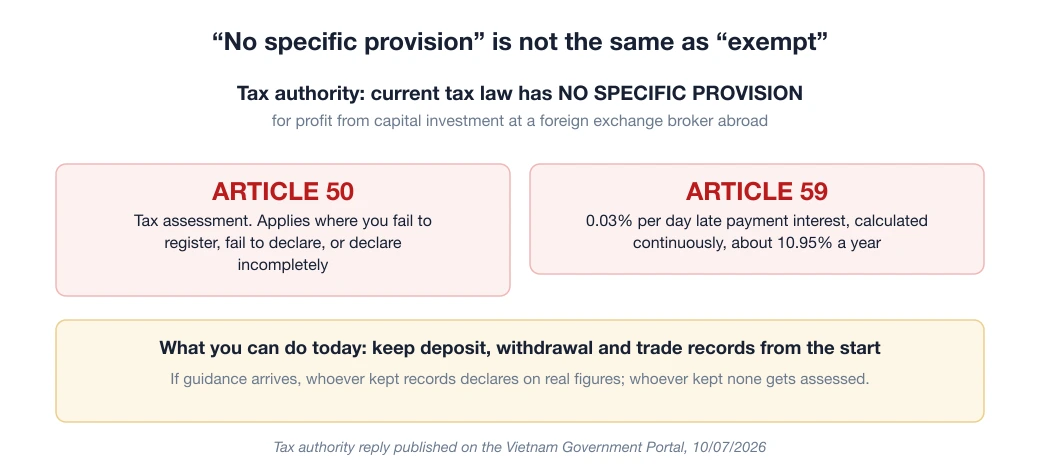
How "no provision yet" differs from "exempt"
This is where a lot of Vietnamese-language writing goes wrong in both directions: some assert "forex profit is tax free", others assert "you must pay 20%". Both claim more certainty than currently exists.
- Exempt means the law mentions that income and permits you not to pay. That is not the case here.
- No specific provision means the income is not clearly identified within the current framework. Guidance may be issued later, and depending on its wording that guidance may cover earlier periods too.
Why there is an argument at all: Article 3 of the Personal Income Tax Law lists income from capital investment as taxable income. The argument that forex profit falls into this category has a basis worth raising.
But "has a basis worth raising" and "has a specific provision to apply" are two different things, and the tax authority itself says the second does not exist yet.
One detail that matters more than the tax question
The reply cites the Ordinance on Foreign Exchange, and not by accident. It points at a layer of problem sitting before the tax question: the State Bank of Vietnam has not licensed any forex broker to operate in Vietnam.
Which means that before discussing "how is this profit taxed", it is worth knowing that trading through a foreign platform currently sits in a zone with no protective legal framework. We analyse that separately in whether forex is legal in Vietnam.
The practical consequence: in a dispute with a broker, there is no Vietnamese compensation scheme or deposit insurance standing behind you. That holds regardless of whether you pay tax.
If there is no provision, is not declaring a problem?
This is the question search data shows readers actually want answered, and it is also the easiest to get wrong.
To be clear: "no specific provision for this income" does not mean "the tax authority has no tools". The 2019 Law on Tax Administration already contains two mechanisms that apply to every kind of income:
- Tax assessment. Article 50. It lists the cases in which a taxpayer has the amount payable assessed for them, the first being "failure to register for tax, failure to declare tax" or declaring incompletely or untruthfully. Assessment means the tax authority determines the amount itself rather than relying on your declaration.
- Late payment interest. Article 59. A rate of 0.03% per day on the amount paid late, running continuously from the day after it arose until the day it is paid into the budget. That works out at roughly 10.95% per year, and it runs for the whole period unpaid; it does not stop because you did not know.
Stated fairly and accurately: those two articles do not speak about forex specifically, they are general provisions. And the tax authority confirms there is no specific provision for this profit, while saying it will report to the Tax Department for guidance.
So there is currently no basis to state firmly how much you must pay. But there is also no basis to say you will certainly never be asked.
This is why keeping records matters more than guessing a rate. If guidance arrives later, whoever kept full deposit and withdrawal statements and trade history can declare on real figures.
Whoever kept nothing lands in exactly the case Article 50 describes, incomplete books and records, and at that point the amount payable is assessed by the tax authority rather than proven by you.
The new tax law effective 01/07/2026 added five asset types, and foreign exchange was not one
This is the detail few people connect, but it explains why the tax authority's answer is in the state it is.
The National Assembly passed Personal Income Tax Law No. 109/2025/QH15 on 10 December 2025, comprising 4 chapters and 29 articles, effective 1 July 2026. It was a major revision, and the legislature widened the list of taxable income to bring in asset types that previously were not taxed.
| Income types ADDED by the 2025 law |
|---|
| Transfer of a national ".vn" domain name |
| Transfer of greenhouse gas emission reduction credits |
| Transfer of gold bullion |
| Transfer of an auctioned vehicle registration plate |
| Transfer of digital assets |
Read that list, then read the question of this article again. The legislature had just reviewed the field and managed to add both digital assets and carbon credits, two things far newer than forex. Retail foreign exchange is not named.
Why that detail matters to you
The law states that a taxpayer is a resident individual with income "specified in Article 3 of this Law arising inside and outside the territory of Vietnam".
That sentence has two halves and both must be read. The second half says income arising abroad is still within scope, so do not assume money at a foreign broker is out of reach.
But the first half narrows it: it must be income specified in Article 3, meaning it must belong to a category named in the list.
Profit from foreign exchange trading at a foreign broker is not named in that list. That is precisely the gap the tax authority described with the phrase "no specific provision", and the reason it could not answer definitively on the spot.
The timeline: passed 10/12/2025, effective 01/07/2026
| Date | Event |
|---|---|
| 10/12/2025 | National Assembly passes PIT Law 109/2025/QH15 |
| 01/07/2026 | The law takes effect |
| 10/07/2026 | Tax authority answers a citizen: no specific provision, will report upward for guidance |
Nine days. The new law had been in force for nine days when a local tax office received this question and still had to refer it upward for guidance.
That says two things. First, the gap is real, not a matter of the respondent lacking information. Second, the tax authority has registered the issue and said it will report back once guidance arrives, so this state can change.
If you are sitting on meaningful profit, the practical response is not to wait. Keep complete statements and trade history, then ask a professional tax adviser about your specific situation. This article reports what the documents say; it cannot replace advice on your own circumstances.
And the question of whether you may hold an account at all
In the same reply, the tax authority states plainly that this is outside its remit and directs the enquirer to the State Bank of Vietnam, since foreign exchange activity is administered by that body under the 2005 Ordinance on Foreign Exchange.
In other words the two questions separate. The tax question and the permitted-or-not question belong to two different authorities, and the second has a much clearer answer: the State Bank has not licensed any retail forex broker in Vietnam.
If you have profit and want to do this properly
We are not a tax authority and this article is not tax advice. Three reasonable steps:
- Keep complete records from the start: deposit and withdrawal statements, trade history, and the legal entity name on the contract. If guidance arrives later, the hardest thing to reconstruct is old data.
- Ask your own administering tax office directly, in writing. A written answer carries more weight than any article online, including this one.
- Do not rely on a blog post to settle a tax obligation. The legal framework is still being completed. Decree 253/2026/ND-CP was only issued on 30/06/2026, so the position can change.
We will update this article when official guidance appears. The update date is shown at the top so you know how current it is.
Frequently asked questions
Is forex profit subject to personal income tax in Vietnam?
On 10 July 2026 the tax authority answered on the Government Portal that "current tax law has no specific provision on taxable income in respect of profit from capital investment on a foreign exchange trading platform of a foreign country", and that it would report to the Tax Department for guidance. So there is no definitive conclusion yet; it is neither "exempt" nor "definitely payable".
Why do some sources say forex profit is taxed at 20%?
Because Article 3 of the Personal Income Tax Law lists income from capital investment as taxable, and the 20% figure is inferred from that. The argument has a basis worth raising, but "has a basis worth raising" differs from "has a specific provision to apply", and the tax authority itself says the second does not exist yet.
What happens if I do not declare?
The 2019 Law on Tax Administration has two general mechanisms applying to all income: Article 50 allows the tax authority to assess the amount payable where a taxpayer fails to register, fails to declare, or declares incompletely; Article 59(2) sets late payment interest at 0.03% per day, running continuously. Neither speaks about forex specifically, but both exist independently of whether dedicated forex guidance has been issued.
If there is no provision, can I simply ignore it?
That reading is not safe. "No specific provision" does not mean "exempt"; guidance may be issued afterwards. The reasonable step is to keep full deposit, withdrawal and trade records from the start, then ask your administering tax office in writing.
Do foreign forex brokers report my income to the Vietnamese tax authority?
This article does not assert that, because we have no official source confirming it. What can be confirmed is that the State Bank of Vietnam has not licensed any forex broker in Vietnam, so these brokers do not operate under domestic supervision.
- Policy Development Portal, Government of Vietnam. Introduction to Personal Income Tax Law No. 109/2025/QH15: passed 10/12/2025, effective 01/07/2026; adds new taxable income types including ".vn" domains, carbon credits, gold bullion, auctioned plates and digital assets. Read 16/08/2026
- National Institute for Finance, Ministry of Finance. Main contents of PIT Law No. 109/2025/QH15: 4 chapters, 29 articles; applies to resident and non-resident individuals, income arising inside and outside Vietnam
- Vietnam Government Portal 10/07/2026. Is income from foreign exchange trading subject to personal income tax? (tax authority reply)
- Law on Tax Administration 2019, Article 50: cases subject to tax assessment (the first being failure to register or declare)
- Law on Tax Administration 2019, Article 59(2): late payment interest of 0.03% per day, calculated continuously
- VnExpress 07/05/2025. State Bank of Vietnam: no forex broker is licensed in Vietnam
Spotted something inaccurate? Tell us and we will check it and publish a correction.