
Exness swap-free account: who it suits and what to check
A swap-free account (also called an Islamic account) is an account that charges no overnight fee when you hold a position into the next day. It was first created for traders who follow Sharia law, which forbids paying or receiving interest.
Today many traders who are not Muslim look at it too, for a very practical reason: holding a position for days without swap eating into the profit. The short answer: swap-free is only worth considering if you hold positions over many nights or need Sharia compliance, and it does not waive the spread or the commission.
What swap is, and why it matters
Each time you hold a position past the daily cut-off (at Exness that is 21:00 GMT+0 in summer and 22:00 GMT+0 in winter, roughly 4 to 5 a.m. Vietnam time), the broker charges an overnight fee (swap). At its core it is the interest-rate difference between the two currencies in the pair you trade.
Swap can be negative (you pay) or positive (you receive), depending on the direction of the trade and the pair. The mechanics are covered in the article on what swap, the overnight fee, is.
For intraday traders (day trading, scalping), swap has almost no effect because the trade closes before the night. For someone holding a trend trade for weeks, though, negative swap adds up and can eat a sizeable share of the profit, and that is exactly when swap-free becomes worth a look.
How Exness swap-free works
Where Exness differs from many brokers: swap-free is usually applied as a status on the trading account, depending on conditions and region, rather than requiring you to declare your religion and wait for approval as some other brokers do.
In practice, many clients get swap-free treatment on the popular instruments.
Three points to get right:
- Not every instrument is swap-free. The major pairs and some metals are usually exempt, while exotic pairs, some CFDs and crypto can still be charged. Always check the contract specifications of your own account before you hold a position for long.
- The conditions can change with your country of residence, your account type and the policy at the time. Do not rely on word of mouth in chat groups; check in your client area.
- No swap ≠ no costs at all. You still pay the spread and commission as normal (see Exness fees and spreads).
The conditions few people read: replacement fees and time limits
At many brokers, a swap-free policy comes with constraints of this kind:
- A limit on the number of free days. Many swap-free programmes waive the fee only for a set number of days. Hold past that point and the broker may start applying a replacement fee (a holding fee or administrative fee), which is economically no different from swap, only named differently.
- This fee is usually charged per lot and per day, and on some instruments it can be higher than normal swap. So for a position held for a very long time, swap-free is not necessarily cheaper.
- Anti-abuse clauses. If the system detects that you are using swap-free to profit from interest-rate differences at scale, the broker has the right to withdraw the swap-free status or charge the fees back. Many brokers have a clause of this kind.
The practical conclusion: do not treat swap-free as “hold a position forever for free”. See it as a tool that helps you neutralise overnight costs over a reasonable time frame, a few days to a few weeks, not a licence to hold positions indefinitely.
Who should actually use swap-free?
| Trading style | Does swap matter? | Use swap-free? |
|---|---|---|
| Scalping (a few minutes) | No, trades close within the day | Not needed |
| Day trading (within the day) | Negligible | Not needed |
| Swing (a few days – a few weeks) | Yes, it adds up visibly | ✔ Worth considering |
| Position (many months) | Very large | Count the replacement fee too |
| For religious reasons (Sharia) | A matter of principle | ✔ Its original purpose |
The table makes it plain: if you are new and trade within the day, swap-free brings you almost no benefit. Do not let it become a reason to pick a broker. It only has real value for people who hold positions for long periods or have a religious requirement.
How much can swap-free save? A worked example
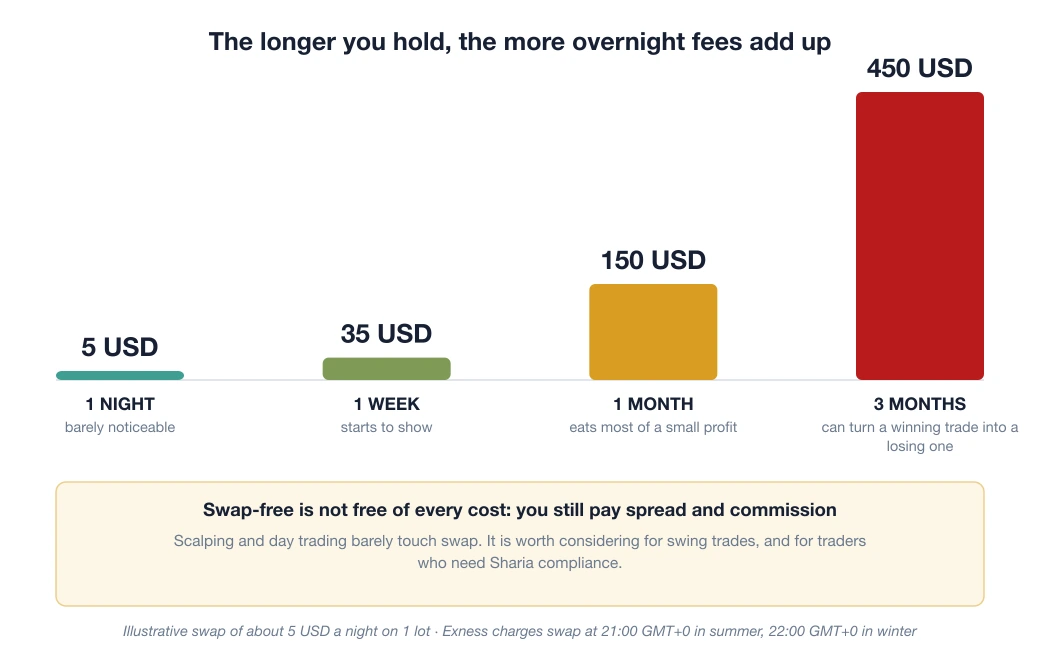
A number shows the problem more clearly than general advice. Say you hold 1 lot of a pair with negative swap of about -5 USD a night (a level you can meet on a pair with an unfavourable interest-rate gap). A lot is a unit of position size; one standard lot is 100,000 units. Swap adds up like this:
| Holding time | Swap paid (regular account) | What it means in practice |
|---|---|---|
| 1 night | ~5 USD | Barely noticeable |
| 1 week | ~35 USD | Starts to show |
| 1 month | ~150 USD | Eats most of a small profit |
| 3 months | ~450 USD | Can turn a winning trade into a losing one |
The swap level is an illustrative assumption to show how it adds up; real swap varies with the pair, the trade direction and interest rates at the time. Many pairs have much smaller swap, even positive swap.
Two conclusions follow: (1) on a trade of a few days, swap-free saves very little, so do not switch brokers just for this feature; (2) on a trade held for months, the number becomes serious.
At that point, though, you have to compare it with the replacement fee covered above, rather than assuming swap-free is free. The most reliable check: open a small position, hold it for a few nights, then go through your trade history yourself and see whether any fee appeared.
How to check whether your account is swap-free
- Log in to the Exness client area (see the login guide if you run into errors).
- Open the trading account details and check the swap status of that account.
- Open the contract specifications and look at the exact instrument you plan to hold for long: swap-free applies per instrument, not to the whole account.
- If it is still unclear, ask support directly and save the answer: the policy can change, and you will want proof to compare against later.
Do not let swap-free lead you astray
In community groups, it is not rare to see people use “swap-free” as a sales pitch to get you to open an account through their link.
Remember the right order: choose a broker whose licence you can verify first (see the broker ranking and the Exness review), and only then look at extras such as swap-free or a rebate.
If a broker will not let you withdraw, a swap waiver is worth nothing, and that principle applies to every pitch. You can check quickly against our warning files when something looks suspicious.
Frequently asked questions
What is an Exness swap-free account?
It is an account that is not charged the overnight fee (swap) when you hold a position into the next day. It was first meant for traders who follow Sharia law; today many traders who hold positions for days also look at it to avoid negative swap adding up.
Is swap-free really completely free?
No. You still pay the spread and commission as normal. On top of that, many swap-free policies only waive the fee for a set number of days; holding longer can trigger a replacement fee (a holding fee) charged per lot and per day.
Who should use an Exness swap-free account?
Mainly people who hold positions for several days to several weeks (swing trading) and people with a religious requirement. If you scalp or trade within the day, swap barely affects you, so swap-free brings no meaningful benefit.
How do I know whether my Exness account is swap-free?
Log in to the client area and check the swap status of the trading account. More importantly, open the contract specifications and look at the exact instrument you plan to hold for long: swap-free applies per instrument, not to the whole account.
Can swap-free status be taken away?
Yes. If the system detects swap-free being abused to profit from interest-rate differences, the broker has the right to withdraw the status or charge the fees back. Many brokers have an anti-abuse clause of this kind.
Spotted something inaccurate? Tell us and we will check it and publish a correction.