
XM bonus: how it works and why withdrawing shrinks it
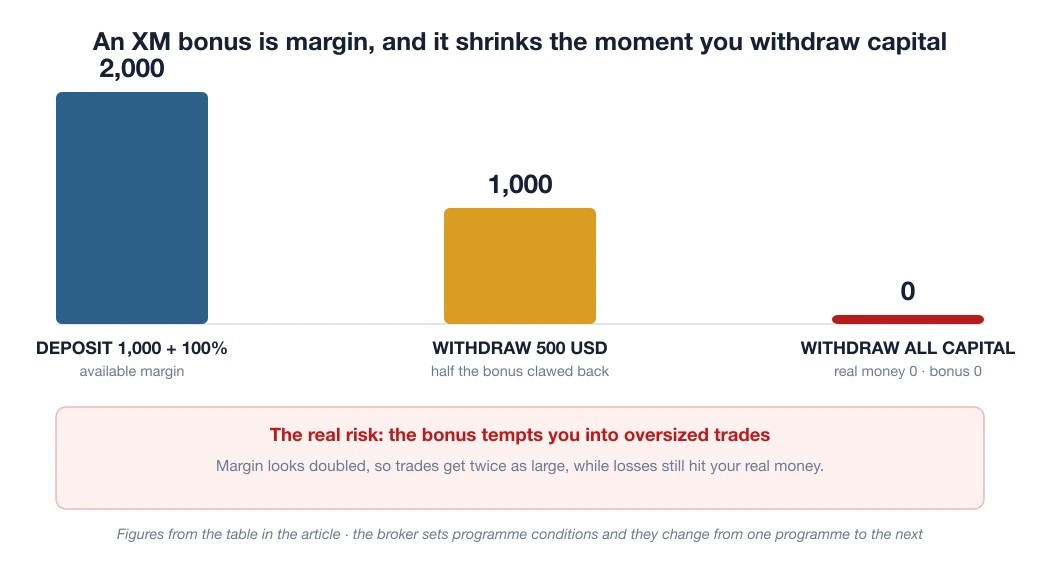
Deposit 1,000 USD and get another 1,000 USD as a bonus. Withdraw 500 USD, and the bonus left over is 500.
That is the mechanism working as published, not a glitch. It only shows itself at the moment you withdraw.
Many people deposit because they see “100% bonus”, and a few weeks later post in a group that “XM took my money”.
The deposit bonus is real, and you can use it as margin. It is just not your cash.
A bonus is margin, not cash
A deposit bonus differs from a rebate and from cashback in where the money comes from; the three mechanisms are set side by side in the article on rebates, cashback and bonuses.
When a broker grants a bonus, it is usually recorded in the account as credit, a kind of loan you can use as margin to open trades, and not money you own and can withdraw.
Margin is the amount locked up to keep an open trade running.
What follows from that:
- You can open bigger trades than your real capital allows, because the credit counts toward your free margin.
- Losses come out of your real money first. This is where many people are disappointed: the bonus lets you take bigger positions, but when you lose, your own money goes first.
- Only the profit generated is money you can withdraw, and it usually comes with a trading volume condition.
Why does withdrawing make the bonus disappear?
This question gets misunderstood a lot. The usual mechanism: the bonus is granted as a percentage of what you deposit. When you withdraw part of your capital, the matching part of the bonus is clawed back, because the basis for granting it is gone.
| Situation | Real money | Bonus (credit) | Available margin |
|---|---|---|---|
| Deposit 1,000 USD, 100% bonus | 1,000 | 1,000 | 2,000 |
| Withdraw 500 USD | 500 | 500 (half clawed back) | 1,000 |
| Withdraw all your capital | 0 | 0 | 0 |
An example of the general mechanism of a credit-type bonus; the rate and the specific conditions change from one programme to the next. Read the terms of the programme you join.
The table makes it plain: nobody is “taking” your money, the bonus simply was never your asset in the first place. But if you did not know this beforehand, the feeling that “my balance suddenly dropped” is easy to read as fraud.
The real risk: a bonus tempts you into oversized trades
This is the actual danger, and it sits in no clause of the terms:
With 1,000 USD of real capital, a disciplined trader sizes each trade at 1–2% risk. But seeing 2,000 USD of available margin, the feeling that “I have more money” leads people to open trades twice as large.
The problem: losses still come out of your 1,000 USD of real money. You end up blowing the account twice as fast as you would without the bonus.
Put another way: a bonus does not raise how much loss you can absorb, it only raises how big a trade you are able to open. That is why we always advise sizing trades on your real money and ignoring the credit; see forex money management.
How does a bonus affect margin level and stop-out?
This is the technical side that decides whether your account lives or dies. Because the credit counts as margin, it pushes your margin level higher than your real position justifies, so you hold on longer before a stop-out, the level at which the broker closes your trades automatically so you do not go further negative.
It sounds good, but look carefully at both sides:
- The upside: if you keep your trade size exactly as it would be without the bonus, the credit acts as a cushion that stops trades being closed early when the market moves against you for a while and then turns back.
- The downside: if you raise your trade size to match the new available margin, that cushion disappears at once, and when you lose, you lose real money faster. Worse: because the stop-out comes later, the loss when it does happen is usually larger.
The practical rule: size trades on your real money and treat the bonus as if it did not exist. Do that and the bonus works purely in your favour. Do not, and it speeds up blowing the account. That is why many people hate bonuses without understanding why.
Four questions to answer before accepting any bonus
- Can this bonus be withdrawn, or is it only usable as margin? Usually the second.
- If I withdraw capital, is the bonus clawed back? Usually yes, in proportion.
- What is the condition for withdrawing profit made with the bonus? It usually requires a set trading volume. Work out whether that figure is realistic for the way you trade.
- Will taking the bonus change how I size trades? If the answer is yes, turn the bonus down. Discipline is worth more than the bonus money.
When does a bonus actually help?
- You keep your trade size the same as without the bonus, so the credit only works as a cushion against stop-out when the market moves against you for a while. This is the right way to use it.
- You have no plan to withdraw capital early, because withdrawing makes the bonus disappear in proportion.
- You have read the conditions carefully and found the volume requirement reasonable, not a figure that pushes you to overtrade to reach it.
If you are a beginner, our plain advice runs the other way: skip bonuses for the first few months. Focus on learning risk management first; adding one more complicated variable before you are steady only muddies things.
Telling a licensed broker’s bonus from a scam platform’s “reward”
The core difference: a licensed broker’s bonus states its conditions clearly, promises no profit, and does not ask you to deposit more before you can withdraw.
A scam platform’s “reward”, by contrast, usually comes with a fixed promised return, forced extra deposits before withdrawal is allowed, or payouts based on recruiting people below you, signs you can check against our warning files and the article on whether a forex bonus is a trap.
At XM, the bonus is a legitimate marketing programme from a licensed broker; see also is XM a scam and the XM account types to pick the right type before you weigh up any offer.
Frequently asked questions
Can an XM bonus be withdrawn as cash?
No. An XM bonus is margin you use to open bigger trades, not cash in your account. When you withdraw money, the matching part of the bonus is deducted. This is a common condition of bonus programmes, not something specific to XM. Only the profit you make yourself can be withdrawn.
Can the XM bonus be withdrawn?
Not directly. The bonus is usually granted as credit, a kind of loan used as margin to open trades, not cash you own. Only profit generated from trading can be withdrawn, and it usually comes with a volume condition.
Why does the XM bonus disappear when I withdraw?
Because the bonus is granted as a percentage of what you deposit. When you withdraw part of your capital, the matching part of the bonus is clawed back because the basis for granting it is gone. This is a term set out in advance, not the broker deducting your money.
Is the XM bonus a trap?
Not if you understand the mechanism. The real risk is psychological: seeing more available margin leads many people to open trades twice as large, while losses still come out of their real money, so the account blows up faster.
Should a beginner take a bonus?
Skip it for the first few months. Focus on learning risk management first; adding one more complicated variable before you are steady only muddies things and easily leads to oversized trades.
How do I tell a licensed broker's bonus from a scam platform's?
A licensed broker's bonus states its conditions clearly, promises no profit and does not ask you to deposit more before you can withdraw. A scam platform's “reward”, by contrast, usually comes with a fixed promised return, forced extra deposits before withdrawal, or payouts based on recruiting people below you.
Spotted something inaccurate? Tell us and we will check it and publish a correction.